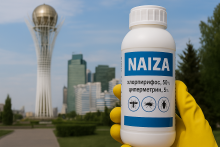
The FBRC editorial team continues its analysis of the chemicals used for disinsection of urban plantings in the regions of Kazakhstan in 2025. This time, the close scrutiny has fallen on the Atyrau Region, where local authorities are carrying out sixfold treatment of green zones using eight different active substances. However, a detailed examination of the provided list of chemicals has revealed discrepancies with official registries and raises questions about the actual composition of the substances used.
OFFICIAL RESPONSE: EIGHT SUBSTANCES WITHOUT SPECIFICS
In response to an official request from our editorial team, the office of the akim of the Atyrau Region provided a treatment schedule and a list of the chemicals used. It reports that six treatments are being carried out from March to July 2025, and the following active substances have been declared for insect control:
- Thiamethoxam, 350 g/l
- Deltamethrin, 10%
- Imidacloprid, 200 g/l
- Diflubenzuron, 240 g/l
- Chlorpyrifos, 500 g/l
- Cypermethrin, 50 g/l
- Pirimiphos-methyl, 500 g/l
- Malathion, 570 g/l
The authorities emphasise that the treatment is carried out according to the methodology recommended by the Kazakh Research Institute for Plant Protection and Quarantine named after Zhasken Zhiembayev, and that biological control methods are not provided for.
THE DEVIL IN THE DETAILS: WHEN THE REGISTRY IS SILENT
Checking the stated concentrations against the Unified Register of Certificates of State Registration of the Eurasian Economic Union (EAEU) reveals an alarming picture. The database lacks chemicals with exact matches to the declared concentrations. One can find products with a similar composition — for instance, ‘Dimilin’ with diflubenzuron, but at 480 g/l rather than 240 g/l, or preparations with chlorpyrifos at 480 g/l instead of the declared 500 g/l.
Even more concerning is the fact of incomplete registry documentation. The records for registered chemicals often lack basic information: hazard class, routes of exposure, ecotoxicity data, level of carcinogenicity. It gives the impression that a chemical's registration in the registry does not guarantee an objective assessment of its safety.
THE HYPOTHESIS OF ‘HOMEMADE COCKTAILS’
Analysis of the situation suggests that the region may not be using ready-made, registered products, but rather mixtures prepared locally from technical-grade active substances. Such a practice, if strict safety protocols are not followed, could create unpredictable risks for public health and the environment.
According to publicly available data, most of the declared substances are classified as hazardous or highly hazardous compounds under certain routes of exposure:
- Deltamethrin and malathion are classified as highly hazardous via inhalation
- Chlorpyrifos consistently demonstrates high toxicity with potential carcinogenic risks
- Imidacloprid and thiamethoxam are extremely toxic to bees
- Pirimiphos-methyl is highly toxic to both bees and fish
ALARMING TREND: FROM PAST TO PRESENT
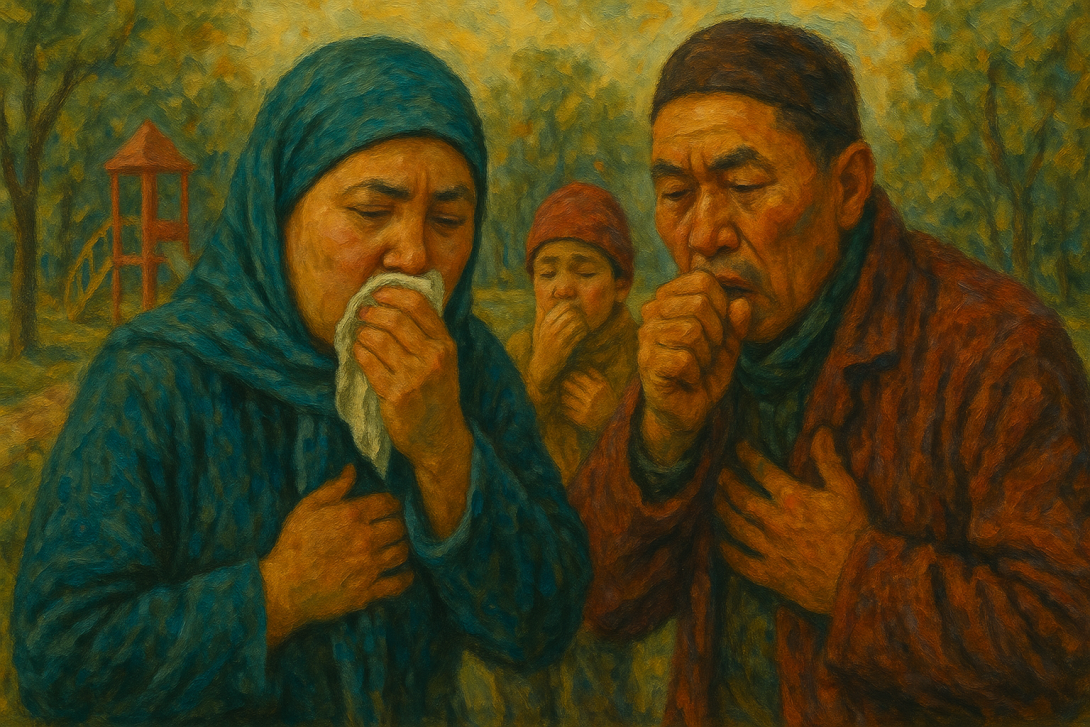
The situation in the Atyrau Region is especially alarming in the context of problems from previous years. In 2024, residents of Atyrau massively complained about unbearable allergies, the symptoms of which — watery eyes, nasal congestion, coughing and respiratory problems — could not be treated with common cold remedies. According to the health department, 2,928 patients were registered on the dispensary list for allergies, of whom 865 were children.
Doctors linked the rise in illness to regional characteristics: a lack of rain, dust storms and periodic releases of hydrogen sulphide. However, it cannot be ruled out that the chemicals used for disinsection — ‘Engeo’, ‘Izumi’, ‘Chlorcyrin’, containing deltamethrin, thiamethoxam, lambda-cyhalothrin and chlorpyrifos — may also have contributed to the worsening situation.
In 2025, health problems among the population persist: residents continue to complain of deteriorating health, coughing, a sore throat and exacerbations of chronic diseases. Official data confirms multiple exceedances of the maximum permissible concentrations of hydrogen sulphide and formaldehyde in the air. Meanwhile, the main reasons cited for the deteriorating environmental situation are industrial emissions, adverse weather conditions and smoke from forest fires. However, the impact of chemical disinsection agents as an additional contributing factor to public health remains underestimated.
LACK OF INFORMATION TRANSPARENCY
Of particular concern is the refusal to involve independent experts in monitoring the preparation of working solutions. The authorities limit themselves to ‘internal regulations’ and the involvement of ‘relevant specialists’, which, in the absence of external oversight, can lead to violations of the technology.
It was planned to inform the public via social networks and the media, but the specific mechanisms for warning about danger and recommendations for protection have not been detailed.
SYSTEMIC PROBLEM OR LOCAL SHORTCOMINGS?
The situation in the Atyrau Region reflects system-wide problems of disinsection in Kazakhstan: the formal nature of chemical registration procedures, a lack of transparent control over the composition of the substances used, and insufficient attention to potential risks to public health.
Earlier, the FBRC editorial team analysed similar problems in the case of the Akmola Region, where it found catastrophic contradictions in official documents: the same chemical was simultaneously assigned to several hazard classes in different registry certificates, and safety standards differed radically between sources. This systemic confusion in documentation leads local officials to sincerely believe in the safety of potentially hazardous substances, relying on contradictory data from official sources.
With correct application and strict adherence to all protocols, even hazardous chemicals can be used with minimal risks. However, under the real-world conditions of municipal services, such standards are difficult to achieve, creating additional threats.
CONCLUSION
The presented analysis is based on a comparison of official documents and open sources. The identified discrepancies in the registries and contradictions in the documentation are documented facts requiring the attention of regulatory bodies. However, as we are regularly reminded, final conclusions about safety should be drawn solely on the basis of official opinions from competent authorities.
Nevertheless, the lack of transparency regarding the composition of the substances used and the contradictions in regulatory documentation create an information vacuum, which does not foster public trust. Until a full system of public oversight over the chemical treatment of urban areas is established, residents of the Atyrau Region should exercise reasonable caution during disinsection work — especially given the experience of previous years and the current complaints of deteriorating health.
The FBRC editorial team will continue to monitor the disinsection situation in the regions of Kazakhstan.