Six months ago, the Ministry of Agriculture (MoA) could not answer the FBRK editorial team's questions about the fate of the 27 broken drones, nor about their flight hours, nor about the operators' qualifications. At that time, more than half of the fleet of agricultural drones, purchased for 368 million tenge, were undergoing warranty repairs in China. In spring 2026, the editorial team sent a follow-up request. This time, the department responded in more detail — and some long-standing gaps have finally been filled.
WHAT HAPPENED
Six months ago, the FBRK editorial team investigated in detail where the 46 agricultural drones purchased by the MoA in 2024 for 368 million tenge had gone. At that time, more than half of the fleet, 27 units, were undergoing warranty repairs with the supplier, data on flight hours were not provided, and the economics of using the equipment raised serious questions.
This year, against the backdrop of a new anti-locust season, our editorial team sent another official request and received a detailed response. 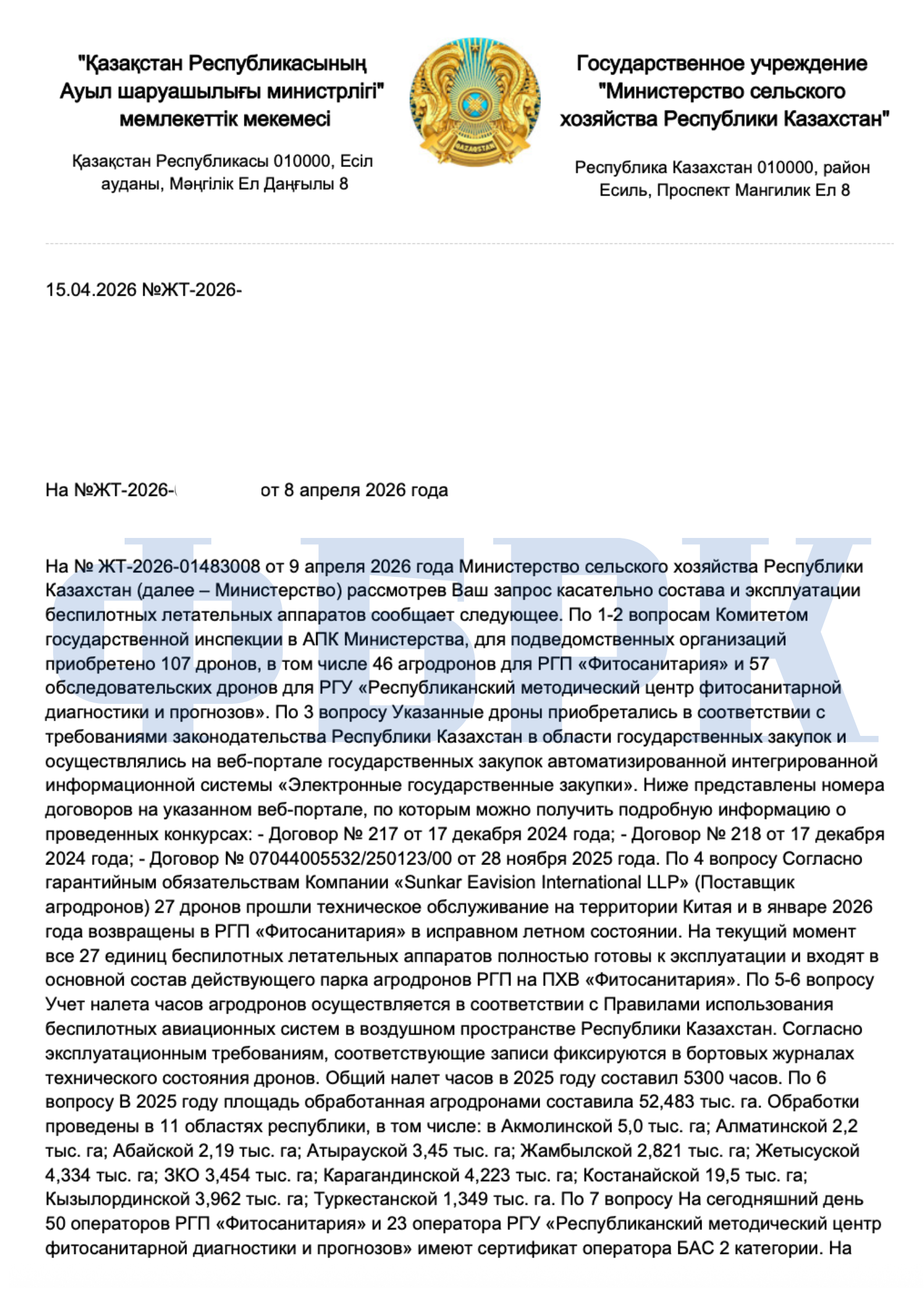
WHAT EXACTLY HAPPENED TO THE 27 DRONES
The main question that had remained unanswered since October 2025 — the fate of the drones being repaired — has finally received official confirmation. According to the MoA, the 27 agricultural drones underwent technical maintenance in China under the warranty obligations of the company 'Sunkar Eavision International LLP', the equipment supplier.
In January 2026, all 27 units were returned to the RSE 'Phytosanitaria' in working condition and were included in the main active fleet.
It is worth noting that in last year's response, the department did not explain either the cause of the breakdowns or the timeline for handing the equipment over to the supplier.
FLIGHT HOURS AND AREAS
Another chronic gap in last year's communication from the ministry was the data on flight hours. At that time, the department simply did not provide them. Now it is known that the total flight time of the agricultural drones in 2025 was 5,300 hours. The area treated was 52,483 thousand hectares across 11 regions of the republic.
The largest coverage was in the Kostanay Region: 19.5 thousand hectares. It was followed by the Zhetysu Region (4,334 thousand hectares), Karaganda Region (4,223 thousand hectares), and the Atyrau Region (3.45 thousand hectares). The least amount was treated in the Turkistan Region — 1,349 thousand hectares.
According to the department, flight hours are recorded in accordance with the Rules for the Use of Unmanned Aircraft Systems in the Airspace of the Republic of Kazakhstan and are recorded in logbooks.
FLEET COMPOSITION AND WHO OPERATES IT
In total, 107 drones have been acquired for the MoA's subordinate organisations: 46 agricultural drones — for the RSE 'Phytosanitaria' (chemical treatment of fields) and 57 survey drones — for the RSE 'Republican Methodological Centre for Phytosanitary Diagnostics and Forecasts' (monitoring).
The fleet of survey drones (57 units) was assembled twice from different suppliers: in January 2024, Ranked Soul LLP supplied 7 units at 1.8 million tenge each (totalling approximately 13 million tenge), and in November 2025, SkyWorker LLP supplied 50 units at 2.8 million tenge each (139 million tenge). In total, the fleet of 57 drones cost the budget approximately 152 million tenge.
Thus, the total expenditure for the entire fleet of 107 unmanned aerial vehicles (UAVs) — 46 agricultural drones and 57 survey drones — amounted to approximately 520 million tenge, excluding maintenance and operating costs.
Currently, 50 operators from the RSE 'Phytosanitaria' and 23 operators from the Methodological Centre hold a Category 2 Unmanned Aircraft Systems (UAS) operator certificate. This directly answers the question about pilot qualifications, which six months ago remained without a concrete answer.
Recall that in October last year, Sunkar Eavision International LLP filed a statement with the police regarding the dissemination of false information following the FBRK publication on the drone purchase.
The article used information from official documents published on the public procurement portal, which, however, did not deter the company.
Later, an administrative case was initiated against the founder of FBRK, Kirill Pavlov, under Part 4 of Article 456-2 of the Administrative Code of the Republic of Kazakhstan. On 19 December, the Specialised Inter-District Administrative Court of Astana dismissed the case due to the expiry of the statute of limitations.