(24 February 2026 | Source: Zakon.kz, LSM.kz)
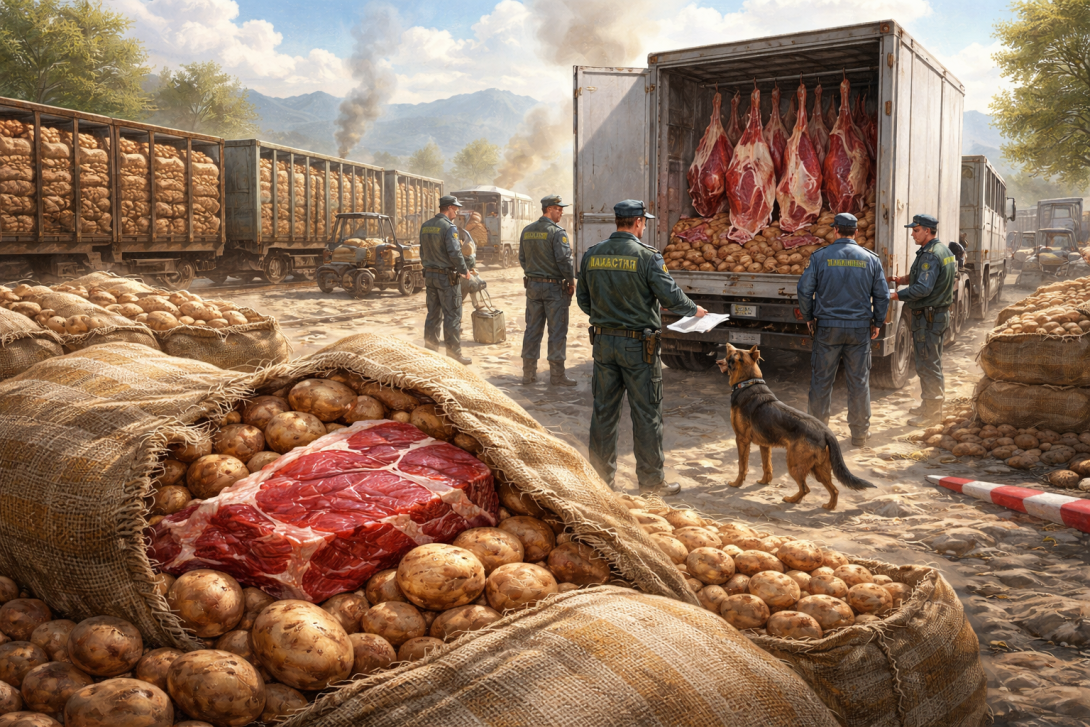
The Ministry of Agriculture (MoA) has publicly responded to the sensational claim about beef being exported from the country under the guise of potatoes. The head of the department, Aidarbek Saparov, called the information a fake, citing technical arguments: meat requires refrigerated transport, meaning it is physically impossible to hide it in ordinary potato wagons.
WHAT THE MINISTER SAID
Aidarbek Saparov assured that the Veterinary Inspection Committee of the MoA has the situation under control. As an example, he cited a case that was stopped: an empty truck without documents was detained at the border — the cargo was seized, reports were filed, and a fine was issued.
“There has been no such case where meat was exported in wagons instead of potatoes — even if by wagon, a refrigerator is required. We have this under control,” the minister stated.
HOW IT ALL BEGAN
The reason for the department's reaction was an interview published on 19 February. The head of the Union of Livestock Breeders, Dauren Salykov, suggested in conversation with journalists that Kazakh beef was being smuggled out, including under the guise of potatoes, due to price differences with neighbouring countries.
According to him, in the markets of, for example, Uzbekistan, beef reaches $10 per kg, whereas in Kazakhstan the price is artificially controlled.
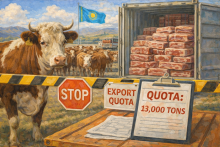
Salykov advocated for open exports and free pricing, warning that if the state continues to protect the urban consumer at the expense of the farmer, the industry will begin to shrink, and shortages will be followed by imports and even higher prices.
Kazakhstan produces 440 thousand tonnes of beef per year — with a surplus of about 6% above domestic demand.
IT'S NOT ABOUT THE POTATOES
Saparov's technical argument is not without logic. It is indeed difficult to hide meat in an open wagon full of potatoes. Furthermore, beef requires a refrigerator and a veterinary certificate — a document that cannot be confused with the phytosanitary one that accompanies potatoes. These are two different control systems, and swapping one for another at the border is an entirely different level of complexity.
But grey exports are far from a single scenario that can simply be refuted and the matter closed. And it is one thing when beef is exported under the guise of lamb: both products go through similar documents, and if one wishes, this can be overlooked.
It is quite another if meat has ever actually been exported under the guise of potatoes: this is not negligence, it is a fundamentally different level of document falsification. And if such a practice occurred, a denial in the press is certainly not the right tool to deal with it.
Let us recall that the editorial board of FBRK has repeatedly received signals that beef is being sent abroad under the guise of lamb.
Particular attention should be paid to cases involving refrigerated trucks where, according to waybills, only half the load was listed. What was in the other half remains a matter of speculation.
The grey export of meat is an issue that has been raised not for the first time and not by a single source. And while the department is busy with denials on social media, another question would seem far more productive: why do market participants consider smuggling more profitable than legal export, and what should be done about it?