
Following the FBRK article about the internal memos of Yeris Nuraliyev, who warned the leadership of the Committee for Veterinary Control and Supervision (CVCS) of the Ministry of Agriculture (MoA) about the threat of the spread of infections as early as the beginning of 2026, the editorial office received an official response from the department's press service. The Committee insists that there is no causal link between the official's appeals and subsequent events. We decided to compare the department's version with Nuraliyev's words and establish which parts are confirmed and which remain a question of interpretation.
WHAT HAPPENED
Previously, FBRK reported that the head of the border and transport veterinary control department, Yeris Nuraliyev, sent internal memos in January and April 2026 to CVCS Chairman Kazbek Tashimov about the risks of the spread of dangerous infections linked to the epizootic situation among neighbouring countries and the mass die-off of saiga antelope.
According to Nuraliyev, there was no response, after which he filed complaints with the Agency for Civil Service Affairs of the Republic of Kazakhstan. Soon afterwards, a reorganisation began in the Committee, which affected his position, and then a disciplinary investigation was launched against Nuraliyev himself.
WHAT THE COMMITTEE SAYS
The CVCS press secretary told the editorial office that the arguments put forward by Nuraliyev bear no causal link to the circumstances described and do not correspond to the factual data. According to the department's version, Nuraliyev appealed more than 10 times to higher authorities and the Agency for Civil Service Affairs with complaints about the CVCS chairman, but following their review, most of the arguments, with the exception of the first appeal, were found to be unsubstantiated.
FBRK sent an official request to the MoA, where we were told that the Committee had issued an instruction to conduct an analysis of the epizootic situation, the validity of the proposed measures and their funding sources, and, crucially, this work was to be carried out by Nuraliyev himself. The response explicitly states that "the aforementioned measures were not fully implemented by Nuraliyev Ye.R." In other words, the Committee does not acknowledge that his complaints went unanswered.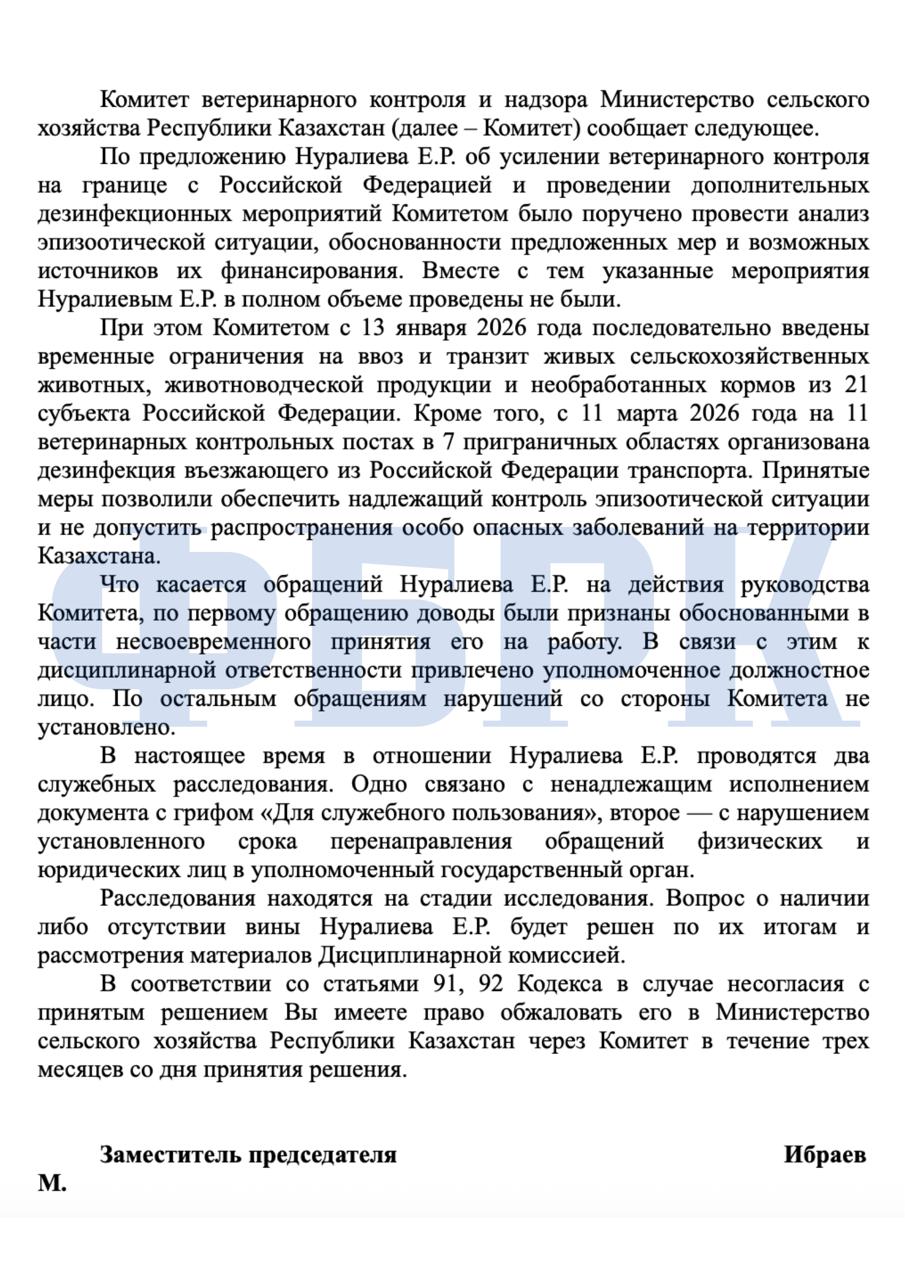
This detail forces a different perspective on the chronology of events. Restrictions on the import and transit of live agricultural animals, livestock products and untreated feed from 21 constituent entities of Russia were introduced by the Committee sequentially from 13 January 2026 — that is, ten days before Nuraliyev sent his internal memo on 23 January in execution of the instruction from the meeting of 12 January.
It turns out that part of the border restrictions came into effect before his memo, rather than in response to an ignored warning. However, the specific measure Nuraliyev requested — organised disinfection of incoming vehicles — was launched with a much more noticeable delay: only on 11 March 2026, at 11 veterinary control posts across 7 border regions, almost two months after his appeal.
In other words, the version of complete inaction on the part of the department is not confirmed, but neither is the version of flawless responsiveness: the general restrictions were introduced in parallel and independently, while Nuraliyev's actual proposal was implemented with a delay, the reasons for which are not clarified in the document.
HOW THE COMPLAINTS WERE HANDLED
Equally intriguing is how the Committee describes the fate of Nuraliyev's appeals concerning the actions of the leadership.
In relation to his first complaint, the arguments were indeed recognised as valid, but only in the narrow part concerning the untimely hiring of him, for which a separate official was subjected to disciplinary action. In relation to all other appeals, which apparently concerned the substantive conflict with Chairman Kazbek Tashimov, no violations on the part of the Committee were found.
In other words, the system once acknowledged the complainant's correctness on a procedural matter — and, according to the department's version, his substantive grievances were thereby exhausted.
At the same time, the pendulum has swung in the opposite direction as well. There are currently two disciplinary investigations underway against Nuraliyev himself. One is linked to the improper handling of a document marked "For official use". The second concerns the violation of the established deadline for forwarding appeals from individuals and legal entities to the authorised state body — that is, concerning the quality of his own work as head of the department.
The Committee emphasises that both investigations are at the review stage, and the question of whether guilt exists will be decided upon their completion by the Disciplinary Commission.
WHAT THIS MEANS
Putting it all together, the story becomes a dispute over the distribution of responsibility within the system. The Committee insists that it delegated the substantiation of the initiative to the initiator himself and did not receive it in full, and that border measures were introduced irrespective of this conflict; Nuraliyev, meanwhile, insists that his warnings were only heeded once the matter had left the department. Both versions are probably partly true simultaneously — the general restrictions did indeed proceed under their own momentum, while the specific disinfection proposal was implemented with a delay. However, the very fact that the position targeted by the reorganisation was that of an employee who, shortly afterwards, began filing numerous complaints against the leadership, and who then became the subject of a disciplinary investigation, leaves room for questions.
FBRK will continue to monitor developments.