Ministry of Water Resources and Irrigation responded to a repeated request from the FBRK editorial team regarding the Tasqyn and Talsim-NG digital systems. The department notes that the Talsim-NG system is undergoing its first 'combat' season across eight of the country's river basins. An independent assessment of its effectiveness has not been carried out and, it is reported, will only be possible after the flood period ends.
WHAT HAPPENED
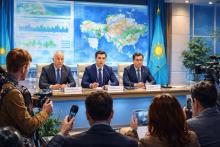
On 10 April 2026, at a press conference of the Central Communications Service (SCC), the moderator dismissed an FBRK question about the effectiveness of Tasqyn and Talsim-NG as "not relevant to the topic", even though the event was dedicated to the culture of water conservation. Following this, the press service of the Ministry of Water Resources and Irrigation sent a brief written response, stating that the results would be summarised after the flood season.
But the systems were commissioned in February 2025, yet no measurable statistics on their accuracy have been published. It is for this reason that the FBRK editorial team sent a repeated request — this time directly to the ministry. 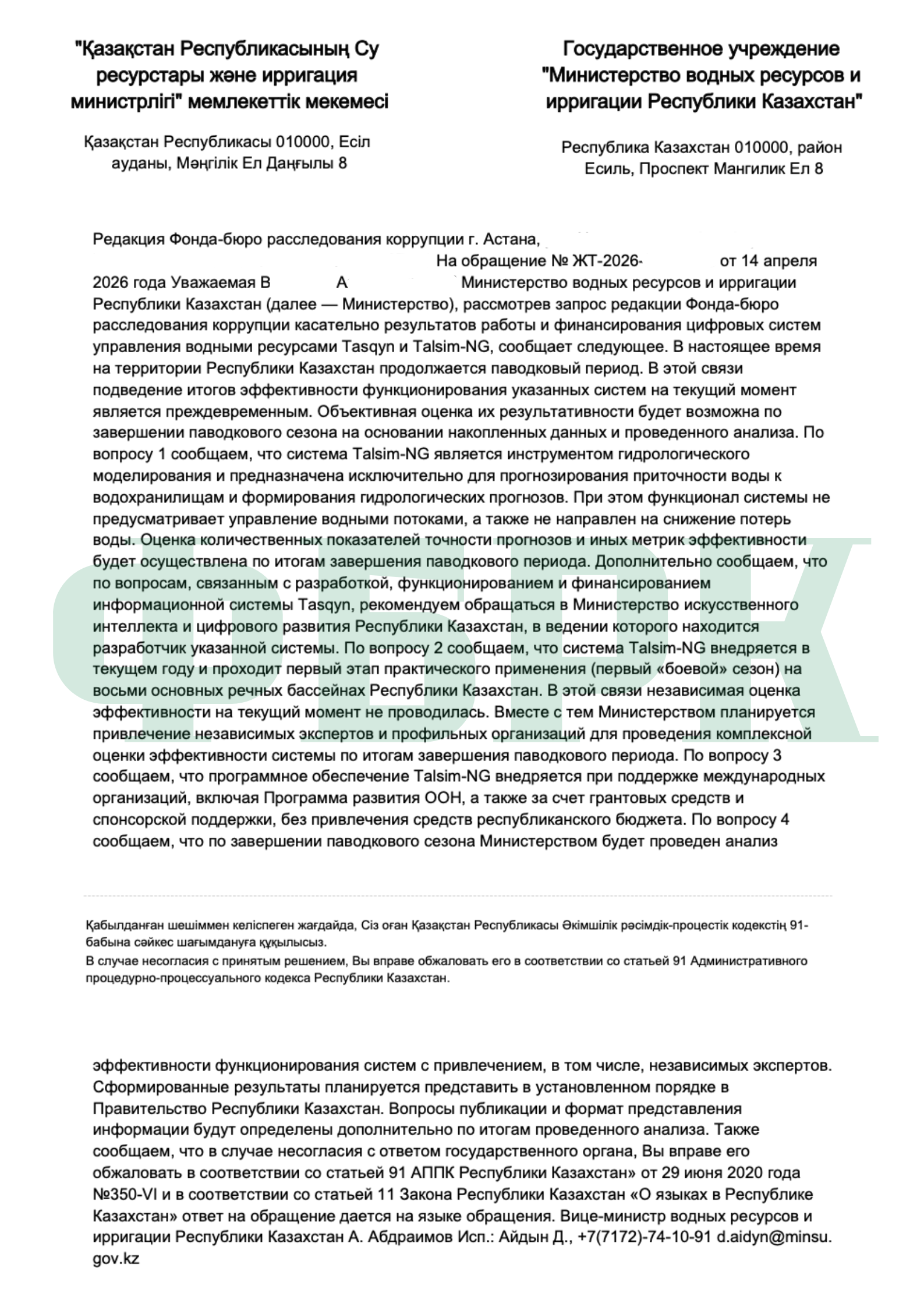
WHAT TALSIM-NG CAN DO — AND WHAT IT CANNOT
For the first time, the department has clearly delineated the functionality of the systems. As noted in the response, Talsim-NG is exclusively a tool for hydrological modelling: it forecasts the inflow of water into reservoirs. The system is not designed to manage water flows, nor is it tasked with reducing water losses.
And here it is important to clarify. Reducing water loss is indeed not part of Talsim-NG's functionality; however, the question of the overall effectiveness of both systems is directly linked to the issue of water accounting. Without accurate accounting — how much water enters, how much is lost, how much is used — it is impossible to either rationally allocate the resource or conserve it.
This is precisely why the quality of Talsim-NG's forecasts is fundamental: a poor forecast leads to incorrect distribution, and incorrect distribution leads to losses.
The Ministry of Water Resources promises to conduct an assessment of the forecasts' accuracy following the 2026 flood season — the system's first 'combat' season across eight of the country's river basins.
WHO PAYS FOR AND WHO IS RESPONSIBLE FOR TASQYN
On the question of funding for the Tasqyn system, the Ministry of Water Resources redirected our editorial team to the Ministry of Artificial Intelligence and Digital Development of the Republic of Kazakhstan. Although we already know that the system's developer is JSC "NC "Qazaqstan Gharysh Sapary", which fully financed the creation of Tasqyn.
At the same time, the "company's own funds" are the funds of a structure that is entirely owned by the state. And here another question seems inevitable: at what point did taxpayers' money come to be considered corporate, 'own' funds — and why should this exempt one from public accountability?
Talsim-NG, for its part, is being implemented without funds from the republican budget — with the support of the United Nations Development Programme (UNDP), through grants and sponsorship aid.
WHAT WILL HAPPEN AFTER THE FLOODS
The Ministry of Water Resources stated that after the season ends, it intends to carry out an effectiveness analysis of both systems with the involvement of independent experts. The results are planned to be submitted to the Government of the Republic of Kazakhstan. The format of publication for this data and the timeline have not been specified.
Nevertheless, the essence remains the same: accurate water accounting is the foundation of any policy for its conservation. It is precisely for this purpose that digital systems like Talsim-NG and Tasqyn are being developed. But as long as their actual accuracy remains outside the public domain, it is impossible to assess whether this policy is working in practice.