The flood forecasting system in Kazakhstan has been accepted into industrial operation, but, judging by the official response from the relevant department, no one has actually assessed how accurately it predicts the floods themselves. The Ministry of Artificial Intelligence and Digital Development responded to an official request from FBK about the acceptance criteria for the information system "Flood Forecasting and Modelling Tasqyn," and this response raises a far more serious question than a formal bureaucratic procedure: what did the state-accepted system actually represent - a forecasting tool, or an expensive way to automatically plug numbers into ready-made formulas?
FACTUAL BASIS
From the ministry's response, it follows that the acceptance of Tasqyn into industrial operation was formalised by an act dated 6 February 2025, approved by the chairman of the board of JSC "NC "Kazakhstan Gharysh Sapary" (KGS) Kairzhan Kozhayev based on a decision by the acceptance committee, which included representatives of the JSC itself, the Aerospace Committee, and the Information Security Committee.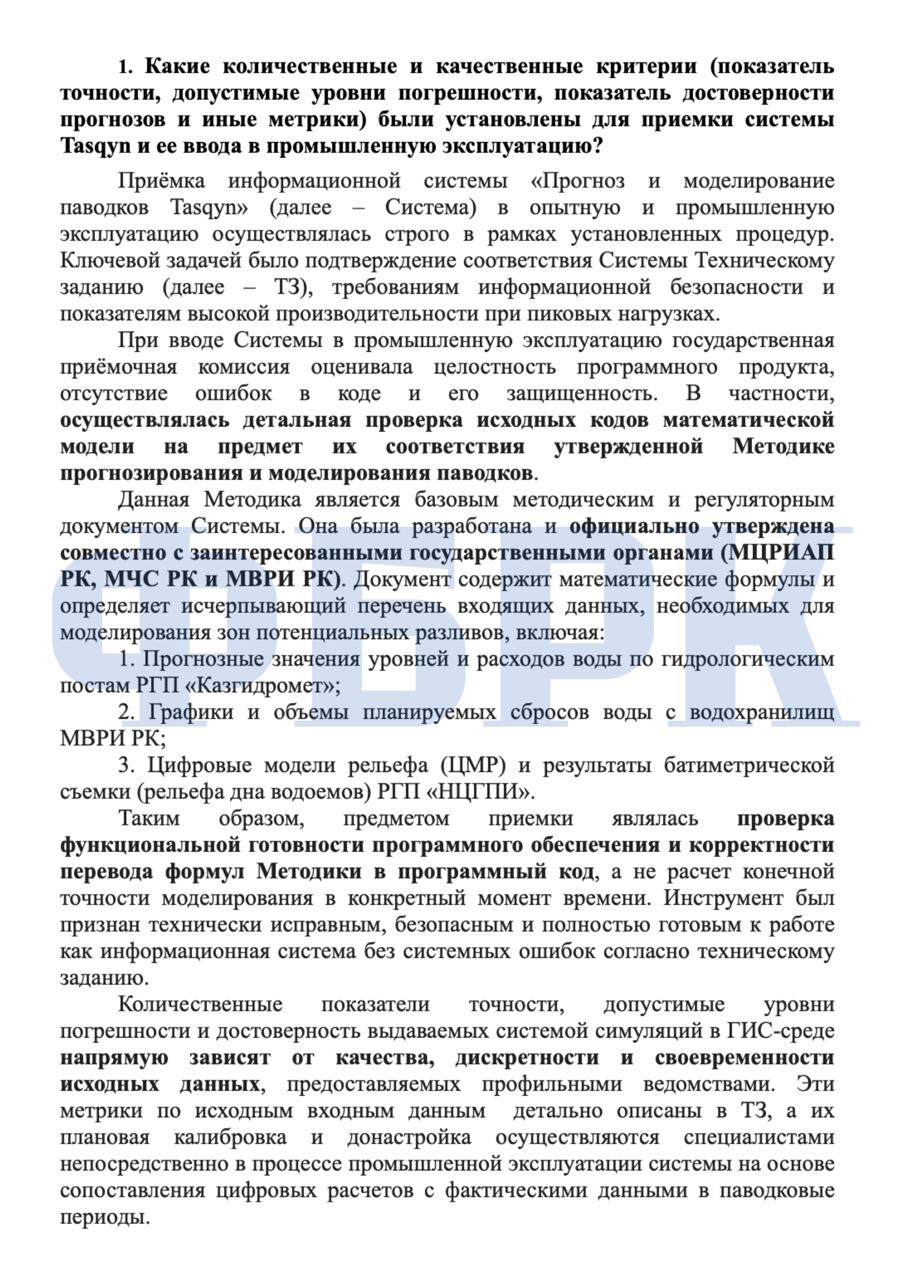
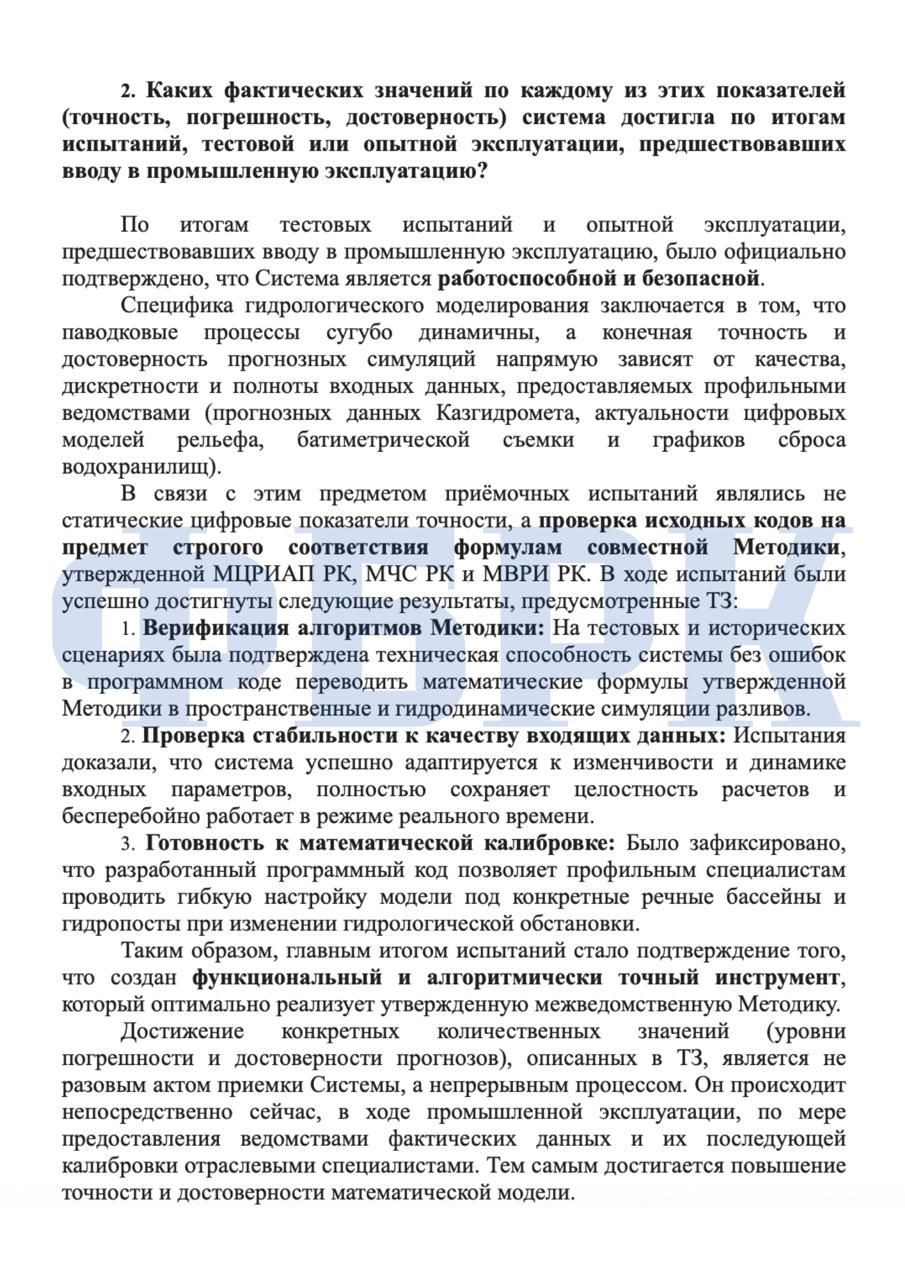
At the same time, as the ministry directly states, the subject of acceptance was not forecast accuracy, but rather the "functional readiness of the software and the correctness of translating the formulas of the Methodology into program code." What was checked was the absence of errors in the source code, the security of the system, and its compliance with the Methodology for forecasting and modelling floods - a document developed and approved jointly by the Ministry of Digital Development, Innovation and Aerospace Industry (MDDIAI), now the Ministry of Artificial Intelligence and Digital Development, the Ministry of Emergency Situations (MES), and the Ministry of Water Resources and Irrigation (MWRI).
To the FBK's direct question about the actual values of accuracy, error margin, and forecast reliability achieved as a result of testing, the response contains no specific figures at all. According to the ministry, the assessment of the accuracy of hydrological forecasts for 2025 and 2026 is not carried out by it at all, but by the RSE "Kazhydromet".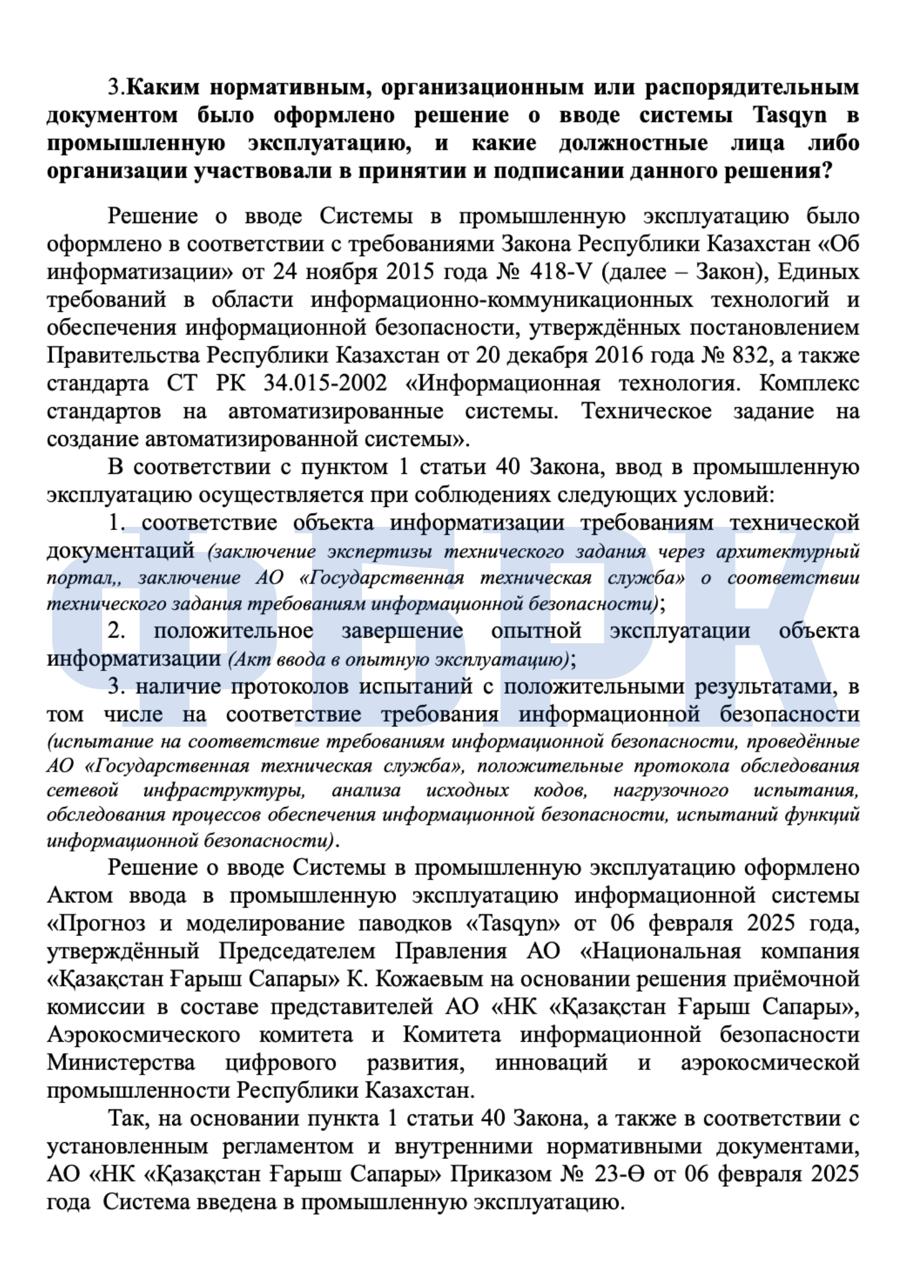
CONTEXT
It is worth noting that this is far from the first time the FBK has sought a clear answer from the state regarding Tasqyn. As early as 10 April 2026, the editorial team raised the issue at an SCC briefing on water conservation, but the moderator dismissed the question as not relevant to the agenda, and a written response was limited to a description of the system's functionality without a single figure on accuracy.
On 24 June, at a briefing on the digitalisation of the water sector, FBK founder Kirill Pavlov reminded that in 2025, Tasqyn classified 182 settlements as high-risk zones, whereas water actually arrived in only 16 of them, and only 14 were recorded in the system itself. The journalist also pointed out errors in forecasting water levels of up to four metres.
Vice-Minister of Water Resources and Irrigation Aslan Abdraimov acknowledged certain deviations in the assessment of water volumes, but did not answer the question about Tasqyn's acceptance parameters, referring the journalist to the Ministry of Artificial Intelligence and Digital Development.
WHAT THIS MEANS
The ministry's response constructs a logical chain that, upon closer inspection, appears to be a closed loop. But let's try to figure it out nonetheless.
The state commission checked whether the program code correctly reproduces the formulas of the already existing and previously approved Methodology; if the data is entered correctly and the map is rendered without failures, the task is considered complete. However, the actual accuracy of the result - that is, the answer to the question of where the flood will actually occur and whether people can be warned in advance - is placed outside the scope of the acceptance process and delegated to the realm of "continuous calibration", which occurs during industrial operation. In other words, the formulas and methodologies existed before Tasqyn - essentially, the platform was expected not just to automate a paper-based calculation, but to deliver a qualitatively new result: fewer errors and more time for reaction. But, judging by the ministry's response, it is precisely this criterion that was not subject to verification.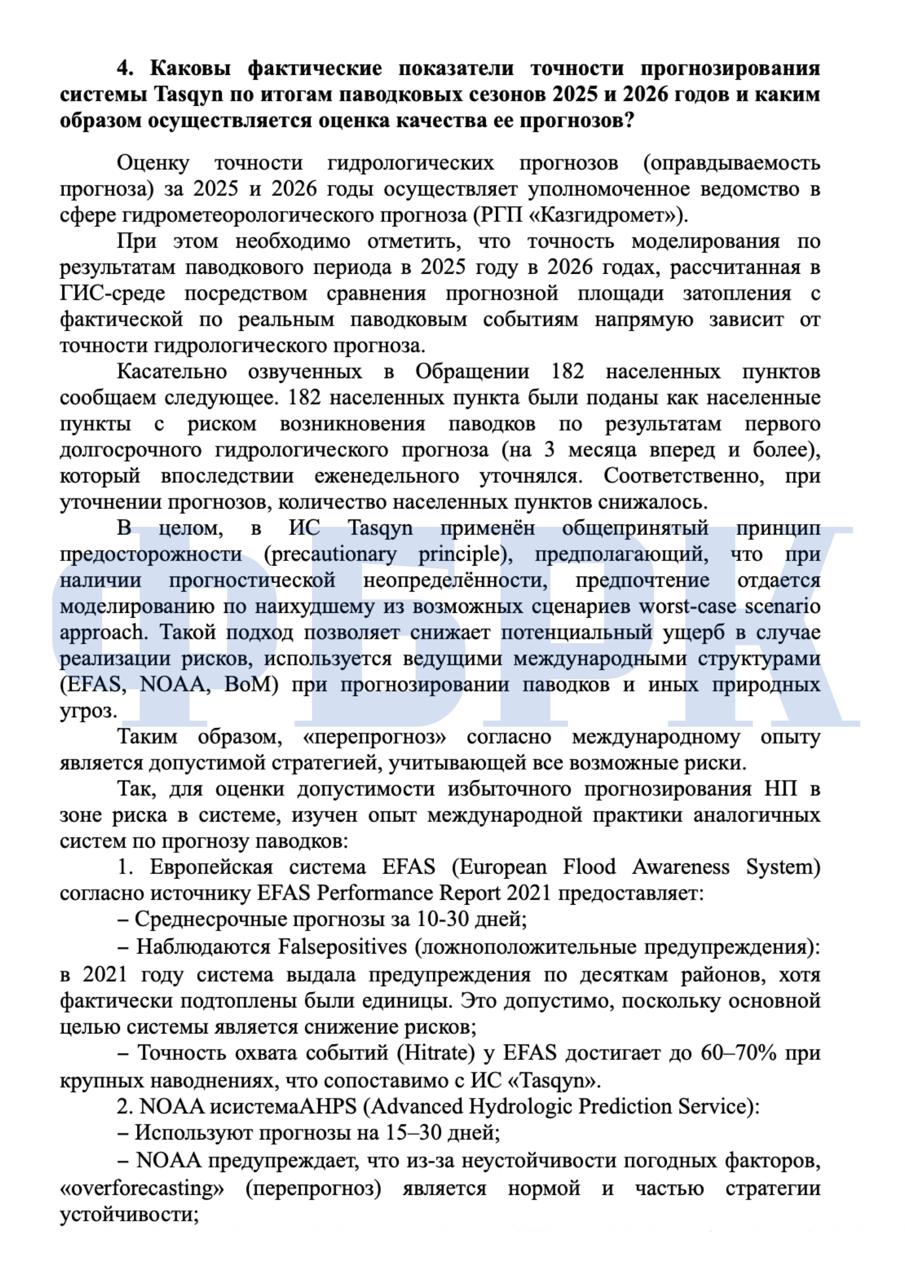
It is telling how the department explains the discrepancy between the 182 declared and 16 actually flooded locations. According to them, this is a consequence of the "precautionary principle" and worst-case scenario modelling - an approach used by the European Flood Awareness System (EFAS), the American National Oceanic and Atmospheric Administration (NOAA), and the Australian Bureau of Meteorology: better to warn about 100 cases and be wrong in 70 than to miss 5 real ones. The logic itself is not objectionable; excessive warning is indeed international practice. But it explains why false alarms are acceptable, not how accurate the actual forecast is — and the question was precisely about the latter. Moreover, the ministry acknowledges that part of the reduction in the number of affected locations was ensured not by Tasqyn's calculations, but by preventive measures taken by the Ministry of Emergency Situations and local executive bodies - work that was physically impossible to incorporate into the digital terrain model, as it was carried out in parallel with the modelling. Part of the effect attributed to the system was, in fact, achieved by earthworks.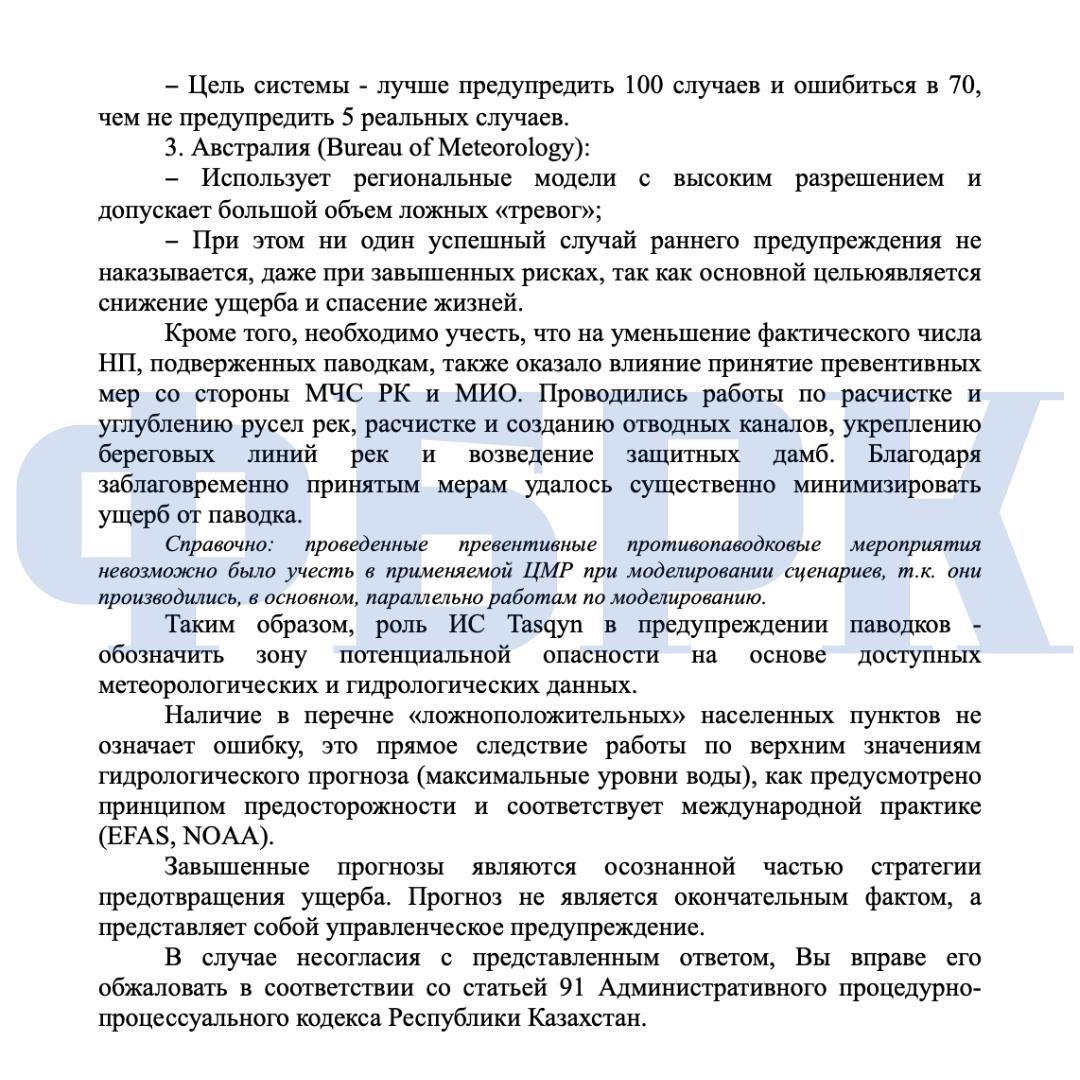
If the only confirmed result of two years of operation is that the approved methodology is now considered automated, then for the state, the risk is paying for infrastructure whose effectiveness on the key parameter (forecast accuracy) has formally not been measured and not published. For residents of settlements that annually appear on risk lists, the risk is a gradual loss of trust in warnings, if the gap between declared and actual flood zones does not receive a public explanation with specific figures. So, what exactly was created with public funds?