While the Ministry of Agriculture (MoA) continues to insist that the epizootic situation in the country remains favourable, it has emerged that as early as the beginning of 2026, warnings about serious risks were sounding within the ministry itself. The FBRK has obtained internal documents indicating that the head of the border and transport veterinary control department, Yeris Nuraliyev, had informed the chairman of the veterinary control and supervision committee, Kazbek Tashimov, in advance about the threat of the spread of dangerous infections. However, his signals, it seems, went unheeded. Now Nuraliyev claims that after his submissions, he himself came under pressure from the head of the committee.
HOW THE EPIZOOTIC SITUATION LOOKS TODAY
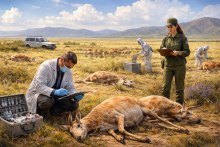
According to data from the chairman of the public association "Veterinary Doctors of West Kazakhstan Region", Professor Gaisa Absatirov, the current situation with the mass die-off of saiga antelope has led to a noticeable decline in their population.
According to forecasts, taking into account the 2026 offspring, the number should have exceeded 4 million, but this did not happen – and, in the expert's opinion, the reason lies not only in competition for pastures, but also in the high population density, which increases the risk of epizootics and the transmission of diseases between saigas, livestock and even humans.
Among the potential infections, he cites pasteurellosis, clostridiosis, peste des petits ruminants, listeriosis, anthrax, and among parasitic diseases – tick-borne diseases, echinococcosis and coenurosis, singling out as the most dangerous transboundary viral disease – foot-and-mouth disease. As a historical analogy, Absatirov cites the epizootic of 1957–1958, when around 45,000 adult saigas and two-thirds of newborns died, and the disease spread over vast distances, introducing foot-and-mouth disease into herds of livestock in previously unaffected regions. He also outlines the routes of virus transmission – via milk, saliva, nasal discharge, through feed, bedding, transport, and through the air over distances of up to 60 km.
Separately, the expert disputes the MoA's version, according to which the saigas were diagnosed with pasteurellosis, rather than foot-and-mouth disease. Absatirov maintains that the widespread carriage of pasteurella among wild and farm animals makes pasteurellosis an opportunistic infection whose symptoms (oedematous, thoracic and septicaemic forms) do not include lesions of the oral and nasal mucosa, salivation, lameness or lesions in the interdigital cleft area. Meanwhile, available photo and video material from the field records precisely these signs – salivation, ulcers and erosions in the oral cavity, lameness, and hoof lesions – with diseased saigas in close contact with livestock.
Ultimately, as Absatirov writes, a population "self-regulation" effect has occurred: in addition to diseases, mass tick infestations and increased abortion rates among saigas have been recorded, and the offspring rate has fallen to 17% instead of the usual 40–50%. He stresses that infections among saigas and livestock have not gone away and may continue for as long as the epizootic chain remains intact.
WHAT IS HAPPENING WITHIN THE MINISTRY ITSELF
And while the expert community raises the alarm, and the Minister of Agriculture, Aidarbek Saparov, waves off any signs of particularly dangerous animal diseases, the situation within the ministry itself is no less worrying.
The FBRK editorial board has obtained internal memos from January and April 2026. On 23 January, at the height of discussions about outbreaks in Russia, the head of the border and transport veterinary control department of the MoA's Veterinary Control and Supervision Committee (VCSC), Yeris Nuraliyev, sent a memo to the committee chairman, Kazbek Tashimov, in fulfilment of an instruction given at the VCSC staff meeting on 12 January 2026 regarding disinfection of potentially incoming livestock.
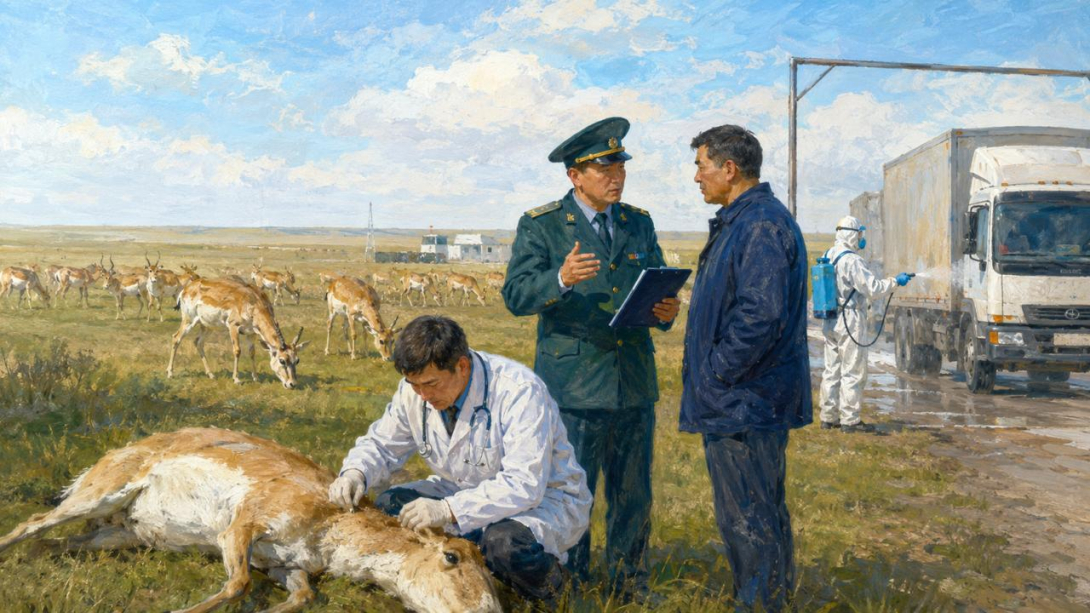
In it, he pointed to the unstable epizootic situation in neighbouring states and proposed organising disinfection of incoming vehicles at border crossing points. According to him, the disinfection work at the "Kazygurt" post proved to be disorganised and showed low effectiveness, and he therefore proposed transferring this function to a competitive environment (individual entrepreneurs or limited liability partnerships), or to district veterinary stations on a fee-paying basis. In support, he cited the experience of Russia and Kyrgyzstan, where disinfection of incoming vehicles is mandatory, and the experience of Uzbekistan, where every vehicle undergoes a paid high-pressure wash.
A separate memo concerned precisely the saigas and was also addressed to Tashimov. In it, Nuraliyev described the migration routes of the Volga-Ural population, which winters in the Kurmangazy district of Atyrau region and in Astrakhan region (temporary restrictions were introduced there on 13 January 2026) and in Saratov region (restrictions from 24 February 2026), noting that migration routes know no borders. He pointed out that multiple cases of saiga diseases were being recorded in the country (mange, ixodid tick infestations, coenurosis, abortions), confirmed by video and photo materials, and that carcasses of dead animals were not being collected or disposed of, remaining as reservoirs of pathogens.
Nuraliyev directly proposed developing, together with the scientific community, a set of measures ranging from dust baths with feed-grade sulphur and hexachlorane dusts against mange and ticks along migration routes, to baits with antiparasitic drugs against coenurosis and water baths with copper sulphate against manisiiosis, calling them economically justified. Separately, he warned that without the joint development of vaccines for wild fauna, inaction could lead to an "ecological catastrophe with unpredictable consequences".
However, according to Nuraliyev, his proposals for strengthening control were not heard.
After his official initiatives went unanswered, relations with the committee's leadership, he says, developed into a protracted conflict. Seeking a response, he began to contact the Agency for Civil Service Affairs and other state bodies, claiming violations of his rights as a civil servant.
It was these appeals, Nuraliyev claims, that became the subject of a conversation with the committee chairman, Kazbek Tashimov, on 20 July. The committee head allegedly tried to pressure him into resigning voluntarily, expressing displeasure that the internal conflict had spilled beyond the ministry. Soon after, a reorganisation of the committee began, as part of which Nuraliyev's own position was made redundant.
At present, an internal investigation is being conducted into Yeris Nuraliyev, the emergence of which he links to Tashimov's actions, viewing it as part of the process of removing him from his post.
WHAT THIS MEANS
Of course, the coincidence of these events does not in itself prove a causal link between Nuraliyev's memos, his appeals to state bodies, and the subsequent redundancy of his position.
But something else here is interesting.
If one of the veterinary service's senior officials really did warn about the risks of dangerous infections spreading several months before the issue became a matter of public debate, why were his signals ignored? After all, if these warnings were indeed disregarded, then the MoA's problem lies not only in its unwillingness to admit mistakes, but also in its inability to listen to its own specialists before the situation spirals out of control.