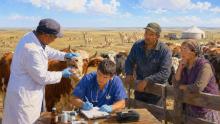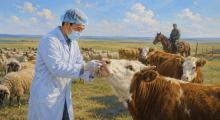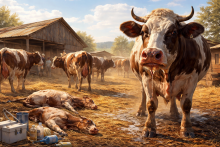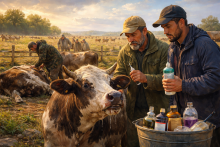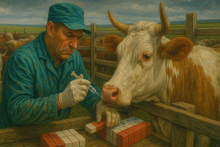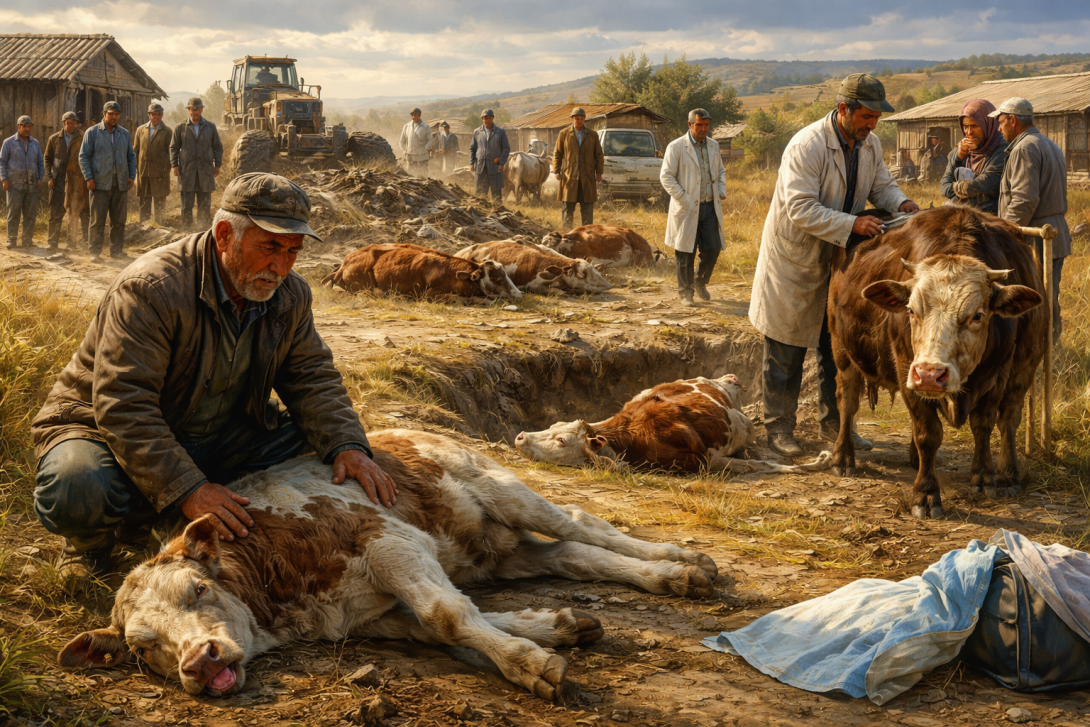
While the relevant departments report on their foot-and-mouth disease-free status, farmers in the West Kazakhstan Region (WKR) are burying calves and counting their losses. Livestock are falling ill, veterinarians are breaking diagnostic rules, and scientific projects to combat diseases are stuck in the expert review queue for months. The system designed to protect livestock farming is clearly operating with a significant delay.
WHAT FARMERS ARE SAYING
Photo and video evidence of how the disease is spreading through villages continues to be received by the FBRK anonymous bot. The published materials can be found on our YouTube channel, "Fund-Bureau of Corruption Investigation".
The picture described by farmers differs somewhat from the official explanations, which has long ceased to be surprising. Some livestock breeders doubt that the non-foot-and-mouth disease (according to authorities, there is no foot-and-mouth disease in the country) came exclusively from saiga antelope. According to them, the disease appeared even where saigas have never lived, including near the village of Taipak. Others point to the possible introduction from the Russian side via shared pastures.
How people are actually treating the animals also deserves special attention: rinsing the mouth cavity with salt water or potassium permanganate, administering antibiotics according to regimens circulated in general chat groups. Based on the appeals, farmers are practically seeing no veterinary control.
COMPENSATION - ONLY IF YOU MANAGED TO DRAW UP A REPORT
Farms in the Bokeyorda, Zhanakala, Kaztalovka and Zhanibek districts of the WKR have already suffered losses due to livestock disease. One of the victims, a resident of the Bokeyorda district, Azilkhan Biarystanov, lost 20 calves and one cow.
According to him, the carcasses were simply thrown into the livestock burial pit because the veterinarians initially did not warn about the need to draw up reports beforehand. Without these reports, obtaining compensation under the "Aul Amanaty" programme could be extremely difficult.
The Deputy Head of the WKR Agriculture Department, Rustem Zulkashev, explained that a certificate from a veterinary specialist confirming the livestock loss is required for loan restructuring. The Deputy Akim of the WKR, Kaliyar Aytmukhambetov, confirmed that reports have not been drawn up for all dead animals and stated that instructions have been given to complete them.
BRUCELLOSIS: RULES EXIST, COMPLIANCE DOES NOT
Parallel to the non-foot-and-mouth disease, the situation with brucellosis is worsening in the region.
The Chairman of the Public Association "Veterinary Doctors of the WKR", Professor Gaisa Absatirov, notes that veterinary specialists do not adhere to the deadlines for taking blood from animals. Blood for diagnostics from brood stock should be taken from the 14th to the 21st day after calving, but in practice this rule is ignored. This creates conflicts between farmers and veterinarians, and the diagnostic results become unreliable.
According to Absatirov, there is effectively no strategy to combat brucellosis in Kazakhstan: current rules, based on the recommendations of the World Organisation for Animal Health (WOAH), have yielded no results for decades.
Scientists from the West Kazakhstan Innovation and Technology University submitted an application for a scientific project on brucellosis back in November 2025, but the results of the expert review are still pending. A similar application submitted via the WKR akimat also remains unanswered.
It should be noted that, according to official reports from the Ministry of Agriculture (MoA), no cases of foot-and-mouth disease have been recorded in either saiga antelope or domestic livestock.
Who to believe - the official summaries or the videos from village chats - is for everyone to decide for themselves. But the experience with regulating saiga numbers, the chronic shortage of local veterinary specialists, and the scientific applications gathering dust for months without expert review already speak volumes about how prepared the relevant departments are for such crises.
However, very recently the Government of the Republic of Kazakhstan approved the Comprehensive Veterinary Development Plan for 2026–2030, meaning there is hope that a solution to the accumulated problems is not far off. Do we believe it?