The FBRK editorial team continues to analyse which preparations are used for the disinsection of urban plantings in the regions of Kazakhstan in 2025.
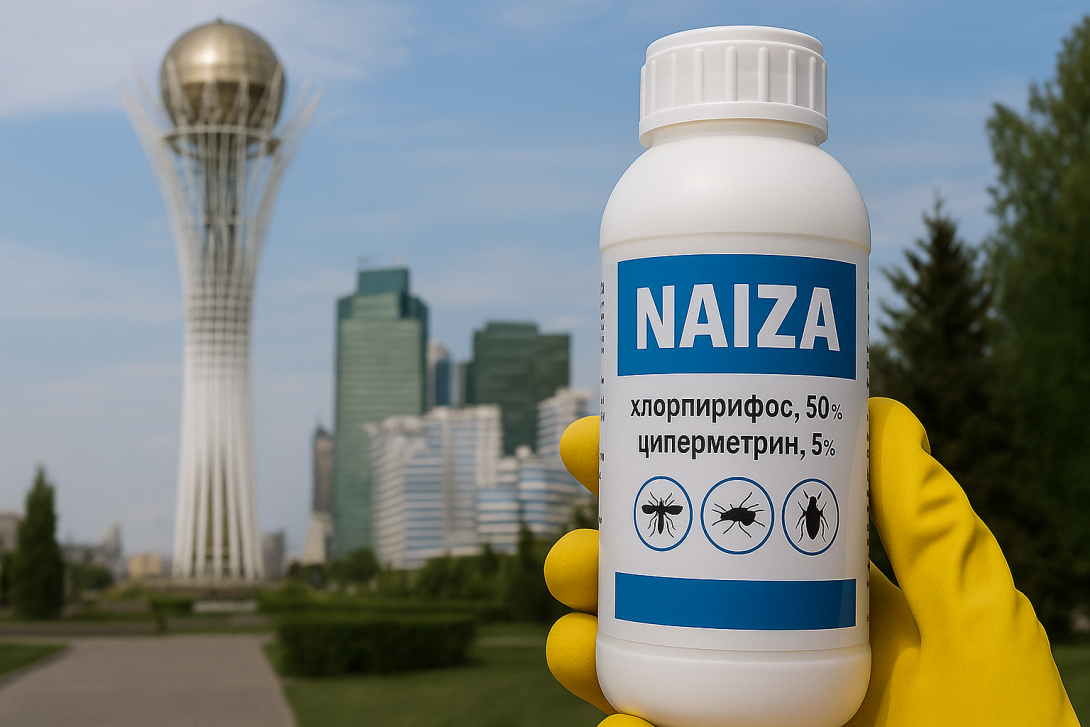
In Astana, the authorities are demonstrating an opaque approach: information about the composition of the preparation used, 'Naiza', is completely absent from open sources, and its actual composition — chlorpyrifos and cypermethrin — only became known after FBRK's request to the akimat.
For the third consecutive year, the FBRK editorial team is analysing which preparations are used to treat green spaces in various regions of Kazakhstan. Our investigation reveals systemic problems: local authorities continue to use potentially controversial chemical substances, whilst often providing contradictory information about the characteristics of the products used, or even concealing their composition entirely.
EVOLUTION OF APPROACHES: WHAT HAS CHANGED IN THREE YEARS
The FBRK analysis shows gradual changes in the capital's approach to disinsection in recent years. In 2023, the arsenal was significantly larger and included both safe biological preparations 'Ekstrasol' and 'Izabion', as well as chemical insecticides 'Enzhio' and 'Aktara' with the active ingredients thiamethoxam and lambda-cyhalothrin. Additionally, 'Ultragran' and 'Malathion' were used.
In 2024, the list was reduced to two main preparations: the safe biological 'Baktitsid' for water bodies and 'Ultragran' for open areas. The latter contained chlorpyrifos and cypermethrin — the same substances used in 2025. It is possible that the authorities have started providing less detailed information about the full range of products used, or that a genuine streamlining of the disinsection arsenal has taken place.
THE 2025 SITUATION: OPAQUE 'NAIZA' AND THE PROVEN 'BAKTITSID'
According to the response from the Department of Environmental Protection and Nature Management of Astana, two preparations are used for disinsection in 2025: the proven 'Baktitsid' and 'Naiza' with its unclear composition.
'Baktitsid' is a biological preparation based on Bacillus thuringiensis bacteria, which naturally target mosquito larvae and other insects, whilst being harmless to humans, warm-blooded animals, and beneficial insects. The preparation is used for treating water bodies and marshy areas.
Information opacity surrounding the preparation 'Naiza' is of particular concern. There is no information whatsoever about this product in open sources. The official response from the department merely states that it is an 'insectoacaricidal agent' at a dosage of 0.275 l per hectare, but the active ingredients are not specified.
The composition of the preparation was only determined after additional requests from FBRK to the akimat and the receipt of relevant certification documents. The question arises: why do the authorities not initially disclose full information about the substances being sprayed in the city's residential areas?
Analysis of the certificate of conformity shows that the product is manufactured by the Chinese company Jiangsu Fengshan Group Co., Ltd. According to the state registration certificate, the preparation contains 5% cypermethrin and 50% chlorpyrifos, as well as an aromatic solvent and polyethylene glycol ether.
SCALE OF APPLICATION: HALF-YEARLY TREATMENTS ACROSS THE ENTIRE CITY
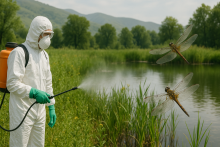
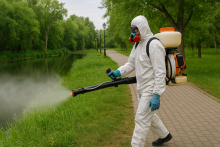
According to the capital's akimat, disinsection work in Astana is carried out in six rounds from April to October, with each round lasting 20 days per month. As of June 2025, the city has already commenced the third treatment round. To date, the treatment of small and large water bodies has been completed, and approximately 300 water bodies and marshy areas have been additionally identified and treated.
Work is carried out in two shifts during the night-time from 9:00 PM to 4:00 AM. Professional disinfection workers who have undergone special training and safety briefings are involved in the disinsection.
The scale of application causes particular concern: for six months of the year, residents of the capital are regularly confronted with the results of using substances banned in developed countries.
THE PROBLEM OF CHOICE: USING A PRODUCT WITHOUT PUBLIC INFORMATION
The composition of the 'Naiza' preparation includes active ingredients that have already been used in the capital in previous years as part of other products. Both components are well-studied and pose serious risks to public health, especially for children. However, the problem lies not only in the substances themselves, but also in the fact that the authorities chose a product about which information is inaccessible to citizens.
Chlorpyrifos is an organophosphate insecticide classified as hazard class II, which has a negative effect on the nervous system. International studies link it to an increased likelihood of children being born with autism spectrum disorders. In 2021, the USA managed to ban the use of chlorpyrifos precisely because of its link to neurological damage in children. In European Union countries, chlorpyrifos is also a banned substance.
Cypermethrin belongs to the synthetic pyrethroid group and, if safety precautions are not followed, can cause neurological symptoms, allergic reactions, and poses a particular danger to aquatic organisms. Research shows that pyrethroids negatively affect the development of the nervous system in children and are linked to behavioural problems and attention disorders.
POTENTIAL RISKS IF SAFETY MEASURES ARE BREACHED
The use of these substances in urban environments requires strict adherence to safety precautions. If safety recommendations are not followed or concentrations are exceeded, risks to the population may arise. Children playing on recently treated lawns and playgrounds, through skin contact with residues of the preparations, could be exposed to the active substances. Families with pets also need to exercise caution when walking in parks and squares during the treatment period. Pregnant women particularly need to observe safety precautions in treated areas.
Cypermethrin can persist in the environment for up to several weeks, necessitating prolonged adherence to safety precautions after treatment. In this regard, the general advice from the authorities to 'close windows' may prove insufficient for complete protection against exposure to environmentally persistent substances, especially if application technology is violated.
We have previously reported that cypermethrin is used in children's health camps in Kostanay Region, where it may pose health risks to children on holiday.
REQUIREMENTS FOR BUSINESSES: COERCION TO PARTICIPATE IN CONTROVERSIAL ACTIVITIES
According to media reports citing the akimat, management companies, housing cooperatives (KSC), condominium associations (OSI), as well as educational, healthcare, cultural, sports, construction facilities, markets, and shopping centres, must join the efforts by improving and draining basement premises and carrying out their disinsection treatment.
Small and medium-sized businesses, including supermarkets, shops, restaurants, and other premises located on the ground and first floors of apartment buildings, are obliged to enter into contracts with organisations providing disinsection services and to ensure the relevant work is carried out on their premises.
In effect, the authorities are forcing businesses to participate in activities using potentially controversial substances, whilst not providing full information about the risks.
BREACH OF TRANSPARENCY PRINCIPLES: AUTHORITIES REJECT PUBLIC OVERSIGHT
The authorities' stance on public oversight is particularly concerning. When asked about the possibility of involving independent experts or public representatives to monitor compliance with preparation concentration standards, the department responded with a categorical refusal.
The department justifies this by stating 'monitoring compliance with concentration standards is a professional activity' and is carried out by a scientific group of associate professors and candidates of science. This position contradicts the principles of openness and transparency in public administration, especially in matters concerning public health.
The combination of an opaque choice of preparations and a refusal of independent oversight raises serious questions about the authorities' approach.
SIMULATION OF INFORMATION: PROMISES WITHOUT GUARANTEES
The department claims to constantly inform residents via the media, official websites, and WhatsApp chats; however, the real effectiveness of this information is doubtful. In practice, most Astana residents find out about the disinsection after the fact, or remain entirely unaware.
Citizens are advised to limit visits to treated areas and close windows during treatment. However, the complete lack of information about the composition of the products used in open sources makes it impossible for citizens to take informed precautions. The advice 'close windows during treatment' seems clearly insufficient when dealing with preparations that are highly persistent in the environment.
REGIONAL PICTURE: KAZAKHSTAN CONTINUES TO USE BANNED SUBSTANCES
Astana is not alone in using combined disinsection methods, but the choice of specific substances raises questions. We have previously reported that in Aktobe, they use imidacloprid — a systemic insecticide from the neonicotinoid group, banned in European Union countries.
In the Almaty Region, a mixed approach is also used: alongside biological preparations, the chemical agents 'Diuron' and 'Tsipetrin' are used. However, there is a fundamental difference: 'Diuron' belongs to hazard class IV (low-hazard substances), which is radically different from the situation in Astana, where chlorpyrifos of hazard class II is used.
This shows that the choice of less hazardous alternatives is possible even when using chemical methods, but the capital's authorities choose more toxic substances instead.
CONCLUSION
Astana is demonstrating systemic problems in its approach to urban disinsection. The combination of an opaque choice of preparations, a refusal of public oversight, and the continued use of substances banned in developed countries raises serious questions about the authorities' priorities.
The existence of the biological 'Baktitsid' proves that safe alternatives are possible, but the authorities prefer less transparent solutions. International experience shows that effective insect control does not require substances banned in the civilised world.
The health of the capital's residents should not be sacrificed for convenience and cost savings. Every day's delay in transitioning to safe methods poses an additional risk to all Astana residents.
The FBRK editorial team will continue to monitor the situation and analyse the practices of other regions of Kazakhstan.
To be continued...