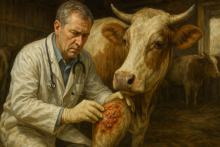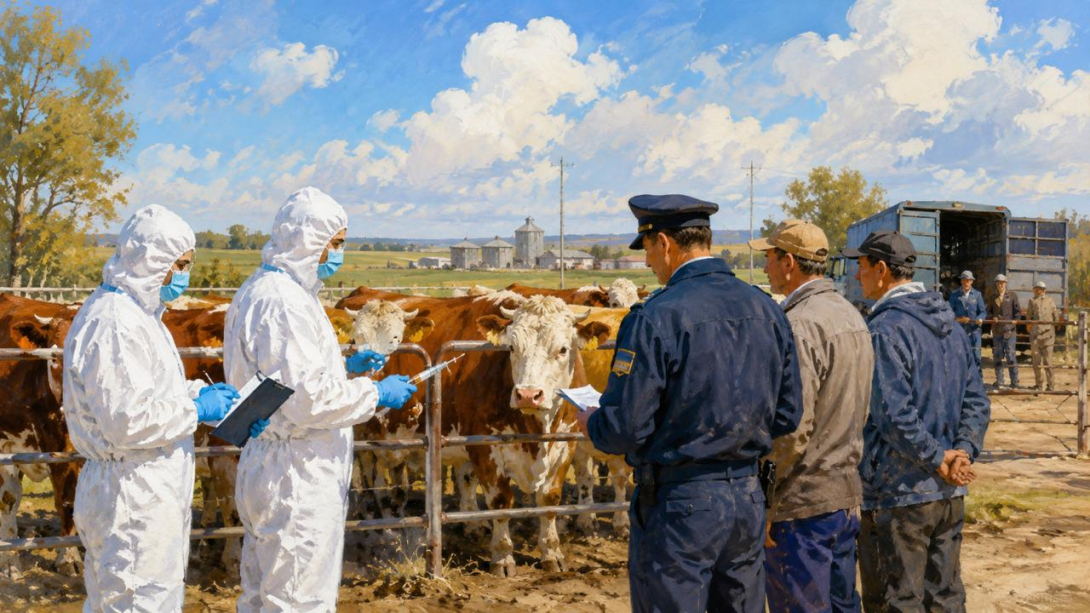
In the villages of Kazambasy and Oktyabrskoye in the Auliekol district of the Kostanay region, restrictions have been introduced due to brucellosis in livestock. However, the official version has once again diverged from the opinions of independent experts. Doctor of Veterinary Sciences Gaisa Absatirov believes that behind the diagnosis of "brucellosis," the authorities may be hiding a far more dangerous disease - foot-and-mouth disease.
WHAT THE INSPECTION REVEALED
As reported by Kazinform, according to the regional veterinary department, in the village of Kazambasy, 323 heads of cattle were examined using the PCR method (a molecular diagnostic method that detects the genetic material of the disease-causing agent). Brucellosis was confirmed in 23 animals, which were sent for sanitary slaughter. The department claims that livestock infection rates dropped from 1.9% in 2025 to 0.8% in 2026, and the number of human cases fell from 16 in 2023 to two in the first half of 2026.
It should be noted, however, that according to official statistics from the Committee for Sanitary and Epidemiological Control of the Ministry of Health, over ten years, more than 8,800 cases of brucellosis have been recorded among people in the country.
WHY THE PROFESSOR DOUBTS THE DIAGNOSIS
The authorities have also banned the preparation and export of hay, straw, and fodder. According to the words of Gaisa Absatirov, it is precisely this that raises questions, since brucellosis, unlike foot-and-mouth disease, is not transmitted through feed. Kazakhstan has the status of a territory free from foot-and-mouth disease, and acknowledging an outbreak threatens the closure of export markets. It is for this reason, in his view, that the situation is being played down. The professor also criticised previously purchased vaccines for their lack of relevant virus strains. Kazakhstan's veterinary authorities have neither officially confirmed nor denied these claims.
Founder of FBRK, agricultural expert Kirill Pavlov, has previously also linked similar restrictions to another disease - foot-and-mouth disease - which they prefer not to name publicly. The journalist recalled that livestock deaths in the region were explained in various ways: first rabies, then rhinotracheitis. The FBRK editorial team also closely tracked these strange changes. However, the changing diagnoses not only failed to bring the problem closer to a solution but also left farmers alone with an unknown disease. While officials could not decide what was actually killing the animals, farm owners were effectively forced to fight the consequences on their own.
WHAT THIS MEANS
Independent experts are not speaking for the first time about signs of foot-and-mouth disease where completely different diagnoses officially appear. If these assessments at least partially correspond to reality - and that is precisely what follows from the current epizootic situation in the country - an awkward question arises: is maintaining the country's status as free from foot-and-mouth disease becoming a more important task for the authorities than the timely recognition of real risks? After all, the price of such uncertainty is paid not by officials or statistics, but by farmers who could lose their livestock, market outlets, and livelihoods.