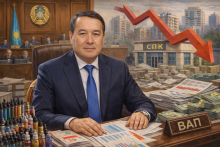
The Supreme Audit Chamber (SAC) has completed an audit of the activities of social-entrepreneurial corporations (SECs) and their impact on regional development. The results of the state audit were discussed at a meeting chaired by Alikhan Smailov.
According to the department's press service, due to a lack of uniform approaches and proper regulation by the Ministry of National Economy, the corporations operate in a fragmented manner and are not integrated into the state planning system. Their plans are formal in nature, do not undergo external evaluation, and their performance results do not affect the effectiveness of regional administrations (akimats).
Alikhan Smailov emphasised that the ministry, as the authorised body, must establish clear rules and define the role of SECs in the regions.
"You must decide and develop uniform approaches to what SECs should be doing. Are they development institutions or something else? What is their social role in the regions? What is their role in attracting investment? What instruments should they use? Regarding the issuance of loans – what can they be used for and what can they not be used for? A unified position must be developed," noted Alikhan Smailov.
It has been reported that over the past five years, more than 528 billion tenge in budget funds have been transferred to SECs, of which 288 billion tenge was for lending to entrepreneurs. However, instead of implementing development projects, the audit revealed a practice of placing funds in bank deposits and participating in commercial projects with low social impact.
Despite regular financing, SECs remain unprofitable: at the start of the current year, the total accumulated loss reached 209 billion tenge — seven times more than in 2020. Dividend payments are also unstable: over the past year, SECs transferred less than 0.5 billion tenge to the budget, almost four times less than the 2023 figure.
Auditors also identified a number of violations in individual corporations:
- SEC "Ertis" is carrying out commercial housing construction worth 16.6 billion tenge under the guise of investment projects. Violations amounting to 3.3 billion tenge were identified.
- SEC "Aqjaiyq" received land plots for investment projects; however, they have either not been developed or have been used for other commercial purposes.
- SEC "Aktobe" granted a large loan to a single private company over three years. The total amount of support was 11.2 billion tenge. At the same time, a person affiliated with this firm was included in the project selection committee, and the loan was issued without collateral and with violations.
- SEC "Semey" selects projects without risk analysis or effectiveness evaluation.
Furthermore, control inspections of stabilisation funds revealed inadequate storage conditions for food products, a limited range of goods, and the procurement of items that are not in demand.
Overall, the audit identified financial violations totalling 138 billion tenge, ineffective planning amounting to 14.5 billion tenge, and inefficient use of the budget and assets worth 33.6 billion tenge.
Auditors plan to refer materials on 14 identified cases to law enforcement agencies.