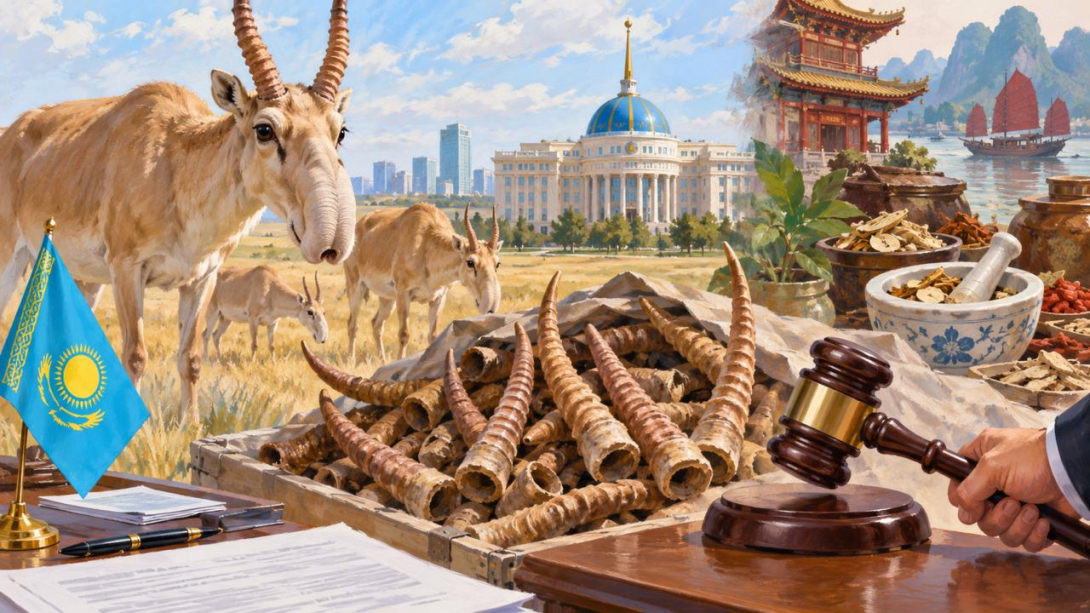
Kazakhstan has once again opened applications for the purchase of saiga antelope horns — this time for a batch weighing 1 tonne with a starting price of over 1.2 billion tenge. The official basis for the sale was an order from the Ministry of Ecology and Natural Resources, signed under the previous minister, Erlan Nyssanbayev, shortly before he was replaced by Alibek Kuantyrov, who has no prior experience in wildlife protection.
WHAT IS BEING OFFERED FOR SALE
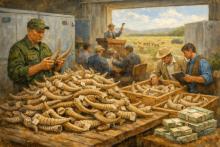
The lot is listed on the E-qazyna portal and has the status "Accepting applications". At the time of publication, the competition listing had already been viewed by 1,933 people.
The starting price for the batch is 1.2 billion tenge, which corresponds to a set price of $2,600 per kilogram of horns. A guarantee deposit of 184 million tenge is required to participate in the auction.
ON WHAT BASIS ARE THE HORNS BEING SOLD
The sale of saiga derivatives was authorised by an order from the Minister of Ecology and Natural Resources of the Republic of Kazakhstan dated 30 July 2026, "On certain issues of the sale of saiga derivatives", signed by Erlan Nyssanbayev. The document requires Zhasyl Damu JSC to sell 1 tonne of saiga derivatives and fixes the price per kilogram of horns.
The custodian of the goods is the Republican State Enterprise "Production Association Okhotzooprom" under the Forestry and Wildlife Committee of the Ministry of Ecology and Natural Resources of the Republic of Kazakhstan.
HOW THE HORN SALE SITUATION HAS DEVELOPED
This is not the first attempt to sell the derivatives. As reported earlier by the Financial and Business Rating Agency of Kazakhstan, in August Zhasyl Damu JSC had already offered a tonne of saiga horns at electronic auction with the same parameters — starting price of 1,227,148,000 tenge and guarantee deposit of 184,072,200 tenge. It appears the batch was never sold.
Historic demand for saiga horns is primarily linked to traditional Asian medicine. According to TRAFFIC, male saiga horns were in high demand above all in China and several countries in Southeast Asia. In traditional Chinese medicine, the material is known as Lingyangjiao and is used in various forms of medicinal products.
However, modern demand cannot automatically be assumed to match that of several decades ago. A study of the Chinese market published in 2024 notes that the use of saiga horn in Chinese medicine is constrained by existing stockpiles, and due to the shortage of raw material, horns from other species are used as substitutes.
A CITES document from July 2026 specifically states the need to study and reduce demand for illegally sourced saiga horns on the traditional medicine market.
And while part of the accumulated horn stock remains unsold, staffing changes have taken place at the Ministry of Ecology and Natural Resources. President Kassym-Jomart Tokayev approved an updated government composition, and the relevant ministry is now headed by Alibek Kuantyrov, who replaced Erlan Nyssanbayev in the post.
Prior to his appointment, Kuantyrov held the position of Deputy Minister of Foreign Affairs, and previously headed the Ministry of National Economy and the KAZENERGY Association. He has no professional experience in the field of wildlife protection.
Judging by his earlier public statements, his environmental agenda was built more around sustainable natural resource use and "greening" the economy rather than around questions of conserving rare species. How the new minister will approach regulating saiga numbers and the continued sale of horns remains to be seen.