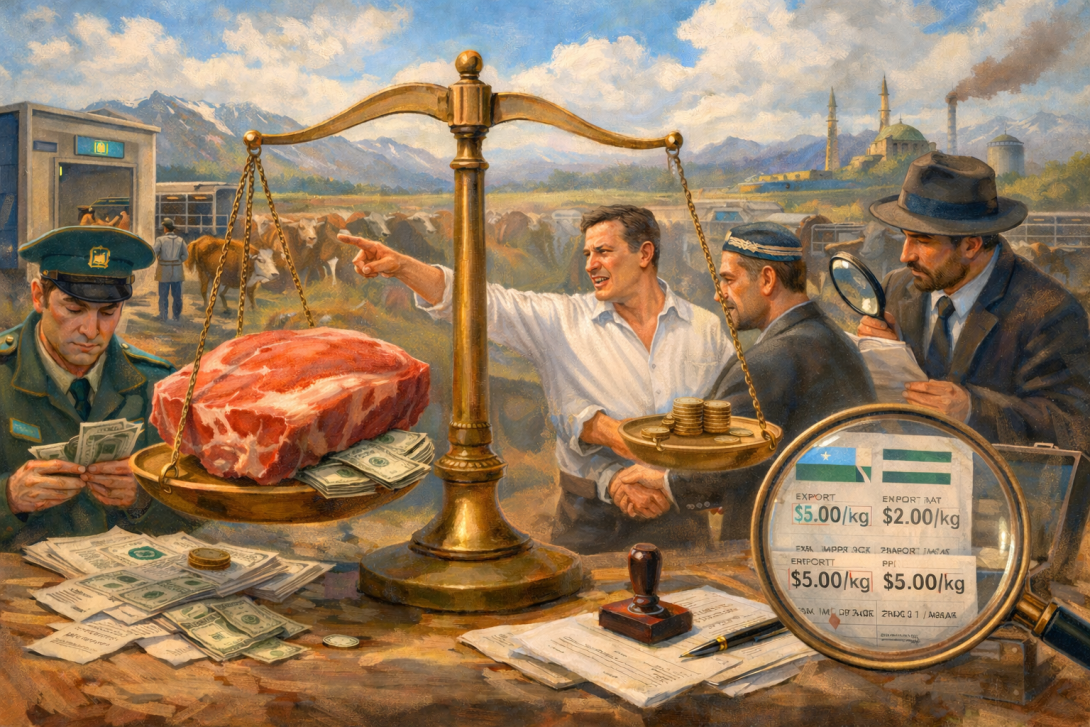
Kazakhstani beef is allegedly leaving for foreign markets cheaper than it costs in domestic shops — that is the picture painted by official customs statistics. However, experts warn that these figures should not be taken literally. Behind the low export price in the documents may lie not the producers' market logic, but a deliberate undervaluation of customs value — a tool that simultaneously reduces the seller's tax burden, distorts industry statistics, and harms honest exporters.
HOW THE AVERAGE EXPORT PRICE IS FORMED
As inbusiness.kz reports, citing data from the Bureau of National Statistics of the Republic of Kazakhstan, in 2025 Kazakhstan exported 32.3 thousand tonnes of beef worth $127.4 million. This gives an average price of $3.95 per kilogram of beef (approx. 1 930 tenge).
However, $3.95 per kg is not the price at which most exporters actually trade. It is an arithmetic mean, composed of fundamentally different segments. A handful of companies send premium cuts of marbled beef to high-margin markets at $13–14 per kg (approx. 6 340-6 830 tenge). Another, larger group supplies carcasses to Central Asian countries at $6–8 per kg (approx. 2 930-3 900 tenge). But according to analysts at the portal eldala.kz, about half of all exports, roughly 15 thousand tonnes, passed through at a price of around $2 per kg (approx. 975 tenge), and in some cases lower.
WHY $2 PER KG IS NOT A MARKET PRICE
Of course, the production cost of beef in Kazakhstan does not fit into such a figure. Especially since domestically, the retail price per kilogram of beef reaches 4,000–6,000 tenge. Selling for export at around 1,000 tenge per kg at a loss is inexplicable from the point of view of normal market logic.
Agricultural expert and founder of the FBRK, Kirill Pavlov, explains this phenomenon as follows:
"When filling out customs documents, there is a certain corridor, a range, within which prices are indicated. If there is no lower limit, then the minimum is always stated," he says.
According to him, two mechanisms are at play here: outright smuggling and official shipments with a deliberately undervalued cost — in order to pay less tax. As a result, both sides of the deal lose:
"Kazakhstan loses as the exporting side, and, say, Uzbekistan loses as the importing side — because everywhere statistics are distorted, everywhere taxes are underpaid," explains Kirill Pavlov.
It is worth recalling that back in January of this year, the FBRK published investigations into the grey export of livestock, in particular — we analysed documents from the Mangystau region, recording violations during the transit of cattle from Russia to Uzbekistan. Our editorial team assumed that a cargo substitution scheme operates in Kazakhstan: Russian cattle, documented as in transit to Uzbekistan, may be sold domestically, while Kazakhstani cattle are exported under the Russian documents instead.
Moreover, the FBRK recorded cases where cattle were documented as small ruminants — to avoid duties and veterinary restrictions.
Livestock passing through documents as mutton or Russian transit either does not enter the statistics of Kazakhstani beef exports at all, or enters at someone else's, undervalued price, which further distorts an already opaque picture.
WHAT THE BUDGET AND THE INDUSTRY LOSE
Undervaluing the export price is not just a loss of tax revenue. Companies that operate legitimately and honestly declare the market value find themselves in a deliberately disadvantageous position: buyers demand they work at "grey" prices, citing competitors. As a result, honest exporters either leave the market or are forced to adopt the rules of the game set by others.
WHAT CHANGES FROM 2026
The Interdepartmental Commission on Foreign Trade, chaired by Deputy Prime Minister Serik Zhumangarin, has lowered the threshold for obtaining an export quota to 500 head.
For the first half of 2026, an export quota for beef has been approved at 20 thousand tonnes. The ban on the export of breeding cattle and bulls has been extended.