
There is currently an active fight against locusts in Kazakhstan. At the same time, there remains a risk of the pest spreading from the territory of Russia's border regions. The editorial board of FBRK inquired about which preparations are used for chemical treatment against locusts in our country.
According to the latest data, around 1.6 million hectares have already been treated for this purpose in Kazakhstan. Of this, 270,000 hectares were in the border Kostanay Region, and 482,000 hectares in Aktobe Region, where locusts migrate from the Orenburg region.
To date, along the Russian-Kazakh border, Kazakhstanis have treated approximately 104 km. As reported by the Deputy Minister of Agriculture of the Orenburg region, their side has treated 22,000 hectares, and 10 km along the border. In the opinion of the Kazakh authorities, the neighbours should intensify efforts to combat the pests.
In this regard, representatives of the ministries of agriculture of Kazakhstan and Russia are agreeing on measures to prevent the migration of locust pests into neighbouring states.
At the same time, the editorial board of FBRK has found out what is being used to poison locusts in the Aktobe, Almaty, Atyrau, Zhambyl, West Kazakhstan, Kostanay, Kyzylorda, Turkestan regions, and in the Zhetysu region.
The main preparations used against locusts are those based on the substances "Imidacloprid", "Diflubenzuron", "Cyhalothrin", "Thiamethoxam", "Cypermethrin", "Chlorpyrifos", "Fipronil" and "Acetamiprid" (see photo).
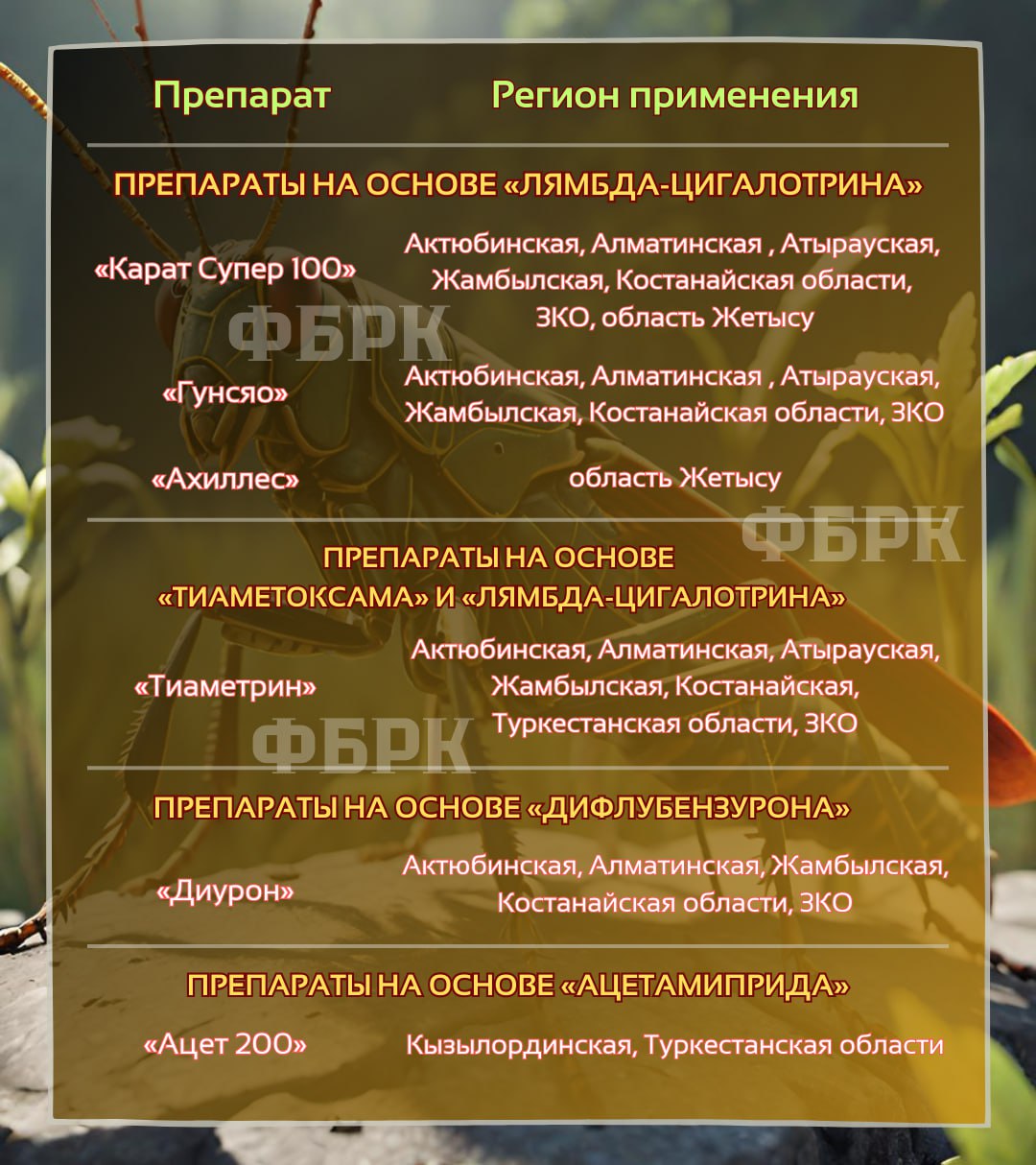
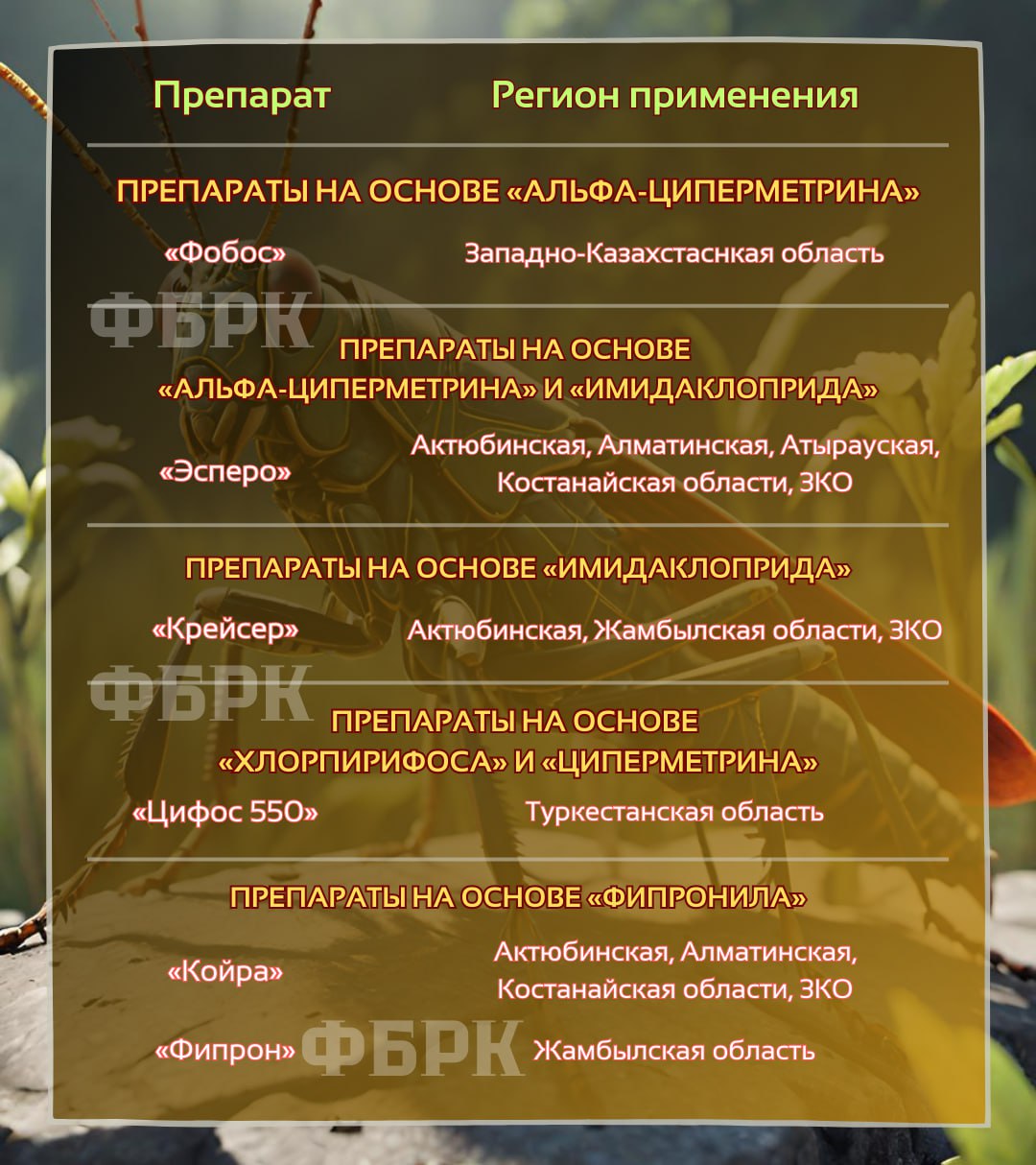
These preparations are among those approved for use in agriculture on the territory of Kazakhstan, including for controlling locusts. However, it is worth noting that the active ingredients of the preparations have moderate persistence in soils, enter groundwater and wastewater, and consequently enter water bodies.
Furthermore, the listed substances not only poison locusts but also have a harmful effect on other fauna. Almost all preparations currently used in the fight against locusts are highly toxic to bees and bumblebees.
For example, "Thiamethoxam", "Imidacloprid" and "Acetamiprid" belong to the class of neonicotinoids, which were developed by modifying nicotine. Neonicotinoid pesticides lead to the decline of pollinating insects, which is why they are banned in the countries of the European Union.
In 2023, in southern Kazakhstan, after disinsection with neonicotinoid pesticides, beekeepers sent video evidence of mass bee deaths in apiaries. In addition, in 2020, a team of American researchers concluded that the use of neonicotinoids led to a significant decline in bird populations in the USA.
Albert Einstein is often credited with the famous conclusion: "If the bee disappears from the surface of the earth, man would have no more than four years to live", although there is no evidence that the brilliant scientist actually said this.
But whoever the actual author of this statement may be, they probably wanted to emphasise that bees are an important element of the Earth's ecosystem and help maintain balance in nature, and therefore the development of agriculture. They pollinate over 75% of agricultural crops. The yield of cotton, as well as oilseed crops used as livestock feed, depends on them.
We understand that the pressing problem of the locust invasion literally forces local authorities to use quite ruthless pesticides. But what to do when, by deliberately destroying one thing, we indirectly wipe out something else, including our own future?