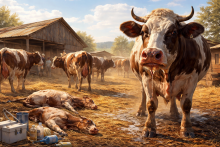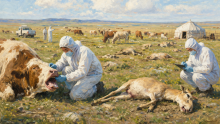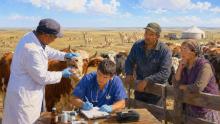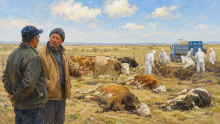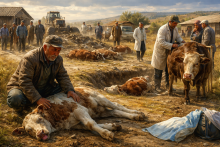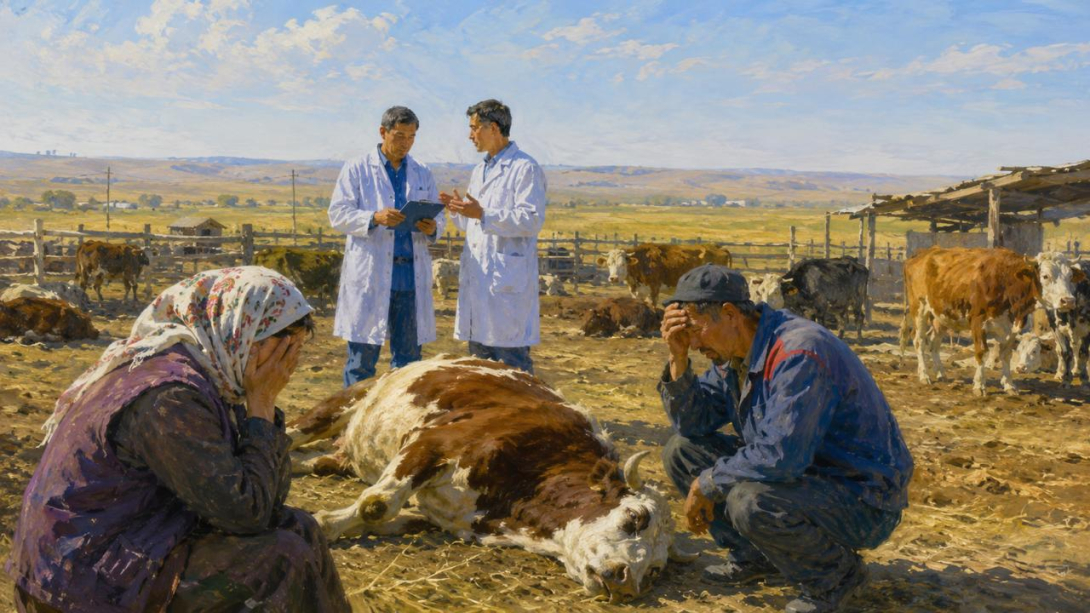
Livestock deaths in Kenyzek, Atyrau region, which FBK previously reported on, have come under the spotlight of relevant specialists. The situation was commented on by Doctor of Veterinary Sciences Gaisa Absatirov. The expert notes that a diagnosis of "unknown disease" is being made increasingly often in Kazakh veterinary medicine, and specialists are helpless because they simply do not know what they are dealing with.
WHAT HAPPENED
Earlier, FBK reported on the situation in the Atyrau region, where cattle have been dying for the second year running for a reason that official veterinary services have failed to name: the animals weaken and die within a matter of days, while specialists, after carrying out tests, can only throw up their hands.
Businesswoman Raya Mukhanbetova lost 13 head, and the diagnosis was never established. Farmer Yerkin Sharipov lost 20–30 head last year, in a similar manner – without any explanation of the cause.
The akim of Kenyzek rural district, Eduard Ospanov, said that tests on the animals, water and hay did not reveal any disease. Compensation will only be paid out if the illness is confirmed.
WHAT THE PROFESSOR SAYS
Gaisa Absatirov, on his personal Facebook page, points out a contradiction widespread in Kazakh veterinary medicine: there is no diagnosis, yet vaccination is already being carried out. He asks against which disease the immunisation is directed and how effective it can be without the pathogen. According to him, a similar picture emerged in the spring, when cattle were being vaccinated against rhinotracheitis and saigas against pasteurellosis, even though the symptoms did not match those diagnoses.
The professor reminds us that significant funds are allocated from the budget for veterinary infrastructure and diagnostic equipment, yet diagnostics are not improving. He sees the way out in involving international experts, and, until diagnoses are established, ironically suggests naming diseases after the geography of the outbreak, by analogy with "Newcastle disease" or "Teschen disease": the deaths in Kenyzek could then be called "Kenyzek disease", and the disputed diagnoses of the chairman of the veterinary control and supervision committee of the Kazakh Ministry of Agriculture, Kazbek Tashimov, could be dubbed "Tashimov disease".
WHAT THIS MEANS
In practice, medicine and veterinary science do indeed encounter diseases that cannot be identified at the first attempt. But what happens once no answer is found?
In our case, instead of a diagnosis, the label "unknown disease" appears. Instead of an explanation of the causes, there is another round of tests. And at some point, this ceases to be perceived as an emergency, even though it ought to remain precisely that until the cause of the livestock deaths is established.
In this sense, the question "what is this disease?" gradually transforms into a far more unpleasant one: how much uncertainty can the state system withstand before uncertainty itself becomes its working method?
But until a diagnosis is established, responsibility does not disappear. It simply becomes blurred. The animals continue to die, the farmer bears the losses, specialists can cite the lack of confirmation, officials can point to test results, and every subsequent case begins to look like an isolated episode. In such a setup, no one formally claims that there is no problem. But neither is there anyone held accountable for failing to explain it.
Meanwhile, Minister of Agriculture Aidarbek Saparov brushes off journalists, claiming that there is no mass livestock mortality in the country at all, and that veterinary measures are being carried out as planned. You can tell.