(15 January 2026 | Source: FBRK)
The Veterinary Control and Oversight Committee (VCOC) of the Ministry of Agriculture (MoA) refused the FBRK editorial team's request to provide statistics on animal disease outbreaks, citing the "For Official Use Only" classification. However, it turns out that similar epizootic data is freely published in international scientific journals by Kazakhstani scientists. So, what is going on?
CLASSIFIED DATA IN THE PUBLIC DOMAIN
On 24 December 2025, FBRK sent an official request to the VCOC asking for the total number of registered animal disease outbreaks for 2015-2025 broken down by region; a monthly breakdown for 2025; the methodology for counting outbreaks; vaccination statistics; and specific data on brucellosis and anthrax.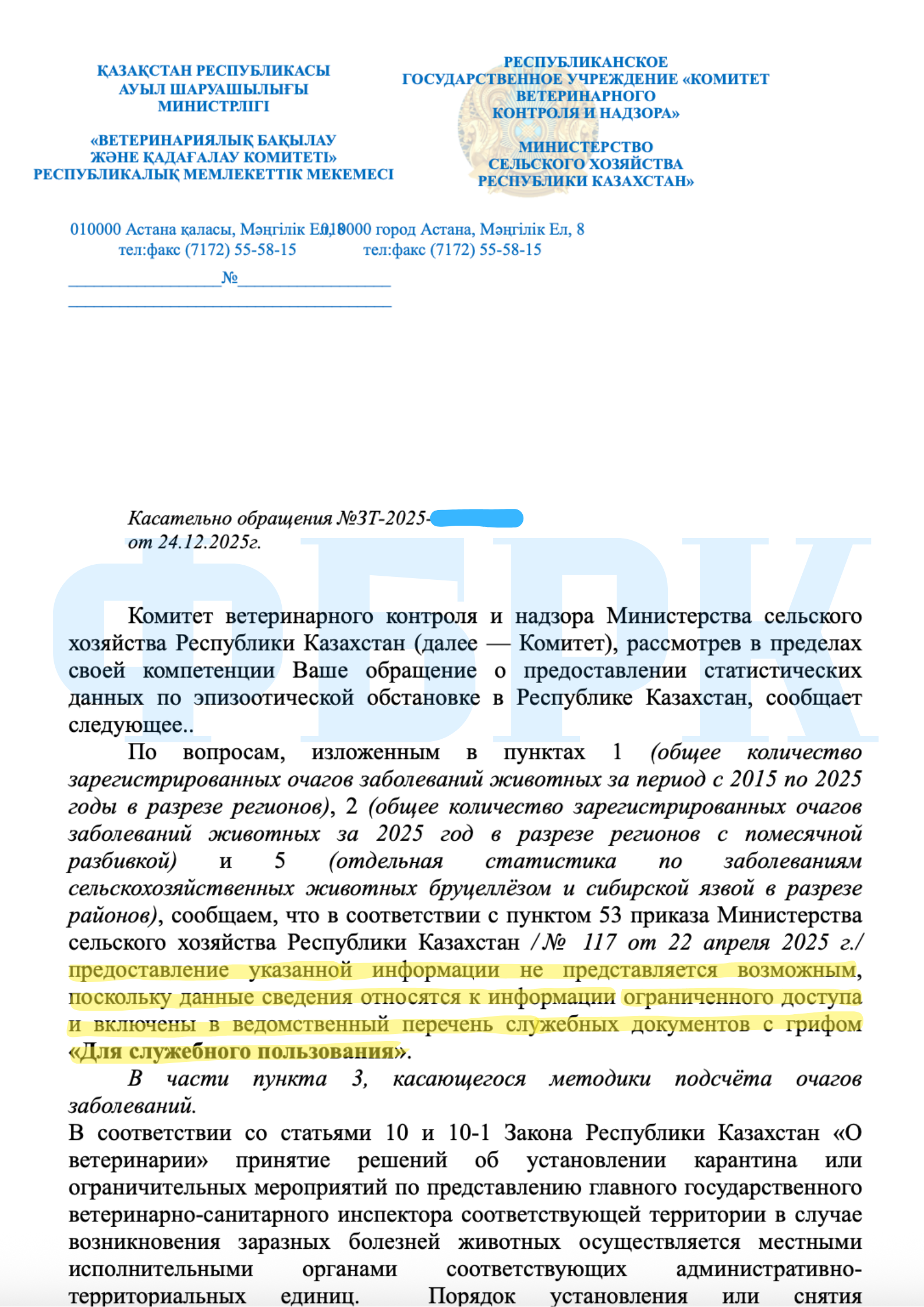
However, as the department's response indicates, the information for points 1, 2, and 5 "is classified as restricted information and is included in the departmental list of official documents marked 'For Official Use Only'".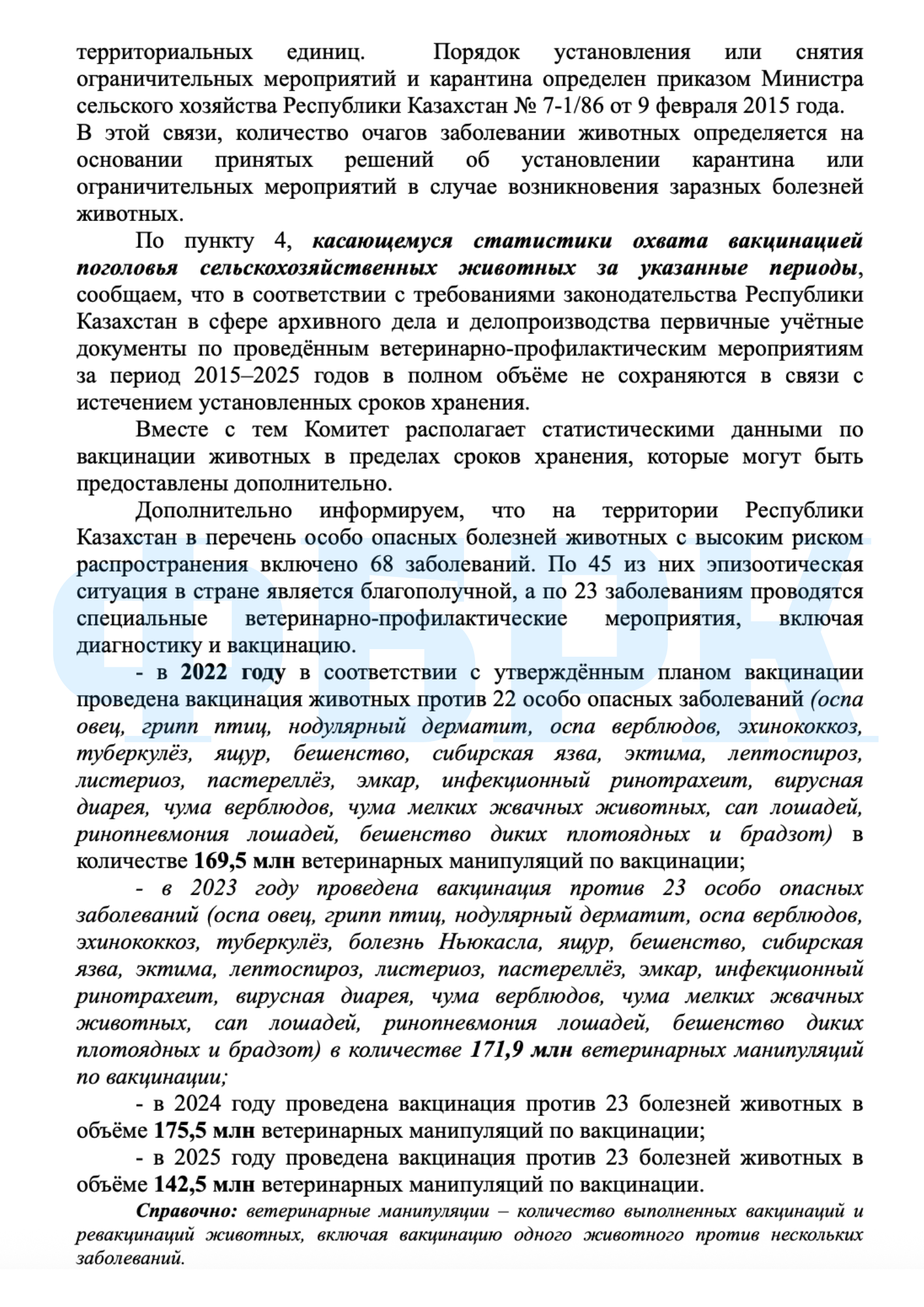
But here's the rub: it turns out similar data is available in the public domain.
In April 2025, the International Journal of Veterinary Science published an article by Kazakhstani scientists entitled "Retrospective Analysis of the Bovine Leukemia Epizootic Situation in Kazakhstan".
The authors, including staff from the West Kazakhstan Innovation and Technology University, the Republican Veterinary Laboratory, and the Kazakh Scientific Research Veterinary Institute (KazSRVI), published detailed statistics on bovine leukemia for 2019-2023, broken down by all regions of the country.
According to this work, 225,516 head of cattle were tested during the specified period, of which 10,153 tested positive — an infection rate of 4.5%. The highest levels of infection were recorded in the North Kazakhstan (12.99%), Kostanay (12.33%), and East Kazakhstan (9.31%) regions.
The Mangystau, Kyzylorda, and Turkestan regions, as well as the Ulytau and Zhetysu regions, remain free of this disease.
The article contains graphs of disease dynamics, geographic maps of infection spread, and a detailed description of the diagnostic methodology.
But if such data is truly classified, how did it end up in an international peer-reviewed journal? Either the department is violating its own secrecy regime by allowing scientists to publish "For Official Use Only" information, or it is originally using the classification incorrectly, as a means to block inconvenient requests.
VETERINARY PROPHYLACTIC MEASURES STATISTICS
Regarding the fourth point of the request — on vaccination coverage statistics — the VCOC reported that "primary accounting documents for veterinary prophylactic measures carried out over the period 2015-2025 are not retained in full due to the expiration of the established storage periods".
The standard retention periods for veterinary records in Kazakhstan are at least 3 years, and therefore the department provided statistics only for the period 2022-2025. Incidentally, the statistics themselves look quite interesting.
- 2022: 169.5 million veterinary procedures;
- 2023: 171.9 million;
- 2024: 175.5 million;
- 2025: 142.5 million.
The sharp drop in the volume of vaccinations by 33 million procedures (almost 19%) with the same number of diseases (23 particularly dangerous infections) is not explained. No epizootiological or budgetary reasons are given in the letter.
"ROSY REPORTS" AGAINST A BACKDROP OF CATASTROPHE
On 10 January 2026, Doctor of Veterinary Sciences, Professor Gaisa Absatirov published a detailed analysis of the epizootic situation in Kazakhstan for 2025 on social media.
According to him, "Kazakhstani veterinary medicine has long been in a state of crisis", and "in the rosy reports and speeches of high-ranking officials from the MoA and VCOC, the state of domestic veterinary medicine is presented through 'rose-tinted glasses'".
The professor listed serious outbreaks of particularly dangerous infections in 2025:
- Anthrax in Akmola region — people fell ill, and animal deaths occurred;
- Anthrax at the Atyrau city market — animal deaths and human illness;
- Blackleg in Ulytau region — clinical signs and animal deaths;
- Mass mortality of domestic poultry in North Kazakhstan region;
- Rabies outbreaks in Kostanay and Mangystau regions, resulting in human fatalities;
- Foot-and-mouth disease outbreak in Kyzylorda region;
- Violations of vaccination schedules and intervals in Zhambyl region.
Absatirov also points out "the unhealthy atmosphere within the VCOC of the MoA of the Republic of Kazakhstan itself, whose head and staff are more preoccupied with internal conflicts and squabbles". This indirectly explains the possible failure in vaccination: administrative chaos within the department could have led to the disruption of preventive measures.
Incidentally, none of the listed outbreaks are mentioned in the VCOC's response to the FBRK request. Instead, the committee states that "the epizootic situation in the country is favourable for 45 out of 68 particularly dangerous diseases". It is likely these very formulations that Professor Absatirov calls "rosy reports".
A METHOD WITHOUT A METHOD
On the question of the methodology for counting disease outbreaks, the VCOC responded with a lengthy quote from Articles 10 and 10-1 of the Law of the Republic of Kazakhstan "On Veterinary Medicine" and an order from the Minister of Agriculture No. 7-1/86 dated 9 February 2015. The gist of the response: "the number of animal disease outbreaks is determined based on decisions made to establish quarantine or restrictive measures". Only this is not a methodology, but a reference to procedure.
Meanwhile, the scientific article describes a real diagnostic methodology for leukemia: using the agar gel immunodiffusion (AGID) test, followed by confirmation through enzyme-linked immunosorbent assay (ELISA) and haematological tests. Animals with positive results are isolated and sent for sanitary slaughter within 15 calendar days.
So, researchers openly publish a methodology, while the department, when directly asked, retreats into generalities about legislation.
A SYSTEMIC PROBLEM OR AN ISOLATED GLITCH?
The situation with the VCOC's response looks like an administrative paradox we are already well acquainted with. We assume the department is citing a secrecy classification to refuse providing information, whilst similar data is published in open scientific journals.
This is not protecting state secrets — it is using administrative resources to block public oversight.
Meanwhile, the real epizootic situation, judging by the statements of subject matter experts, requires not secrecy, but maximum transparency and strict control. Especially when it comes to diseases dangerous to humans.