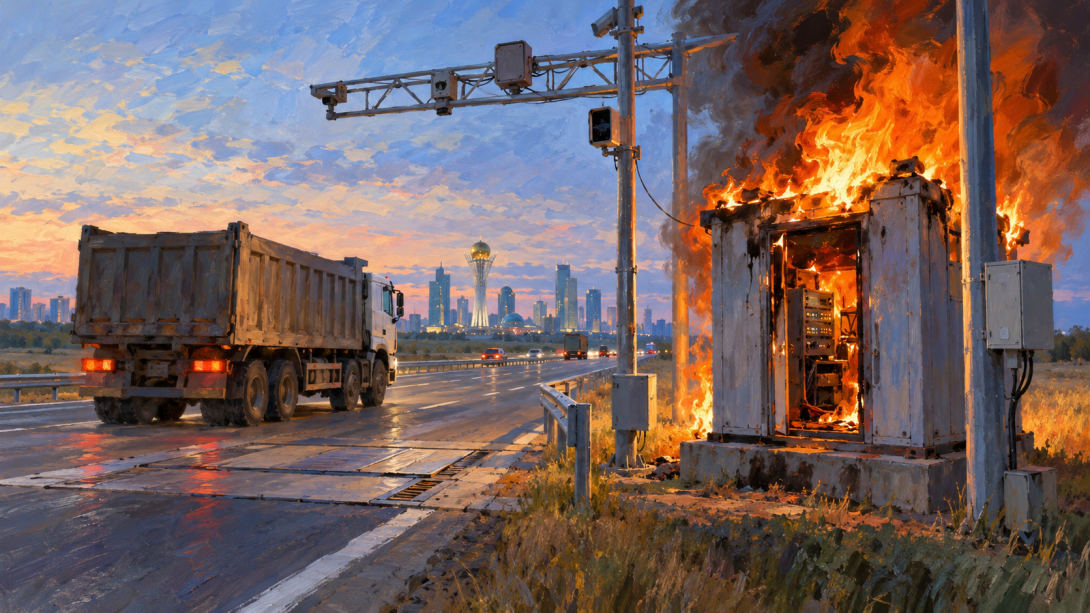
An automated weighing station (AWS) used to detect overloaded goods vehicles has been set on fire on the Astana–Karaganda highway. The arson comes amid the retrieval of the personal files of several employees of the relevant agency, linked to the case of the deputy chairman of the Committee for Road Transport and Transport Control (CRTTC) of the Ministry of Transport of the Republic of Kazakhstan, Gani Salmayev.
WHAT IS KNOWN FROM THE PREVIOUS FBRK REPORT
On 26 August, searches were carried out at the premises of Gani Salmayev. According to FBRK sources, around 20 million tenge was allegedly found during the search, which is referred to in the investigation materials as a suspected bribe. Salmayev is charged under Article 361 of the Criminal Code of the Republic of Kazakhstan ("Abuse of official powers") and Article 366 of the Criminal Code of the Republic of Kazakhstan ("Receiving a bribe").
Until March 2026, Salmayev headed the Department for Road Transport Control (DRTC) – a division of the CRTTC that directly oversees the weighing control stations.
WHAT IS KNOWN ABOUT THE CANCELLED FINES
According to FBRK sources, the Transport Control Inspectorate (TCI) for the city of Astana cancelled previously issued fines totalling more than 40 million tenge for overloading against a single legal entity. The sources claim that a decision of this scale could not have been made by a single inspectorate alone and point to the involvement of the central apparatus, including the DRTC, whose acting head is a person close to Salmayev.
Fines for overloading go to the republican budget – which means that cancelling penalties of this amount means the budget never received them.
WHO ELSE HAS COME UNDER SCRUTINY
FBRK sources claim that several CRTTC employees have come within the orbit of interest of the Anti-Corruption Service of the National Security Committee of the Republic of Kazakhstan (ACS NSC): Gani Salmayev himself, head of the CRTTC situational centre Sultan Mussagaliyev, and deputy head of the TCI for the Akmola region Nurymzhan Zhumabayev.
WHAT HAPPENED ON THE HIGHWAY AT NIGHT
According to FBRK sources, shortly after this information emerged, another AWS was set on fire – referring to the very blaze that NC JSC "KazAvtoZhol" later officially confirmed: at around 02:15 on 28 August, at the 15th kilometre of the Astana–Karaganda–Almaty highway, near Kuygenzhar.
According to the company, the system recorded the last vehicle passing through at 02:11 – a few minutes before the incident; the equipment inside the apparatus cabinet is, according to preliminary data, still in working order. This is already the third such case since the beginning of 2026, and KazAvtoZhol does not rule out the deliberate nature of the damage.
There is no open data on who may be behind the incident; FBRK sources suggest the possible involvement of one of the companies operating in the extraction of common minerals.
The arson of the station that detects overloading occurred in the same days as the cancellation of fines for overloading and heightened scrutiny of employees of the relevant agency, making it logical to view these events as part of a single chain rather than in isolation.
CONTEXT
Earlier, FBRK had already written about the systemic gap between fines assessed and fines collected for overloading: of the 3.4 billion tenge assessed, only around 2 billion tenge were actually collected – roughly 41% of fines remained unpaid. Moreover, with the transition of the violation recording system to a fully automatic mode in 2025, the total amount of fines rose sharply: over 10 months it tripled compared with the previous year, reaching 4.4 billion tenge.
It is worth noting that some AWS stations are not equipped with cameras that capture the rear registration plate, which is particularly critical for trailers and semi-trailers, where the excess weight does not always fall on the front axle. Without the rear plate, it is impossible to correctly identify the owner of an overloaded vehicle; however, the updated AWS operating rules adopted at the end of 2025 did not include this requirement.
FBRK sources have also reported that at the entrance to Astana, the asphalt is already being removed and weighing equipment dismantled – apparently pointing to a replacement of the entire recording system. Against this backdrop, the arson of the station on the Astana–Karaganda–Almaty highway looks less like an isolated incident and more like another episode in a saga in which overload control regularly fails – whether technically or in terms of personnel.