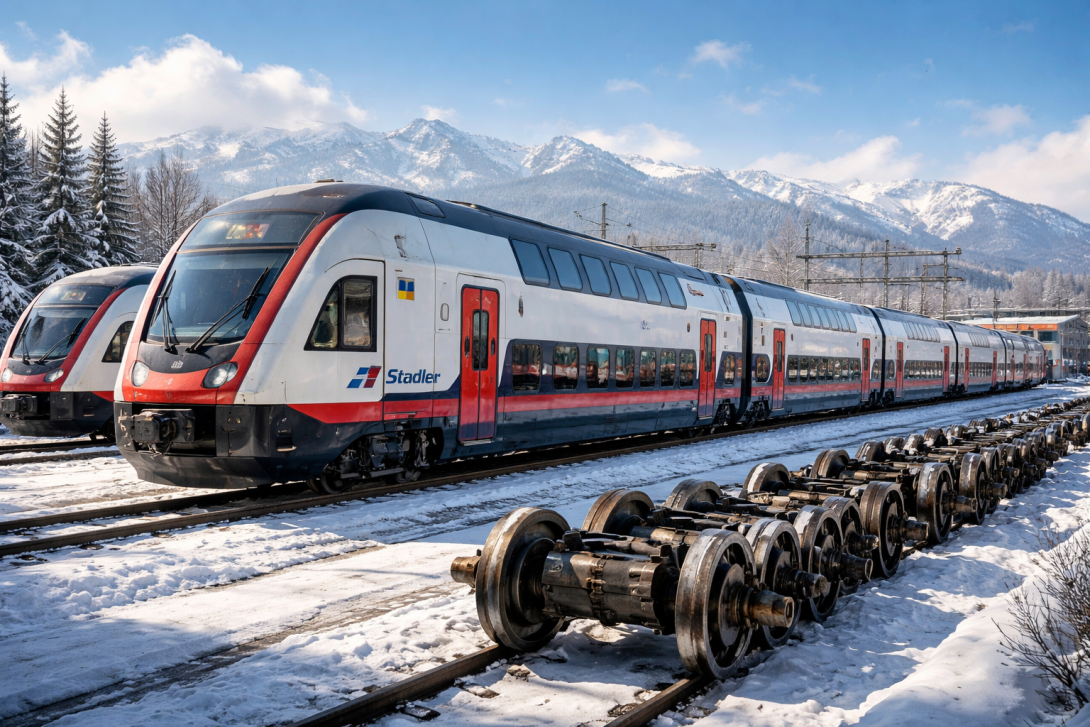
(25 February 2026 | Source: ORDA)
Despite statements about the readiness of new passenger carriages from the Swiss company Stadler, none had entered service on Kazakhstan's railways by the beginning of 2026. The national carrier, JSC "NC "Kazakhstan Temir Zholy" (KTZ), did not confirm the transfer of the carriages into operation and refused to disclose payment details, citing contractual conditions.
HOW MANY CARRIAGES WERE DUE TO BE DELIVERED
As reported by ORDA, in 2025 the Stadler Kazakhstan plant planned to deliver 51 passenger carriages: compartment class, open-plan (platzkart), staff, and power-generator carriages. However, not a single one was transferred to KTZ's balance sheet.
Officially, in November 2025, JSC "NWF "Samruk-Kazyna" reported the completion of certification tests and the preparation of the first batch for delivery. A representative of Stadler Kazakhstan, Sergey Leontyev, stated that the new carriages would enter service on routes by the end of 2025.
However, the deadlines were postponed to 2026. The reasons have not been officially disclosed.
POSSIBLE QUALITY COMPLAINTS
According to sources from the publication, the carriages did not pass tests in winter conditions and do not meet a number of technical operation requirements in Kazakhstan. This concerns possible non-conformities in the operation of:
- the braking system;
- diesel generator sets;
- fire suppression systems;
- climate control equipment;
- toilet complexes.
According to the sources, this is precisely what prevented the carriages from being launched on the routes. Officially, KTZ has neither confirmed nor denied this information.
In response to a request, the company stated that the carriages had passed the required tests and certification according to the technical regulation TR CU 001/002 "On the Safety of Railway Rolling Stock", and that the commissioning of more than 100 carriages is planned for 2026.
PREVIOUS CONCERNS ABOUT INFRASTRUCTURE
At the end of 2025, FBRK already wrote about possible technical difficulties with the introduction of Stadler carriages. In the article about gaps on the platforms of Nurly Zhol station, we pointed out that on some tracks the distance between the carriage and the edge of the platform could be minimal. Whether the current delays are related to these issues has not been officially reported.
HOW MUCH WAS PAID FOR THE CARRIAGES
According to the publication, in 2023 KTZ paid the plant an advance of approximately 147 billion tenge, and in 2025, a further 43.3 billion tenge for the first batch. The total payment for the manufactured carriages could amount to around 200 billion tenge.
The national company refused to disclose the exact payment and service cost data, citing contractual conditions. However, previously published sources indicated that the contract provides for:
- the delivery of 557 carriages by 2030;
- a project cost of approximately 730–735 billion tenge;
- technical maintenance until 2040 amounting to approximately 650 billion tenge;
- a cost per carriage of approximately 1.2 billion tenge.
WHAT THE MANUFACTURERS SAY
Stadler Kazakhstan stated that in 2025, more than 50 carriages were produced and all passed the necessary tests and received certificates of conformity. The company described the information about substandard carriages as untrue.
At the same time, the manufacturer confirmed that the preliminary validation stage is ongoing and the actual transfer of the carriages to the customer has not yet been completed.
THE CONTRACT AND KTZ AUDIT
The cooperation agreement between KTZ, JSC "Passenger Transportation", and the companies Stadler Bussnang AG and Stadler CIS AG was signed in 2021 during the visit of Kassym-Jomart Tokayev to Switzerland.
In 2022, the Swiss company acquired the 'Tulpar' plant and committed to delivering 557 passenger carriages by 2030.
In June 2024, the Supreme Audit Chamber (SAC) conducted an audit of KTZ and identified financial violations amounting to 29 billion tenge, inefficient planning totalling 168 billion tenge, and economic losses of 307 billion tenge. A separate audit of the deal with Stadler was not mentioned in the documents.