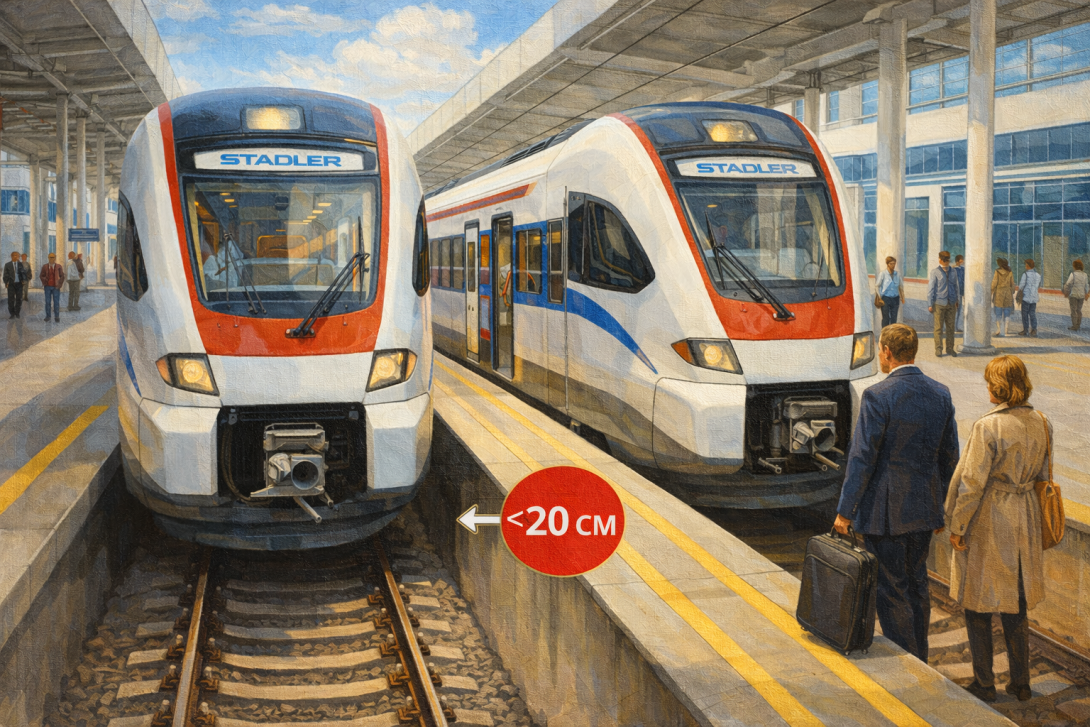
In autumn, it became known that by the end of 2025, Kazakhstan will receive the first batch of 537 passenger carriages from the Swiss company Stadler, but calculations based on technical data from JSC «NC «Kazakhstan Temir Zholy» (KTZ) reveals a potential problem: the gap between the new carriages and the platforms of the capital's Nurly Zhol station could be critically small — less than 20 cm on some tracks, which raises questions about passenger safety.
In 2022, KTZ signed a contract with Stadler for the supply of 537 passenger carriages by 2030 with a total value of €2.3 billion. Production is partially localised in Astana at a modernised plant, where it is planned to achieve 35.2% localisation of components by 2029. The project aims to completely renew the KTZ fleet and reduce the average age of carriages from 16 to 10 years.
However, questions have arisen about the compatibility of the new carriages with existing infrastructure. At the request of the FBRK editorial team, KTZ provided technical information on the parameters of the Nurly Zhol station platforms and the characteristics of the Stadler carriages.
According to the response dated 22 December, the platforms at Nurly Zhol station were built to special technical specifications approved on 31 March 2016. For intercity Talgo trains (tracks No. 1, 2, 3, 6) the distance from the track centre line to the edge of the platform is 1745 mm on straight sections. For trains of Russian manufacture, suburban electric trains and regional Talgo trains (presumably, suburban electric trains — FBRK ed. note) on tracks No. 4 and 5, this distance is increased to 1840 mm.

The response dated 23 December 2025 specifies the parameters of the Stadler carriages: body width is 3100 mm. This means that from the track centre line to the edge of the carriage is 1550 mm.

A simple calculation reveals the problem. The gap between the Stadler carriage and the platform will be:
- On tracks No. 1, 2, 3, 6: 1745 - 1550 = 195 mm (less than 20 cm)
- On tracks No. 4, 5: 1840 - 1550 = 290 mm (about 29 cm)
As far as is known, standard railway engineering practice assumes a minimum gap of no less than 250-300 mm (25-30 cm) to ensure safety. Such a gap is necessary because carriages sway during movement, and passengers need a safe distance from the edge of the platform to avoid injuries from protruding parts of the rolling stock.
A gap of 195 mm is particularly concerning. According to railway transport safety regulations, passengers must not approach the edge of the platform closer than 2 metres when a train passes without stopping. The restrictive white line on platforms indicates the safe distance from a moving train. With a gap of less than 20 cm, the risk of injury increases even when boarding and alighting from a stationary train.
In the KTZ document, it is stated that the platforms are designed for carriages not protruding beyond certain technical limits — no more than 1765 mm from the track centre line to the edge of the rolling stock in a stationary state. The Stadler carriages with a width of 3100 mm formally fit within these parameters, occupying 1550 mm from the centre line. However, this leaves minimal safety margins.
It is unclear whether the future delivery of Stadler carriages with a width of 3100 mm was taken into account during the design of the platforms in 2016. The contract with Stadler was signed in 2022, and Nurly Zhol station opened in 2017 — five years before the contract was concluded.
Several scenarios for solving the problem are possible: reconstruction of the platforms to alter their position relative to the track centre line, restricting the use of certain tracks for Stadler trains, or technical modifications to the carriages themselves. Each option requires significant financial investment and time.
At the time of publication, KTZ did not comment on the potential compatibility problem of the new carriages with the infrastructure of Nurly Zhol station. The first batch of 51 Stadler carriages is expected by the end of December 2025, which will allow a practical assessment of the actual gaps and the implementation of necessary safety measures.