(5 January 2026 | Source: Alau Radio Channel)
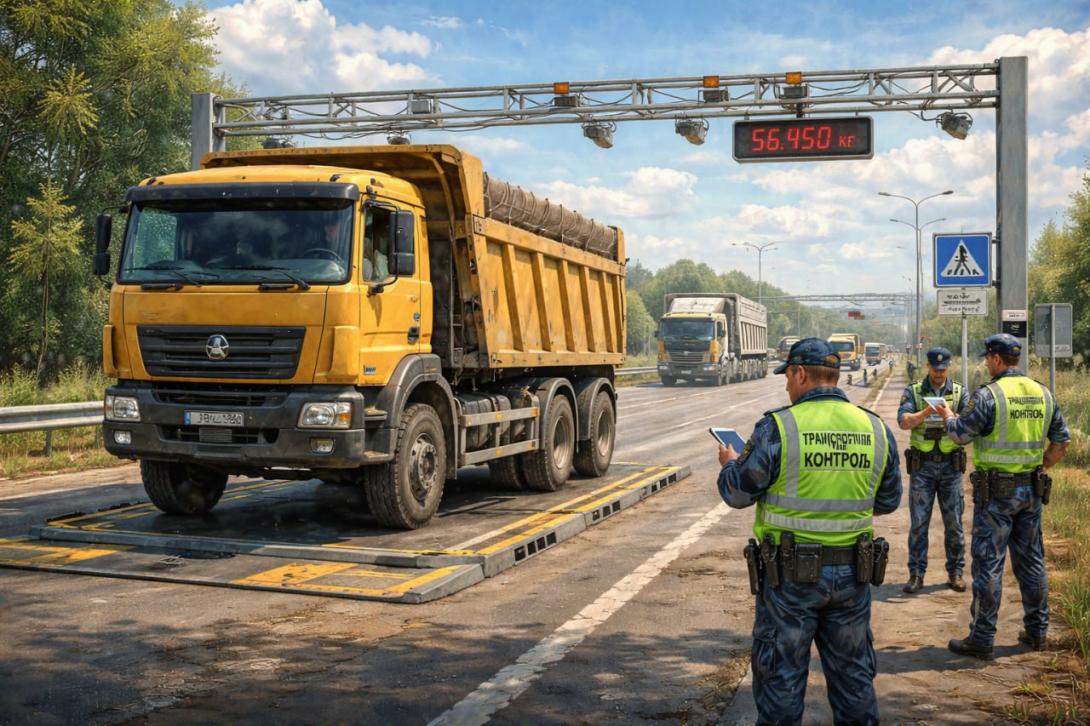
In the Kostanay Region, record investment in road infrastructure is accompanied by increased control over heavy goods vehicles. Regional authorities believe that without systematic monitoring of weight parameters, it will be difficult to preserve the newly renovated roads.
RECORD INVESTMENT IN THE REGION'S ROADS
As stated by the Akim of the Kostanay Region, Kumar Aksakalov, in 2025, 103 billion tenge was allocated for the repair and construction of roads. In some populated areas, asphalt has been laid for the first time; in others, access roads have been brought up to standard condition.
WHY HEAVY GOODS VEHICLES ARE CONSIDERED A KEY PROBLEM
According to the Akim's assessment, the main threat to the road surface remains lorries exceeding the permissible weight. It is noted that these vehicles accelerate the wear and tear of the surface and can lead to damage to the roads within a short time after repairs.
BAN ON THE MOVEMENT OF OVERLOADED DUMP TRUCKS
On 1 January 2026, a regulation came into effect in Kazakhstan, prohibiting the movement of three-axle dump trucks with a total weight exceeding 25 tonnes on public roads and streets of populated areas. This measure is an additional tool for protecting the road surface from premature destruction due to heavy loads.
HOW AUTOMATED WEIGHBRIDGES WORK
To monitor compliance with weight parameters in the Kostanay Region, it is planned to install automated measuring systems (AMS). These systems detect excess weight and speed without stopping vehicles. In 2026, it is planned to deploy 10 AMS on regional and 10 on national roads.
The systems are designed to automatically record violations and apply administrative measures in accordance with current legislation.
WHAT FINES ARE STIPULATED BY LAW
Liability for overloading is established under Article 571 of the Code of Administrative Offences. The amount of the fine depends on the degree of excess weight and the category of the offender.
Excess of 1 to 5 tonnes:
- Individuals — 40 MCI (173,000 tenge),
- Small businesses — 80 MCI (346,000 tenge),
- Medium businesses — 120 MCI (519,000 tenge),
- Large businesses — 200 MCI (865,000 tenge).
Excess of 5 to 10 tonnes:
- From 80 MCI (346,000 tenge) to 280 MCI (1.21 million tenge).
Over 10 tonnes:
- Individuals — 180 MCI (778,500 tenge),
- Small businesses — 480 MCI (2.07 million tenge),
- Medium businesses — 780 MCI (3.37 million tenge),
- Large businesses — 1,000 MCI (4.33 million tenge).
(1 MCI for 2026 amounts to 4,325 tenge - editor's note from FBPC).
HOW ARE THE COLLECTED FINES SPENT?
Theoretically, fines are supposed to be directed towards road restoration and construction, which should, in principle, create a self-financing system of control and repair. However, the condition of the road surface raises questions about how effectively such funds are already being used for their intended purpose.
If the collection system is working, but the roads continue to deteriorate quickly, then either the amount of funds collected is insufficient, or the mechanisms for control and redistribution of funds require further attention. And given the significant amounts of fines and, very likely, frequent violations, the question arises: where do the funds received by the state go, and were they even collected in the first place?
For the record, the FBPC editorial team has previously covered issues related to the regulation of the transport industry on numerous occasions. In May 2023, we reported on schemes involving foreign permit forms (FPF), and in January 2024, on the reform project for their distribution, presented by the committee for road transport and transport control. Furthermore, in October 2024, the FBPC wrote about the growing number of carriers from Russia and Belarus in the Kazakhstani market.