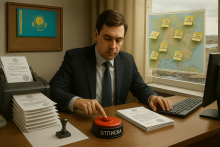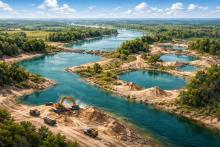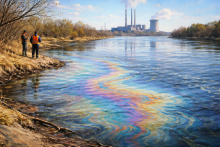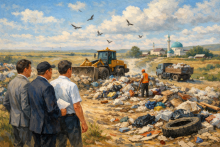
Papers say one thing, the river says another. Large-scale mineral extraction is taking place in close proximity to the River Ishim with formal compliance with all regulations, yet the river's water is classified as "polluted", and actual on-site inspections are not carried out.
As a reminder, journalist and public figure Kirill Pavlov recently published the results of his investigation into mineral extraction along the River Ishim. The investigation identified several problem areas where the water body's ecosystem is under threat. Following the publication of a series of articles on this topic, our editorial team sent formal requests to various state bodies to find out who is behind this activity and how it complies with environmental regulations.
The replies have arrived. And they paint an interesting picture, in which theory and practice seem to exist in parallel worlds.
The Yesil Basin Inspectorate reports that the water protection zone of the River Ishim in the Arshaly district is 500-1000 metres, and the water protection strip is 50-100 metres. Specific figures, clear boundaries. But there is a notable addition: the inspectorate has not issued any approvals for the sites we mentioned, and inspections of compliance with the water protection zone regime there have not been conducted.
So we have a curious paradox: the boundaries exist on paper, but whether anyone actually checks them in reality is an open question. And it's not just a formality. This is about a water body that serves as a source of drinking water for many settlements.
The Ministry of Ecology, in its response, provides a whole collection of permits issued to companies that our editorial team has previously written about in detail - Quarry-Mir-3 LLP, Nefrit Gold LLP, SG Sand Quarry LLP, and others. Environmental impact assessment conclusions, emissions permits, reclamation plans - an impressive set of documents. But let's come down from the bureaucratic heights to earth, or rather, to the water.
According to data from the state enterprise "Kazhydromet", the River Ishim falls into water quality class 4 — "polluted", with elevated levels of zinc and phosphorus. Previously, the Ministry of Water Resources tried to explain this fact by stating that "the change in class is not related to the pollution of the water body, but is due to a revision of background concentrations". According to their data, in 2024 there was a recalculation of the background concentrations of suspended solids. But if the water is classified as "polluted", that means there are pollutants in it - regardless of how the standards are recalculated in offices. This looks particularly interesting in the context of the Yesil Basin Inspectorate's statement that "over the last 5 years (2020-2024) and in 2025, no instances of pollutant discharge into water bodies have been established".
The Department of Entrepreneurship and Industry of the Akmola Region also confirms that the companies have all the necessary licences. The paperwork is in order. However, the question of how this paperwork relates to reality remains open.
In the Ministry of Ecology's response, there is another curious detail - a mention of the construction of a protective dam for the village of Zhibek Zholy. It makes you wonder, why was a protective dam suddenly needed? Could it be related to changes in the river's hydrological regime caused by that very extraction? Incidentally, the village of Zhibek Zholy is also currently under threat - groundwater has risen, and approximately 100 homes have ended up in the flood zone.
In the end, a picture emerges where theory and practice exist separately. In theory, everything is regulated, everything is legal. But what about in practice?
All of this suggests the need to overhaul the system of environmental control itself. It's not enough to issue a permit and tick a box. Constant monitoring is needed, especially when it comes to vital resources like water.
Without effective control and a clear distribution of responsibilities between agencies, environmental standards risk remaining just lines on documents, and the River Ishim risks turning from a source of life into another example of how economic interests prevail over nature.
In this situation, every agency has its own truth, its own papers, and its own justifications. But the River Ishim has only one voice - the quality of its water. And that voice tells us that not everything is as rosy as the official reports suggest.
As a reminder, earlier the FBRK editorial team tried to find out how the main source of drinking water for the capital - the Astana (Vyacheslav) Reservoir - ended up surrounded by various land-use facilities. We approached the relevant agencies with this question, and their responses seem to have raised even more doubts.