
The FBRC editorial team requested from the Ministry of Agriculture (MoA) data on the import of cattle - routes, border crossings, and recipient farms. The Veterinary Control Committee refused the request, citing commercial confidentiality. When our editorial team filed a complaint, the department quickly found a way to 'close the matter': it scheduled a hearing forty minutes before it was due to start and immediately declared it invalid.
WHAT WAS ASKED AND WHAT WAS ANSWERED
In early May 2026, the FBRC editorial team sent an official journalistic request to the MoA regarding the logistics of imported livestock. This concerned specific routes, border crossings, delivery dates, and the recipient farms for the animals.
The MoA's Committee for Veterinary Control and Supervision refused the FBRC's request, citing Article 11 of the Law 'On Access to Information' and Article 28 of the Entrepreneurial Code. We were informed that information about suppliers, dates, and routes 'could constitute commercial confidentiality'.
The FBRC, in turn, filed a complaint, stating that this concerned data from state records, not the documentation of private companies. State records are kept in the public interest, in this case to ensure epizootic safety and veterinary control. Moreover, the wording 'could constitute' is not a proper legal basis for refusal.
FORTY MINUTES TO ATTEND
The deadline for the department to review our complaint was 16 June.
On 12 June at 11:21, the editorial journalist received an SMS notification that the hearing would take place the same day at 12:00, that is, 39 minutes later. There was no prior coordination of time, no clarification on whether the format was convenient, and practically no time to review the preliminary decision.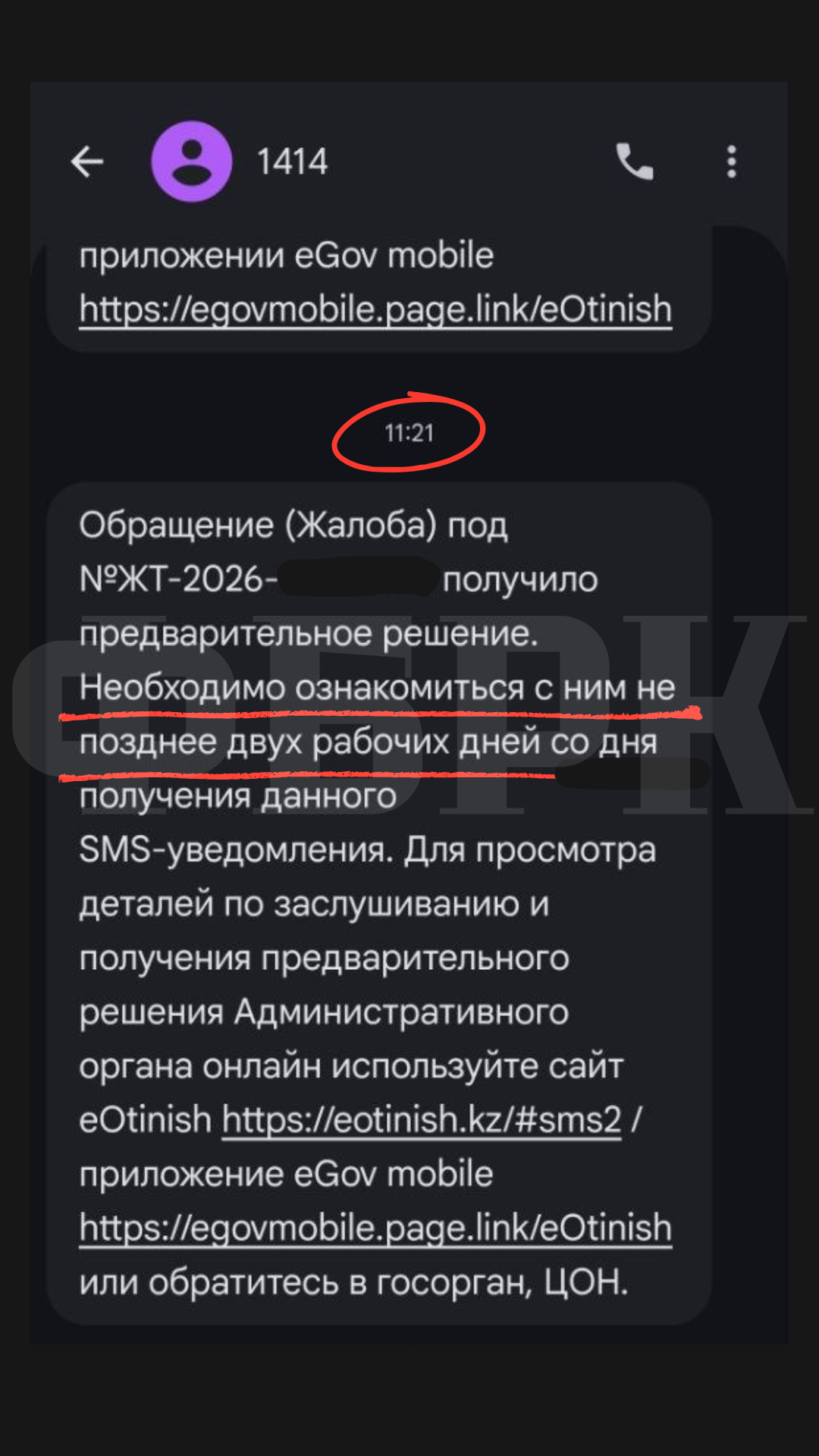
The journalist was unable to connect in time. Shortly afterwards, a record appeared on the portal stating that the hearing did not take place due to 'failure to join the video conference'. 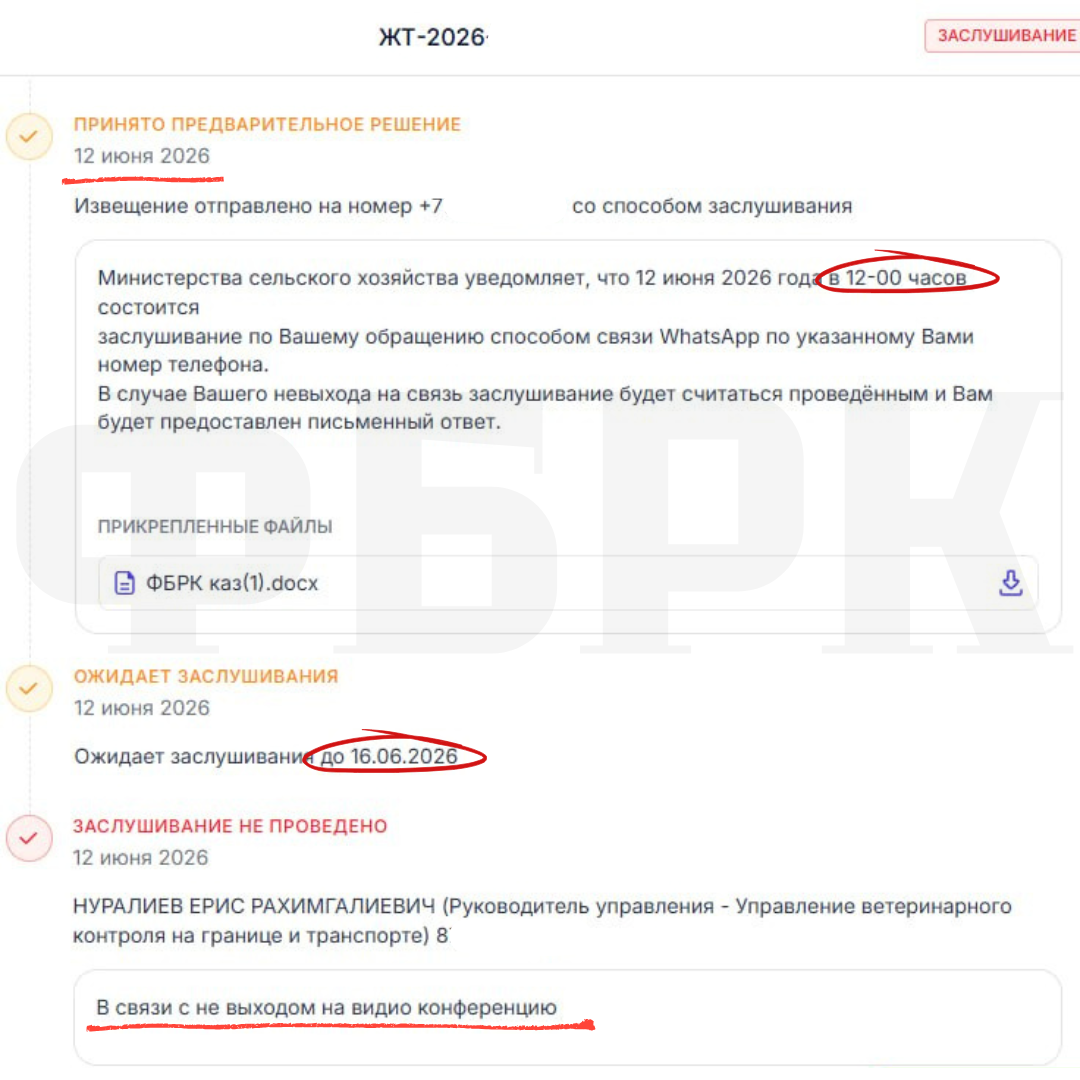
WHAT'S WRONG HERE
Need it be said that the purpose of the hearing procedure is precisely to allow the complainant to argue their position. According to the notification on the e-Otönüsh portal, the hearing was open until 16 June, meaning that the official responsible for it, head of the border and transport veterinary control department, Yeris Nuraliyev, still had two working days left. But instead, it was scheduled and closed on the same day. Why such haste?
Furthermore, the legislation permits hearings in written format - directly within the e-Otönüsh system, without a phone or video call. This option, it seems, was not used.
One gets the impression that the e-Otönüsh system in this case functioned not as a platform for dialogue, but as a tool for recording a formal outcome, convenient primarily for the department itself. Thirty-nine minutes is not an invitation to talk, but rather an ultimatum with a predetermined result. Only one thing is unclear: did the head of the department who signed this decision not know the legal norms, or did he know them all too well?
Returning to the refusal itself, it is worth emphasising once again that data on the import of live animals - dates of entry, border crossings, regions of destination - are generated in state information systems as part of veterinary and customs control. They are collected not in the interests of business, but in the interests of the country's epizootic safety. Article 28 of the Entrepreneurial Code, which the department cites, certainly does not empower state bodies to independently classify such data as commercial confidentiality; that is the prerogative of the business entity itself.
In the end, dialogue with state bodies, especially those that the FBRC has criticised more than once in its articles, increasingly resembles a lottery. You never know in advance whether you will receive a reasoned response on the merits or a neatly crafted formal reply that closes the matter on paper but does not resolve it in reality. The only difference is that in a lottery, at least the rules are announced honestly before the game begins.