
Recently, the committee of the Ministry of Transport of the Republic of Kazakhstan held a conference to discuss the flaws in the mechanism for issuing foreign permit forms (FPF). Despite loud promises, the problems still remain unresolved. This was written on his social media page by the owner of a transport company, Bolatbek Aliyev.
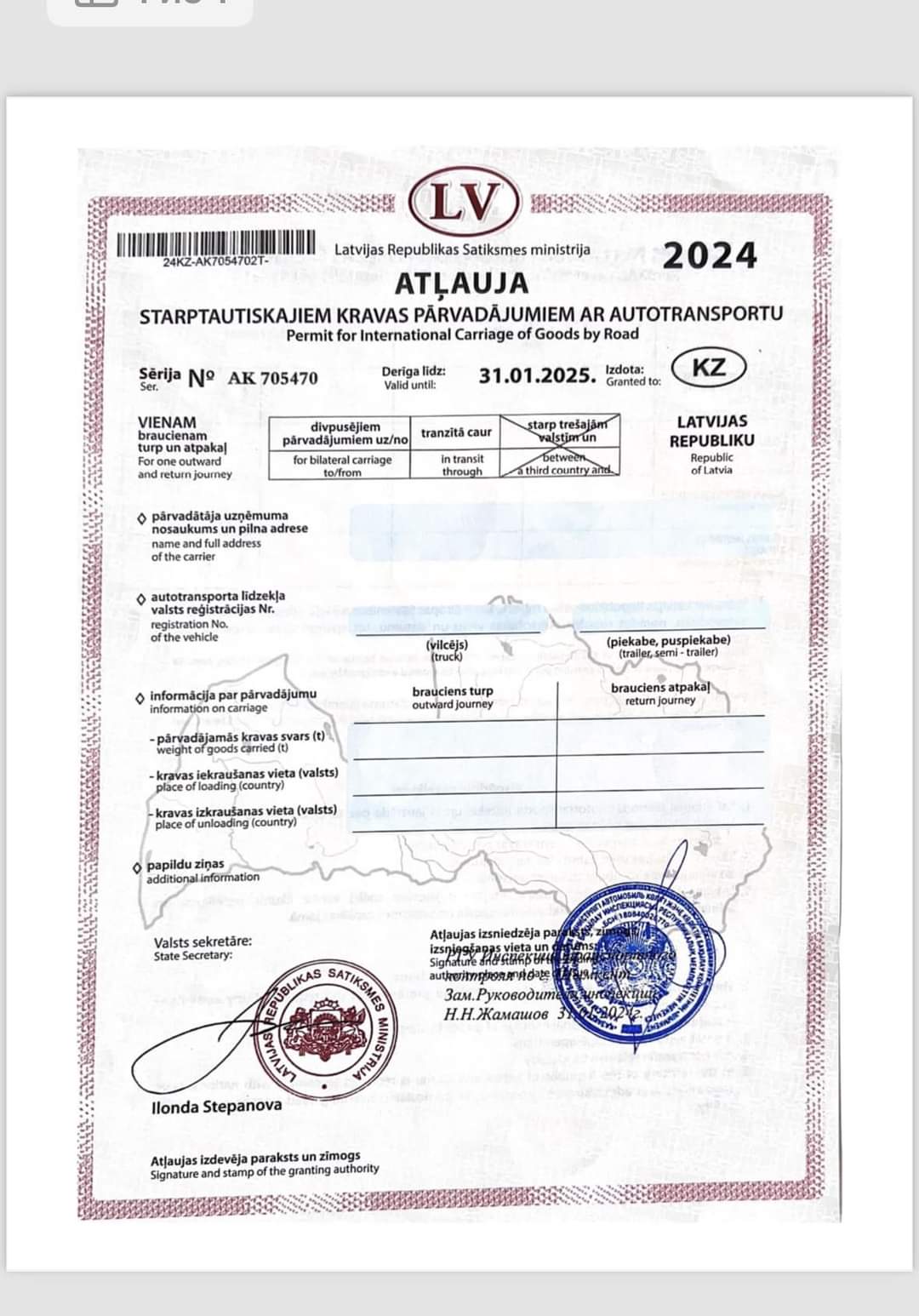
In January 2024, at an open meeting, the Committee for Road Transport and Transport Control (CRTTC) presented a project proposing to reform the distribution system for permit forms. Specifically, the discussion focused on eliminating the artificial shortage of forms and their illegal resale on the black market.
_____________
For reference: A Foreign Permit Form (FPF) grants the carrier the right to travel through the territory of a foreign state in accordance with international treaties ratified by the Republic of Kazakhstan.
According to the current distribution system, half of all forms at the beginning of the year are automatically allocated to the previous year's verified carriers, while the remaining portion goes into a reserve, which is subsequently distributed among other representatives of the transit business.
Carriers are given 100 days to use the form. If a carrier fails to do so, there is an option to return the FPF to the system.
Thus, at the start of the year there is usually a shortage of forms, but closer to December, the distribution system contains many unused permits, which are impossible to utilise by the end of the year.
Furthermore, the forms themselves do not specify either the vehicle number or the company name, which greatly facilitates illegal resale.
We have written about how such schemes work before. Resellers of foreign permit forms create groups of shell companies, registered in the names of close associates, in order to obtain as many FPFs as possible. The forms are later resold to carriers for $500–$1,000.
As early as 2022, transport company owner Bolatbek Aliyev raised the issue of problems with FPF issuance:
"The inspection showed that the transport inspectorate is artificially creating a shortage of forms, refusing to issue them to carrier companies that, for whatever reason, have ended up on a list of undesirable firms. Meanwhile, these forms do exist, even in abundance. They are then handed out to their own people, even if they do not own freight vehicles, who subsequently sell them on."
Today, despite numerous discussions and promises, nothing has changed in the transport sector.
"FPFs are still being issued using an illegitimate method, leading one to suspect a conspiracy at the highest level, based on a business of trading FPFs that allows huge sums of money to be made without doing anything except harming domestic carriers," wrote Bolatbek Aliyev on his page.