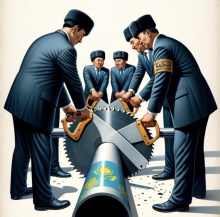
The media has put forward a theory as to why tenders in Kazakhstan's road construction sector are increasingly being awarded to foreign companies, which, in addition, guarantee neither adherence to deadlines nor the quality of work. Meanwhile, domestic companies are being left 'out in the cold'. It is assumed that the reason is a simple lack of government funds.
It is known that the Ministry of Transport oversees the construction and maintenance of national roads, as well as the conduct of tenders for these works. Experts note that in the road construction sector there is a rapid decline in the participation of domestic companies in the department's procurement and in the construction of national highways.
Ten years ago, Kazakh companies were actively participating in the Ministry of Transport's tenders and building the majority of national roads. But last year, for example, 13 companies took part in the competition for the project 'Reconstruction of the Kysylorda – Zhezkazgan highway, km 216-424', of which only 2 were domestic, and the rest were Chinese. A Chinese company was declared the winner.
Journalists suggest that this is linked to the transfer of tenders from public procurement to procurement by International Financial Institutions (IFIs). The Ministry of Transport increasingly cancels its own announced tenders due to a lack of funds. It is known that Kazakhstan is asking for money from the 'Eurasian Development Bank' to finance road projects.
Meanwhile, the high demands from the IFIs place domestic companies in a non-competitive position, as foreign companies have access to low-interest loans for business development.
It is also worth noting that the main criterion in public procurement is project quality, whereas participants in IFI procurement are selected based on the principle of offering the largest discounts. As a result, abnormal discounts (up to 50% of the contract value) become the key criterion for awarding the contract and, at the same time, a critical reason for subsequent work delays and contract termination.
After winning a tender, foreign companies recalculate prices considering the current market situation, and thereby recoup almost all of the discount amount. Kazakh road builders cannot afford such discounts because they are burdened with loans at higher interest rates.
They are also prohibited from reconsidering project costs. The Minister of Transport, Marat Karabayev, firmly reminded them of this in December 2023 at a meeting with road builders.
'I currently see attempts by some companies to again start a discussion about changing project costs. I want to tell you: only count on the amount you previously agreed to <…> Can't cope? Where you stopped, there you terminate (the contract). This applies to absolutely everyone. I'm telling everyone in advance', Karabayev stated.
The unequal conditions created leave domestic companies with no optimal choice for carrying out their activities and lead them either to bankruptcy or to working for foreigners as subcontractors at an even lower price.
Representatives of road construction companies believe that the Ministry of Transport, by favouring foreign companies in road construction, is not taking into account the past successful experience of domestic contractors.
As an example, they cite such large-scale projects as the 'Pavlodar – Semey' and 'Usharal – Dostyk' highways, the 'Astana – Borovoye' route, and the 'Western Europe – Western China' corridor, which were successfully completed by Kazakh companies.
Attention is also drawn to the fact that the involvement of foreign companies in the construction of Kazakh roads is no guarantee of work quality or timely completion of construction.
For example, the Chinese company 'CITIC Construction' is building the 'Karaganda – Balkhash' highway, missing deadlines. It is reported that the road is not yet finished, but experts have already identified defects. In 2022, Kassym-Jomart Tokayev criticised the progress of its construction.
'A Centre – South transport corridor is currently being created. The construction of the road passing through the city of Balkhash is going very slowly; deadlines have been postponed more than once. I instruct the government to complete the construction of the Karaganda – Balkhash and Balkhash – Burulbaytal highways next year', the head of state stated.
There are many examples of poor-quality road construction in Kazakhstan by foreign companies. In 2018, the Turkish construction company 'Tashyapy' won tenders for the construction of three sections of the 'Aktobe – Makat' road, offering discounts of 46% to 51% across the three lots. However, these contracts were subsequently terminated. The re-run competition was also won by a foreign company.
The year before, the Azerbaijani construction company 'Akkord' provided discounts of 42% and 41% in a tender for the construction of two sections of the 'Kurty – Burylbaitai' road. In 2021, the competition for the same sections was announced again.
Furthermore, there are instances of corruption crimes committed by foreign companies in road construction in Kazakhstan. In 2023, sources from the FBRK reported that the Azerbaijani company 'Evrascon' is suspected of receiving a bribe during the construction of a bridge in the North Kazakhstan region.
In 2021, it became known that 'Evrascon' won a tender for the construction of a road and bridge near Nur-Sultan worth 18 billion tenge. The client was the National Company 'Kazavtozhol'. However, it later emerged that some documents for winning the tender had been falsified.
Despite numerous negative examples of the activities of foreign suppliers, the Ministry of Transport continues to transfer tenders for the construction of national highways to the procurement of International Financial Organisations (IFOs).
A competition for the project 'Reconstruction of the Zhezkazgan – Karaganda highway' was announced twice, and withdrawn by the client on both occasions. Journalists suggest that the Ministry of Transport is artificially declaring the competition void in order to transfer it to IFO procurement. Ultimately, a foreign company will most likely win the competition.
Meanwhile, at a recent expanded government meeting held on 7 February 2024, Kassym-Jomart Tokayev instructed that domestic companies be involved in the construction of national highways.
'As the analysis shows, tenders for the construction of national highways are usually won by foreign companies. Domestic companies with appropriate qualifications and the necessary equipment should be involved in such projects. Road construction projects should be linked to the creation of road machinery production with a high degree of localisation', the head of state emphasised.
According to him, all work processes in this sector must be subordinated to one goal – Kazakh roads, whether national or local, must be of high quality. 'This is not yet being observed', the president noted.
One can only hope that the Ministry of Transport will review its approaches to road construction tenders in Kazakhstan in accordance with the President's instruction.