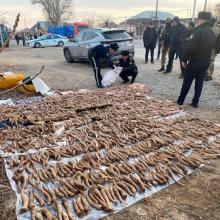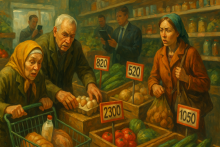
When the Minister of Ecology, Yerlan Nysanbayev, assured Kazakhs of the impeccable quality of saiga meat at the end of July, citing strict control “from habitat to shop counter”, few could have guessed how creatively various departments would interpret the concept of “strict control”. The replies to official inquiries from the FBRK editorial team sent to the relevant ministries paint a picture that resembles a game of Chinese whispers more than a system of state oversight for products from a rare animal.
Let us start with the simplest question: who can sell saiga meat, and where?
The Ministry of Trade and Integration, responsible for standards and trade, readily reported the existence of as many as two standards—for saiga carcasses and canned meat. That sounds impressive, were it not for one small detail: adherence to these standards is voluntary. Yes, you heard correctly—businesses can choose to follow quality requirements or ignore them entirely.
Even more intriguing was the list of potential saiga meat processors: Astana AgroProduct LLP, with debts exceeding 2 billion tenge; Arai KZ LLP, with debts of nearly half a billion and numerous property seizures. The logic is simple: if a company cannot pay its taxes, why not entrust it with processing saigas?
However, these companies have impressive connections. The head of Kubley LLP, Talgat Berekeshev, chairs the Supervisory Board of the Association of Meat Processing Enterprises, and behind the owner of Astana AgroProduct, Serik Rakhimbayev, stands his influential brother Aydin Rakhimbayev—Chairman of the Board of Directors of BI Group and one of the country’s wealthiest businessmen.
When asked about a register of retail outlets authorised to sell saiga meat, the Ministry of Trade delicately remained silent. Apparently, such a register simply does not exist. Nor does a system for tracing products from producer to consumer—this was also not mentioned in the reply. So, saiga meat could appear anywhere in the country, and no one really knows where it came from or whose hands it has passed through.
The Ministry of Ecology and Natural Resources, for its part, showed remarkable modesty by shifting responsibility for key stages of control to the Ministry of Agriculture. Studying the epizootic situation, overseeing primary carcass processing—apparently, none of this falls within their remit. It is just strange that Minister Nysanbayev forgot to mention this when he took personal responsibility for the quality of the product.
However, the Ministry of Ecology was eager to explain (for the hundredth time) the scale of the “culling”—it plans to remove up to 750,000 individual saigas. Yet, to process this number of animals, only 18 slaughter facilities with a total capacity of 3,710 head per day have been inspected. Even if all facilities operate at full capacity, it would take more than 200 days of continuous work. And that is assuming all inspected enterprises deal exclusively with saigas, forgetting about other products.
Particularly amusing against the backdrop of this “culling” is the statement that so-called “population regulation” is not commercial hunting. Apparently, the fact that the meat was supposed to go on sale at 1,600 tenge per kilogram through commercial enterprises is not considered commerce. Perhaps the ministry adheres to a special philosophy of business where trade has nothing to do with commerce. Incidentally, instead of the promised 1,600 tenge per kilogram, saiga meat can be found on the wholesale market for only 2,100 tenge per kilogram.
The list of organisations that received harvesting quotas remains a closely guarded secret. It is only stated that the work is carried out by RSEE Okhotzooprom, but who exactly, how many, and where they are harvesting is unavailable.
Incidentally, even before the official launch of the mass saiga culling campaign, Kazakhstan submitted an application to the CITES Secretariat seeking permission to export steppe antelope horns. In other words, the country asked for the zero quota on trade in saiga derivatives to be lifted. Coincidence? Unlikely.
After all, saiga horns are pure gold on the Asian markets for traditional medicine. In China, people are willing to pay thousands of dollars for them, attributing miraculous properties to them. And here is a remarkable coincidence: the state plans to remove hundreds of thousands of animals precisely at the moment it applies for legalisation of trade in the most valuable part of their bodies.
Incidentally, on 12 August, it became known that a court in the Baiterek district of the West Kazakhstan region found a local resident guilty of the illegal acquisition, storage, and transportation of saiga horns. The man illegally stored 291 saiga horns. The damage to the state amounted to 429,079,500 tenge. Now, let us turn back to the arithmetic. Divide the damage amount by the number of seized horns and we get a potential price per horn that could well reach 1.5 million tenge. And it is no wonder the state is so eagerly preparing for the “culling”.
Meanwhile, the scientific justification for such large-scale intervention in the population remains unavailable to the public. The departments cite either copyright or official secrecy, apparently unable to settle on a wording for the ban. One gets the impression that the data either does not exist at all or would not withstand scrutiny from independent experts.
In the end, the control system so praised by the Minister of Ecology exists more on paper than in reality. Voluntary standards, the absence of registers of retail outlets, blurred lines of responsibility between ministries—all of this resembles pretence of control rather than its actual implementation. With such volumes of culling and such a weak oversight system, talk of guarantees of product quality and safety can only be offered with a great deal of optimism.
Perhaps that is why Minister Nysanbayev took personal responsibility for the quality of saiga meat. After all, when the system does not work, only the personal guarantee of an official remains. True, history knows many examples of how such personal guarantees in the field of food safety end up. One can only hope that Kazakh consumers will not become unwitting participants in an experiment to test the effectiveness of ministerial promises.
Ultimately, this whole saiga affair is beginning to resemble a well-oiled scheme for legalising trade in valuable biological raw materials under the guise of concern for the population. Meat for the domestic market is a shop window demonstrating care for consumers. But the real money lies in the horns, which may soon become a legal export commodity. All that remains is to wait for the CITES decision and see how convincing the Kazakh “scientific justification” proves to be at the international level.
To be continued...