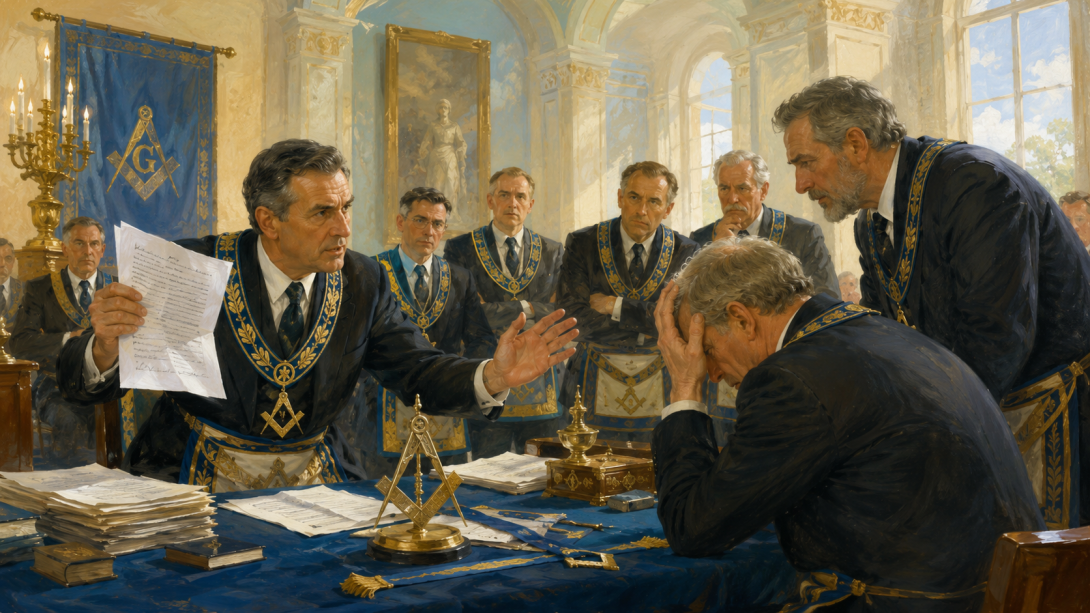
A scandal has erupted inside a Kazakhstani Masonic lodge: a former leader attempted to extend his term of office through a protocol signed by people who were not present at the meeting. The court declared the document invalid.
The current Grand Master of the Grand Lodge of Kazakhstan, Sergei Kravchenko, spoke about the incident in an interview with the founder of the FBRC, Kirill Pavlov. According to him, the former Grand Master, Aidar Alpysbayev, held the position legally, but was not re-elected after his term ended.
HOW THE CONFLICT AROSE
According to the Grand Lodge's internal constitution, a leader is entitled to hold office for two consecutive terms. When other candidates declared their interest in the position, Alpysbayev, according to Kravchenko, removed them from the electoral contest.
"Alpysbayev was the legal head of the PA, elected Grand Master, but at the end of his term he was not re-elected. Although under our internal 'Masonic' Constitution he had that right. But when other contenders put themselves forward, Aidar simply removed them from the electoral contest," Kravchenko explained.
WHAT EXACTLY WAS CONTESTED IN COURT
The Masonic lodge in Kazakhstan operates under the auspices of a registered public association (PA). The minutes of this PA's meeting - the document recording the extension of Alpysbayev's term - turned out to be signed by people who were not present at the meeting. In addition, the former leader attempted to take the PA's seal and charter.
The court sided with the organisation and declared the protocol invalid.
WHY THE POSITION OF GRAND MASTER IS NEEDED
Pavlov observed that Kravchenko struggled to articulate what real advantages the post confers: according to the current Grand Master, the role entails more in the way of unpaid travel expenses than privileges or levers of influence.
WHY 'WILD' LODGES ARE DANGEROUS
Such conflicts are nothing new in the history of Freemasonry, Pavlov recalls. The 'War of Diplomas' in France, the 'Great Schism' in England in 1751, and modern crises in France and Italy all follow a similar pattern: some brothers refuse to obey, courts get involved, and mutual exclusions from the order begin.
"Kazakhstani Freemasonry is cleansing itself. Such things have happened periodically all over the world. But in our order we are used to negotiating - no matter how unhappy you are with a brother's decision, you cannot coerce him. But you have the opportunity to come to an agreement. That is what Freemasonry is famous for; we have a certain 'General Regulation'. We cannot be gods, we are not perfect people, but just as ordinary as everyone else, and we can also make mistakes," Kravchenko said.
Such schisms often lead to the emergence of 'wild lodges' - structures not recognised by the official Masonic community. In global practice, such associations have often taken on the character of destructive movements, and their internal power struggles have been projected onto relations with the state.
According to available information, Alpysbayev is seeking support from foreign figures. A well-established rule operates within Masonic circles: a Mason is someone whom other Masons recognise as a Mason - losing legitimacy within the order effectively means losing one's membership.