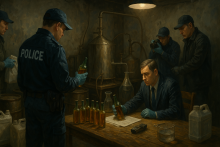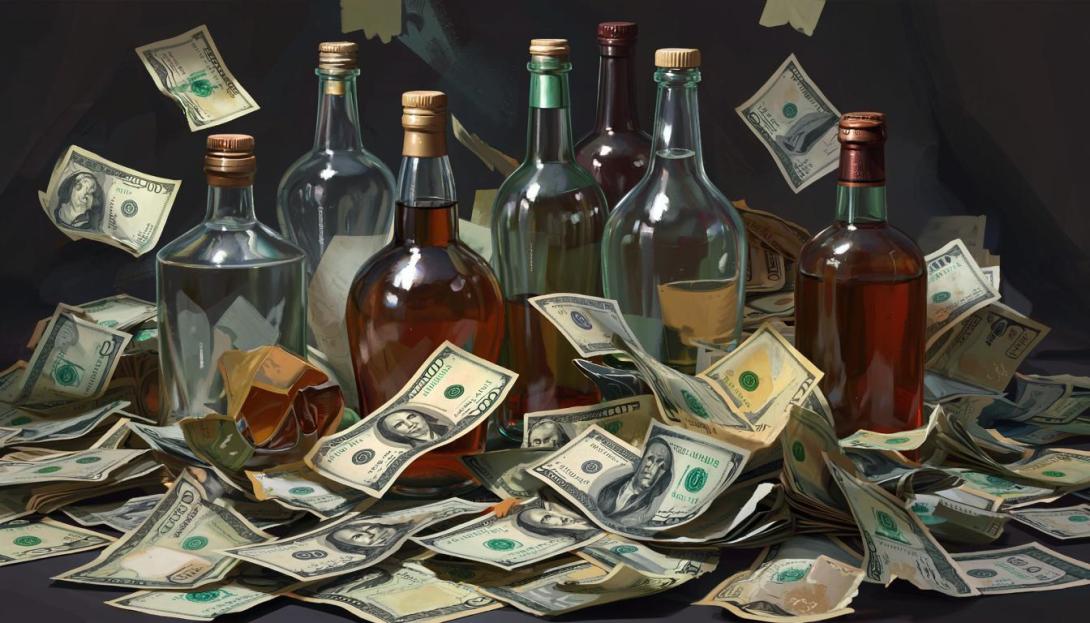
The Ministry of Internal Affairs (MIA) is proposing to ban online alcohol sales and allow trade only in specialist off-licences with a limited number of licences. Is this a fight against crime or a carve-up of a market worth 600 billion tenge?
The editorial team of FBRK decided to investigate who stands behind the largest alcohol retail chains and why all roads lead to a monopoly.
The Head of the MIA, Yerzhan Sadenov, during a government hour announced an initiative that likely took the breath away from some Kazakh businesses, while making others' eyes light up. The proposal is simple: ban online alcohol sales, allow trade only in specialist off-licences, limit the number of licences, and simultaneously review the opening hours of bars and clubs.
The MIA's argument appears statistically flawless. Every year, up to 10,000 crimes are committed while intoxicated. In entertainment venues alone this year, around 1,500 offences have been registered, including three murders. Impressive, isn't it?
However, our colleagues at Ratel drew attention to another, equally intriguing detail. According to the Prosecutor General's Office, the number of crimes committed while under the influence of alcohol is consistently decreasing. In 2022, from January to August, 5,353 such crimes were registered; in 2024, 4,841; and for the same period in 2025, only 4,267. In other words, the MIA is proposing to tighten control over a sector where there is already a sustained improvement in the situation.
Sadenov complains that current measures are not working: licences are obtained by front people, and night shops operate under the guise of cafes. This year alone, 7,000 violations have been prevented, fines exceeded 370 million tenge, and over 2,000 businesses lost their licences. But many obtained new ones the very next day, registered in the name of a friend, brother, or cook.
The picture is indeed bleak. But if the system cannot manage the control of existing licences, can it manage the control of a limited number?
We have been through similar experiments before. Licences for tobacco, transport, construction, grain export – every time a limited resource is distributed by a state body, a corrupt element appears. Not to mention the police raids to suppress illegal trade, which will inevitably flourish. The choice for those caught will probably be quite simple: a large fine to the budget, or a smaller one into the right pocket.
Now let's look at the figures. In 2024, the volume of retail alcohol sales amounted to almost 600 billion tenge. The pie is impressive, and if fewer players are dividing it, the slices become very appetising. It is much easier for a supermarket to section off part of its premises, enclose it with glass panels, and proudly hang an "Off-Licence" sign over the entrance, than it is for a small shop to meet the new requirements. Experts have already expressed fears that the new restrictions will lead to the creation of monopolists. But who are these potential monopolists?
The editorial team of FBRK decided to dig a little into the largest off-licence chains in Kazakhstan to find out exactly who might benefit from the proposed changes.
Let's start with Karaganda. The well-known chain "Volna" originates from there. Legally, it is Volna Trade LLP, run by Denis Demchenko, Alexander Fastishevsky, and Marina Fastishevskaya.
Another large chain is "AlmaWine", backed by an LLP of the same name. The management there is also family-run: Kairat Moldabayev and his son Abzal Moldabayev. Incidentally, Kairat Moldabayev also heads Inter-Pivo LLP and is involved in Aniri Group LLP, which engages in similar activities.
Among the former directors of Aniri Group was one Tleubek Sagimbayev. A person with the same name featured back in 2004 in a story about thefts in Karaganda – not as a suspect, but as an employee of the Sakhtinsk Department for Combating Organised Crime (UGCRO) – now the Department for Combating Organised Crime.
The well-known chain of alcohol shops, "Solod", prefers not to disclose its legal entity publicly, but there is a legal entity with a similar name – Solod Astana LLP. In 2021, this company merged with another legal entity – Altorgprom LLP. This Karaganda-based company is now managed by Ivan Gerus, who, besides the alcohol business, is involved in construction and, apparently, is connected to the Full House Men's Club.
If the coincidence of name, city, and title is to be believed, this club practiced gambling, which made it famous (does anyone know exactly how and thanks to whom such a business survives?).
Previously, Kaiyrzhan Kosherbayev was listed among the management of Solod Astana LLP, and the last director and founder was Zhanat Bazarbayev, who currently runs the Solod sole proprietorship.
The "Kosta" chain also hides its legal entity. There is a sole proprietorship of the same name in Kokshetau, matching the description of the activity, run by Askhat Azirkhanov. A similar situation exists with "Gradusy 24" – there is a company registered in Karaganda called "Gradus KST". Among its founders is Ramazan Tleuf, who in 2013 submitted documents to participate in the selection for the administrative civil service reserve of Corps A.
For those who don't know, Corps A was a special format of civil service for promising managers, which was effectively abolished in 2021 with the transition to a unified system. So, a person who once aimed for high state structures now, quite possibly, successfully trades in alcohol. A career trajectory, certainly, has a right to exist.
Political scientist Gaziz Abishev stated directly that such measures would lead not to a reduction in alcoholism, but to price increases, corruption, and pressure on small businesses. He argues that "the police are trying to shift responsibility onto small and medium-sized businesses. Let those who pay taxes so the police can work, pay twice – through the weakening of their own business." According to the expert, shops make a good markup on alcohol, and a significant portion of revenue comes from it. If they are banned from selling it, they will either have to close down or raise prices on other goods.
Colleagues at Ratel rightly point out: if we follow the MIA's logic (fewer points of sale means fewer drunks and fewer crimes), we could go even further. Ban glasses and corkscrews as accomplices to criminals. Impose a curfew on fridges. Require Kazakh citizens to take an alcohol test before going online to prevent drunken comments. Ban weddings, toasts, and Fridays.
The problem is that alcohol does not create poverty, unemployment, or depression. It accompanies or exacerbates them, if you will.
So what is really happening? A sincere fight against crime against a backdrop of declining statistics, or a carve-up of a market worth 600 billion tenge? Who really benefits from small shops leaving the market and being replaced by large chains? Is there a link between the management of the largest off-licences and the structures that will distribute the limited licences?
Perhaps the MIA's initiative is driven solely by concern for the nation's health. But the history of Kazakh state regulation teaches that every time the state starts generously handing out limited resources, someone always ends up closer to the trough. The only question is exactly who will come out on top this time, as the country decides to become a little more sober – or a little more monopolised.
To be continued…