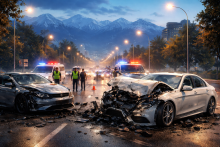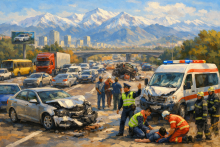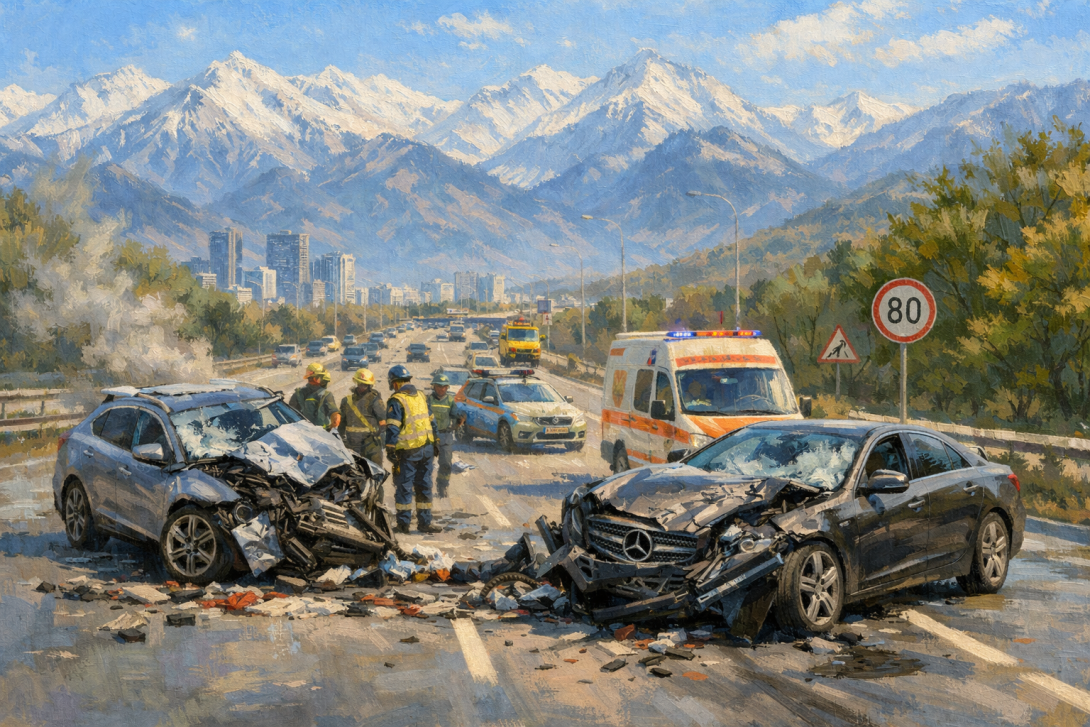
Tragedy on Al-Farabi Avenue in Almaty, which claimed the lives of three people, has once again raised the question of road safety in the city. Despite an overall decrease in road fatalities, the accident showed that systemic risks remain unresolved.
HOW THE SITUATION UNFOLDED
To recall, the high-profile road accident occurred on 21 March 2026 on Al-Farabi Avenue. An electric car, a Zeekr, drove into the oncoming lane and collided with a Mercedes. As a result, three people died, including two female passengers.
The driver of the Zeekr survived, was detained, and is the subject of a criminal case. According to the investigation, he faces up to 10 years in prison. Police reports state he was under the influence of alcohol, and the possibility of speeding is also being considered. Information about a potential illegal street race is being checked.
ROAD FATALITY STATISTICS IN ALMATY
According to the Committee on Legal Statistics and Special Records of the Prosecutor General's Office of the Republic of Kazakhstan, road traffic accident fatalities in Almaty have decreased significantly in recent years.
In 2025, a historic low of 73 deaths was recorded. For comparison, in 2019, this figure was 161 people.
The rate of decline in Almaty outpaces the national average: across Kazakhstan, the mortality rate per 100,000 population decreased by 17%, whereas the reduction in the city is faster.
WHY THE ACCIDENT CAUSED SUCH A STIR
The case provoked a wide public reaction because it occurred against the backdrop of falling road fatalities. This heightened the contrast between the statistical improvement in the situation and the severity of this specific tragedy.
Since January 2020, Almaty has implemented violation recording systems, including 'Sergek' complexes, as well as intelligent intersections and changes to speed limits. These measures have helped reduce the number of fatal accidents, but they do not eliminate the risks associated with driver behaviour and the characteristics of the urban environment.
WHAT SYSTEMIC PROBLEMS THE ACCIDENT EXPOSED
Infrastructure. According to Vision Zero road safety standards, at speeds above 50 km/h, opposing traffic flows must be separated by a physical barrier. In this case, a car was able to cross into the oncoming lane, indicating a vulnerability in the road environment.
Vehicle characteristics. Modern electric cars, such as the Zeekr and LiXiang, have high performance and significant mass (around 3 tonnes). Combined with violations, this increases the severity of accident consequences.
The impunity factor. According to eyewitness reports, a race may have preceded the accident. While cameras record violations, they do not physically prevent them, leaving room for dangerous behaviour on the roads.
EXPERT VIEW
The head of the Vision Zero Community foundation, Yerkanat Zaitov, believes that the very structure of the avenue initially creates risks:
"Al-Farabi is effectively a high-speed motorway within the city, and this creates a key conflict: the road 'provokes' you to drive fast, but cannot handle the consequences of such driving. In the logic of Vision Zero, this means the environment remains hazardous."
CONTEXT AND SIGNIFICANCE
Despite the decline in fatalities, this accident shows that the achieved figures do not mean risks have been eliminated. Without physically changing the urban environment, technological solutions remain limited in their effectiveness.
In the wake of public outcry, the police have tightened controls on road safety, and internal investigations have been launched. The situation has become a reason to discuss driving culture, the inevitability of punishment, and the transparency of investigations.