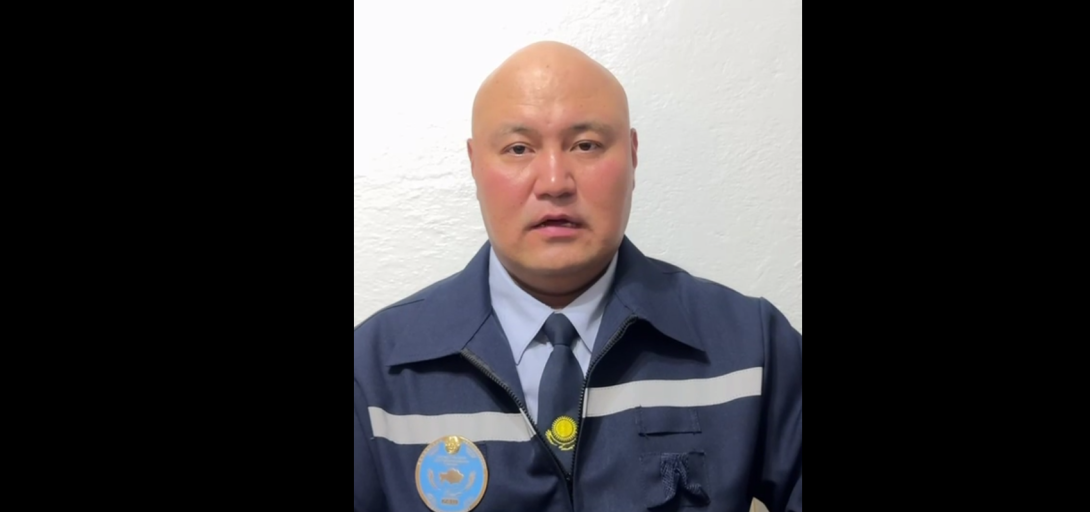
The chief specialist of the Zhambyl Regional Transport Control Inspectorate, Nursultan Bulatbekov, has accused the department's leadership of organising large-scale corruption schemes amounting to over 50 million tenge per year.
A specialist's statement was submitted to the FBRK anonymous bot, detailing a system of extortion and protection rackets that has been operating in the inspectorate for several years. Notably, back in April 2025, the Prosecutor General's Office had already identified widespread violations of the law within this same department, which indirectly supports Bulatbekov's accusations.
On 1 April 2025, a court sentenced the former acting head of the inspectorate, Daulet Kemelov, to 6 years in prison for accepting bribes ranging from 100,000 to 450,000 tenge from lorry owners.
However, corrupt practices within the department continued. As our editorial team has learned, on 3 April, the department of the Committee on Legal Statistics and Special Records of the Prosecutor General's Office completed an audit of the Zhambyl Transport Inspectorate's activities.
The results revealed a further series of systemic violations: exceeding authority when imposing fines over 20 MRP (78,640 tenge), cases being reviewed by unauthorised persons, ignoring repeat offences, and breaching administrative proceedings deadlines.
Eight employees of the inspectorate have come under suspicion. The audit uncovered violations involving several large companies, including M-Nefteservis LLP and other enterprises.
Several months after the official audit, Bulatbekov decided to make a public exposé. In his appeal, sent to the highest authorities, he accused the current acting head of the inspectorate, Yerlan Yermekbayev, the head of the control department, Yerbol Kulymbet, and the chief specialist, Mukhit Suyunbayev, of creating a corruption scheme.
According to the whistleblower, employees have set fixed 'tariffs' for freight vehicles travelling through the Zhambyl region: 2,000 tenge for a lorry without a trailer, 5,000 tenge with a trailer, 10,000 tenge for an articulated lorry, 30,000 tenge for a low-loader, and up to 100,000 tenge for oversized loads.
A scheme involving monthly 'reports' to law enforcement agencies was detailed specifically. According to the appeal, the organised crime unit received 300,000 tenge, the National Security Committee and the Transport Prosecutor's Office received 500,000 tenge each, the anti-corruption service received 1 million tenge, and the inspectorate's leadership received 2 million tenge. The total sum amounted to 4.3 million tenge per month.
Bulatbekov claims that the scheme's organiser was Mukhit Suyunbayev, who collected the so-called 'kitty' under the pseudonym 'Stroyka' (Construction Site). Specialists who refused to participate in the extortion were subjected to psychological pressure, including the threat of dismissal.
According to information from FBRK sources, Yerbol Kulymbet may be the brother of Altay Ali, who holds the position of Chairman of the Transport Committee of the Ministry of Industry and Infrastructural Development of the Republic of Kazakhstan. It is also reported that Mukhit Suyunbayev acted as Kulymbet's accomplice in organising the corruption schemes.
Bulatbekov submitted his statement on 18 July this year, but no action has yet been taken. In his appeal, the specialist notes that he is under pressure for refusing to participate in the corruption schemes and warns that the leadership may take steps to have him dismissed and to 'blacken his name'. He has also threatened to appeal to the President of Kazakhstan via social media if his statement is not acted upon.
Following the April audit, the prosecutor's office demanded disciplinary action against those responsible, additional staff training, and strengthened oversight of legal compliance. However, experts note that the measures are disproportionate to the scale of the violations uncovered.
Bulatbekov's statement contains detailed accusations with specific sums and participants, including representatives of law enforcement agencies. Meanwhile, the authorities' response has been limited to disciplinary measures, raising questions about the readiness of state bodies to genuinely combat corruption within their own ranks.