
After a series of calls from journalists regarding the company's statement «Sunkar Eavision International LLP» the police initiated administrative proceedings against the founder of the FBRC Kirill Pavlov under Part 4 of Article 456-2 of the Code of Administrative Offences of the Republic of Kazakhstan. The local police inspector sends notifications via WhatsApp half an hour before the appointed time and threatens to send the case to court if he fails to appear, which raises questions about compliance with official procedures.
It will be recalled that previously the company accused the editor-in-chief of the FBRC of spreading false information for publishing that the firm had offered drones at 7.1 million tenge, but concluded a contract at 8 million per unit. This information is fully confirmed by official documents from the public procurement portal.
After the initial appeal, the editor-in-chief provided written explanations requesting that complaints be directed to the media outlet's editorial office, rather than to an individual. The founder of the FBRC, Kirill Pavlov, was then summoned to the station, where he clarified the situation.
However, on 5 October the editor-in-chief received a new message from the police station of the Yesil District of Astana. The local inspector Arman Sagadildayevich Baidildayev demanded their presence to give explanations, even though all documents had already been provided and the case (apparently) had been transferred to the editorial office.
The method of notification caused surprise. Instead of an official summons, the local inspector sent a message via WhatsApp one hour before the appointed time, on a Sunday.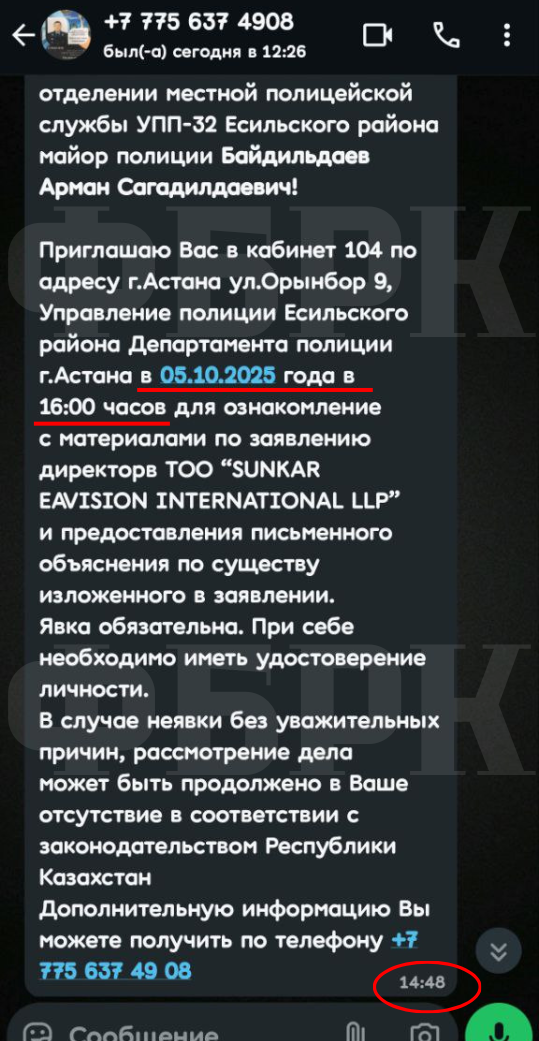
On Monday, 6 October, the situation repeated itself with the founder of the FBRC Kirill Pavlov. The local inspector sent a message demanding attendance for explanations, warning that in the event of non-attendance, the case would be sent to court. The notification arrived half an hour before the specified time.
The message does not explain the nature of the new allegations. When Pavlov tried to contact the local inspector by phone to clarify details, he did not answer the calls. All communication takes place exclusively through the messaging app.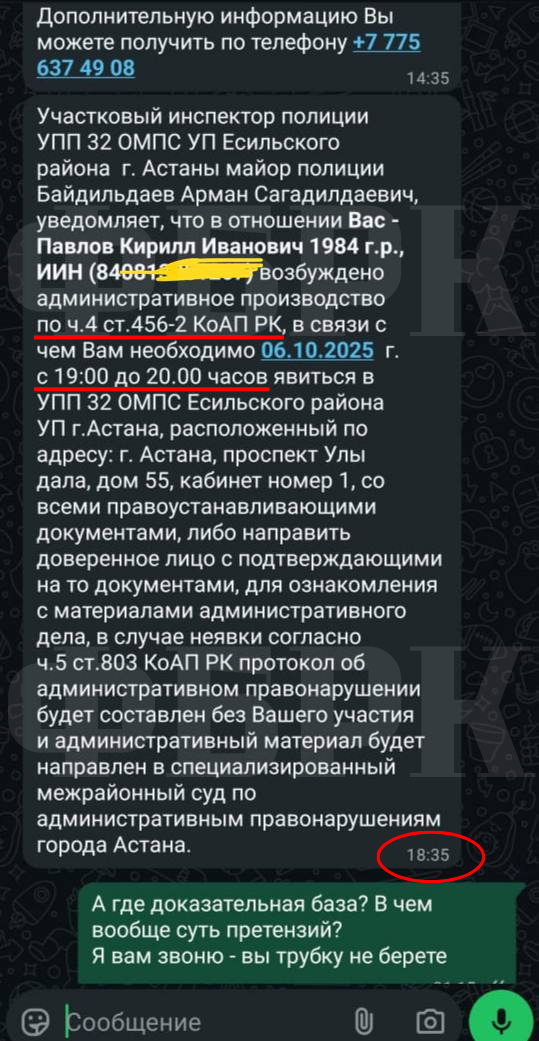
Such practices raise questions about the correctness of the procedures. If the case has been transferred to the editorial office, why continue to summon the editor-in-chief as a private individual?
Last-minute notifications via unofficial channels also appear unlikely to comply with standard procedures. Official summonses are usually sent well in advance through established communication channels.
It gives the impression of targeted pressure on the editorial office. First, a complaint is filed against an individual instead of the media outlet; then the case is formally transferred to the editorial office, but the journalists continue to be pursued as private individuals.
It appears that someone is using law enforcement agencies to put pressure on the media for covering public procurement. The founder of the FBRC intends to appeal the initiation of administrative proceedings, insisting on the application of the correct part of the article for publications in registered media.