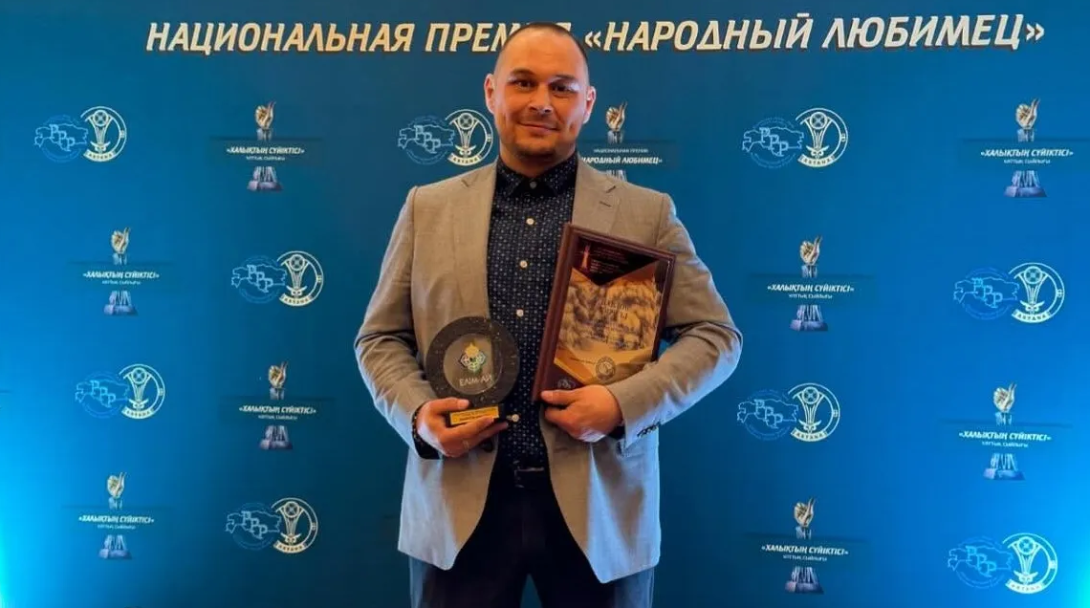
The Capital Court found the founder of FBRK and author of the Telegram channel ‘Kazakh Chuvash’ Kirill Pavlov guilty of spreading false information on social media. On 5 June, he was fined 78,640 tenge (20 MCI) under Article 456-2, part 3 of the Administrative Code of the Republic of Kazakhstan for a publication about the scale of the locust infestation in Kazakhstan.
The administrative case was opened at the end of May after the Ministry of Agriculture took the agricultural expert to court. The ministry accused Pavlov of spreading false information about the locust infestation on farmers' fields and the state's control methods for pests.
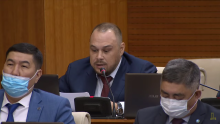
At the court hearing on 4 June, representatives of the Ministry of Agriculture tried to ascertain the blogger's sources of information and his competence in matters of agro-industrial infrastructure. The ministry's lawyer actively questioned Pavlov about whether he was an accredited specialist to cover the topic of locusts.
During the proceedings, disagreements arose over terminology. As Pavlov himself noted, it concerned the difference between the area of distribution of locusts, the area of infestation, and the area of treatment. According to him, he wrote specifically about the area of distribution — the territory where locusts could appear, but the ministry disagreed with this interpretation.
Particular attention in court was paid to discrepancies in statistical data. According to the Food and Agriculture Organization of the United Nations (FAO), the area infested by locusts in Kazakhstan last year exceeded 11 million hectares, whereas according to the Ministry of Agriculture, this figure was 2.5 million hectares.
During the hearing, the ministry's lawyer initially called the FAO ‘an incomprehensible foreign company without a licence’, but later one of the ministry's representatives acknowledged this organisation as an authoritative international structure under the UN, with which Kazakhstan actively cooperates.
Pavlov stated that his analytical materials were based exclusively on official data from the Ministry of Agriculture itself. He expressed surprise at the attention of law enforcement agencies towards authors of publications about locusts and noted that the ministry would have to justify the objectivity of its data.
During the court process, questions related to the expert's international cooperation were also raised. Ministry representatives raised objections regarding his work with American partners, which, in their opinion, could pose a threat to the country's information security.
The case of Kirill Pavlov has become another example of the application of Article 456-2 of the Administrative Code of the Republic of Kazakhstan on the spread of false information online. This provision was introduced to combat false information on social media, but its application often sparks debates about the boundaries of free speech and the right to criticise state bodies.
After the verdict, the founder of FBRK commented on the situation, calling the fine ‘a shot in the foot for the expert community’. In his opinion, a dangerous precedent has been set that could deter analysts from making forecasts and critically analysing official statistics. The expert noted systematic discrepancies between official data and reality in various areas — from grain yields to inflation figures.
The case raises important questions about the boundaries of applying false information legislation — can publications by an expert who relies on data from international organisations and official state statistics be considered the dissemination of false information?
The case highlights the relevance of issues surrounding the transparency of state statistics and the right of citizens to receive reliable information about the situation in agriculture.