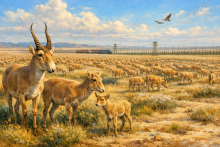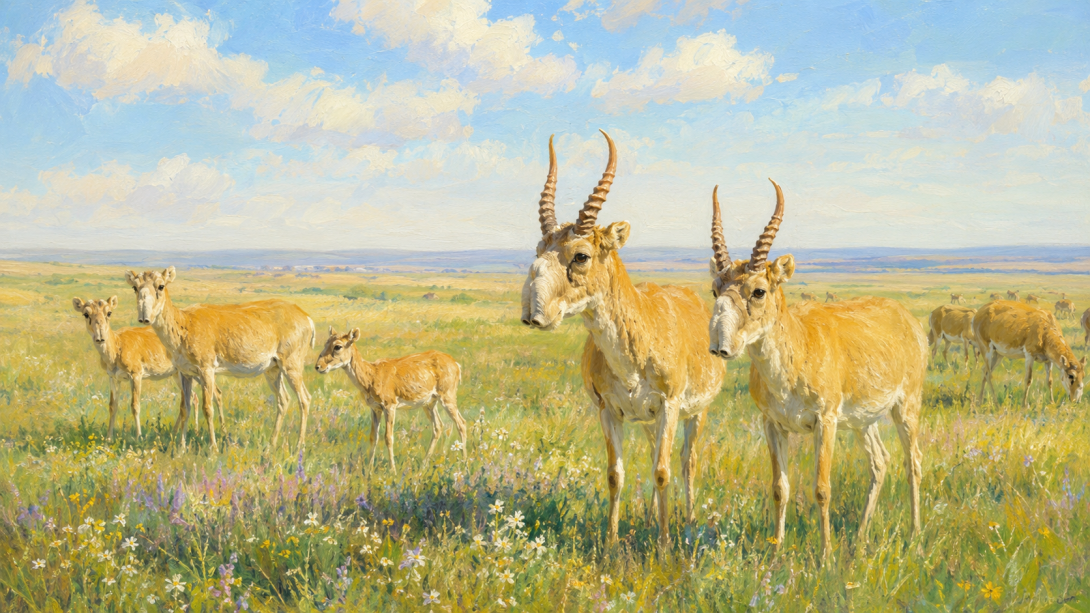
The population of rare ungulates and saigas in Kazakhstan is increasing every year. According to census data for 2025, the country was home to 3.978 million saigas, as well as thousands of goitered gazelles, kulan, argali and Bukhara deer.
POPULATION OF RARE ANIMALS
According to the Project Office for Central Asia on Climate Change and Green Energy, in 2025 the population of the Bukhara deer stood at 1,240 individuals, the goitered gazelle at 16,122, the kulan at 4,702, and the argali at 17,604.
Saigas are counted separately. The total population of all saiga populations stood at 3.978 million individuals. In the Urals region, 2.3 million were counted, in Betpakdala — 1.6 million, and on the Ustyurt plateau — 78 thousand.
WHAT MEASURES ARE BEING TAKEN TO RESTORE POPULATIONS
It has been reported that the Ministry of Ecology and Natural Resources is carrying out systematic work on the reintroduction of wild animals. As part of restoring the kulan population, 66 individuals were relocated to the Ile-Balkhash and Altyn Dala reserves: 42 to the former and 24 to the latter.
The Wild Ungulate Reintroduction Centre, established in 2017 in the south of Kostanay Region within the Altyn Dala State Nature Reserve, currently holds 14 Przewalski's horses — 12 mares and 2 stallions. By the end of 2029, a further 40 horses are planned to be brought there.
WHICH SPECIES ARE BEING RESTORED
As of 2025, the population of the little bustard stood at 16,487 individuals. Of these, 2,455 are in the Kenderli-Kayasanskaya protected zone, 6,146 in South Kazakhstan, 1,922 in the Arys-Karatau zone, 1,985 in the Zhusandaly zone, 470 in the Aktau-Buzachi Nature Sanctuary, and 3,491 in the Andasai Nature Sanctuary.
Kazakhstan is also implementing a programme to return the Turanian tiger, which disappeared in the mid-20th century, to the wild. To restore the population, Amur tigers are being used, as they are genetically the closest to the Turanian subspecies.
The main site for this work is the Ile-Balkhash State Nature Reserve in the south of the Balkhash region. In August 2026, the first female Amur tiger, named Ümit, was released here into the wild. Prior to this, kulan, goitered gazelles and wild boar had been brought into the reserve to build up the food supply.
HOW MANY RARE SPECIES LIVE IN KAZAKHSTAN
Kazakhstan is home to 835 species of vertebrates: 178 species of mammals, 489 birds, 49 reptiles, 12 amphibians, 104 aquatic animals and 3 cyclostomes. Of the birds, 396 species nest in the country, while the rest arrive for wintering or pass through during spring and autumn migrations.
Rare and endangered species include 132 species and subspecies of vertebrates and 96 species of invertebrates. At the same time, the country is estimated to have around 100 thousand species of invertebrates, including at least 50 thousand species of insects.
CONTEXT
In 2023–2024, saiga population regulation was carried out in Kazakhstan. From October 2023, the state enterprise Okhotzooprom removed 43,503 individuals. Against this backdrop, questions arose about the fate of the removed animals: of the 1,132 carcasses delivered to one enterprise, 734 were sent for canned food production, while 398 were deemed unfit and disposed of. At the same time, full information about the fate of all removed saigas was lacking.
In 2025, in the West Kazakhstan Region (WKR), with a declared population of 2.3 million saigas, authorities planned to remove 460 thousand individuals, or 20% of the population. At the same time, reports emerged of more than 5.2 thousand dead saigas, which the Ministry of Ecology attributed to natural mortality.
In spring 2026, reports of saiga deaths came in from several regions of Kazakhstan. At the same time, questions arose about possible infectious diseases. Meanwhile, Deputy Minister of Agriculture Amangali Berdalin stated that there were no registered cases of foot-and-mouth disease among livestock or wild animals in Kazakhstan. According to the Ministry of Ecology, by May, around 26 thousand saigas had died across the country, of which around 11 thousand were in the WKR.
While officials could not determine what exactly was killing the animals, farm owners were in effect forced to deal with the consequences themselves.