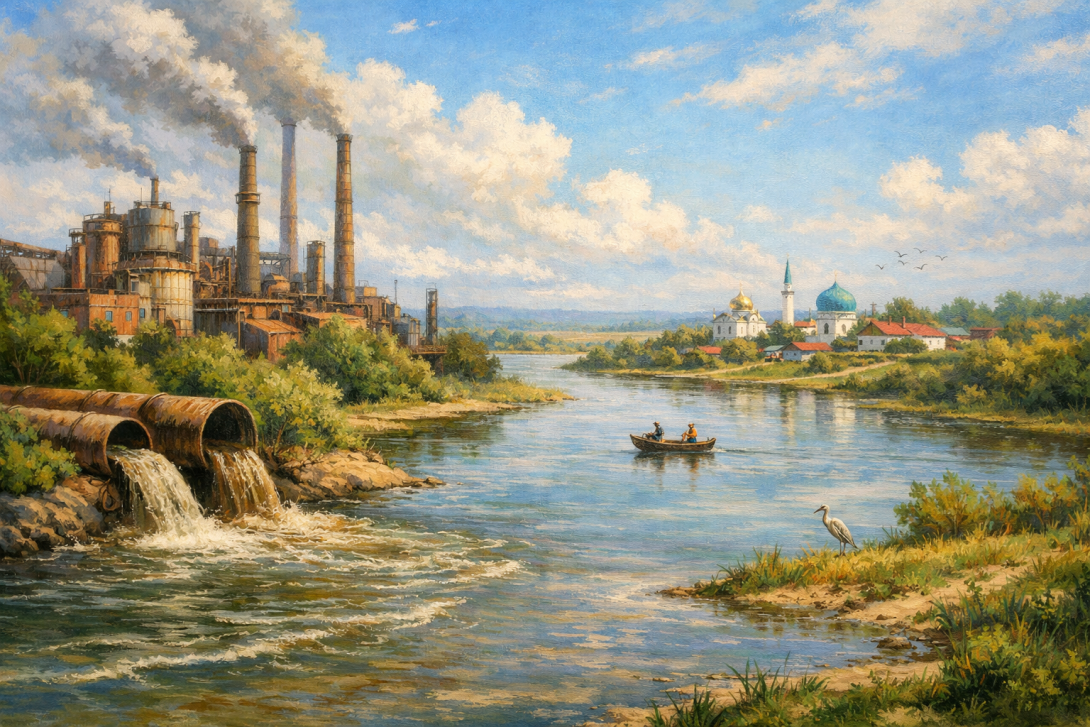
Russian enterprises have been discharging polluted wastewater into the Ural River upstream from Kazakhstan for years, and it is only now that the prosecutor's office has taken action. For residents of the West Kazakhstan Region (WKR), living further downstream along the same river, this news is particularly significant, as everything that enters the water in Orsk inevitably reaches them too.
WHAT THE PROSECUTOR'S OFFICE FOUND
The Orsk Interdistrict Environmental Prosecutor's Office established that in the first half of 2025, enterprises in the Russian cities of Orsk and Novotroitsk systematically exceeded the maximum permissible concentrations of pollutants when discharging wastewater into the Ural. Furthermore, according to the supervisory authority, none of the enterprises conducted an impact assessment of their activities on aquatic biological resources.
The environmental prosecutor filed lawsuits against the economic entities. The court granted all the claims — the enterprises are obliged to carry out environmental protection measures. As emphasised by the regional prosecutor's office, the implementation of the decisions is under the supervision of the oversight body. The specific names of the companies and the list of prescribed measures have not been disclosed.
WHY THIS MATTERS FOR KAZAKHSTAN
The Ural is a transboundary river. Approximately 70% of its flow is formed on Russian territory. Orsk and Novotroitsk, major industrial centres of the Orenburg Region, are located upstream relative to the WKR. This means that any exceedance of standards in these cities directly affects the water quality that reaches the Kazakhstani part of the river.
According to official information obtained by the FBRK editorial office in 2025, the Ministry of Ecology and Natural Resources of Kazakhstan conducts hydrochemical monitoring of the Ural at 17 monitoring points in the WKR and Atyrau Region using 43 parameters. However, it is unclear how quickly this system responds to pollution originating upstream in the territory of another state.
A RIVER LONG UNPROTECTED
The story of the Orsk enterprises is just part of a larger picture. Last year, FBRK spent several months actively reporting on what is happening to the Ural on the Kazakhstani side. We found out that over 640,000 sq.m of coastal areas were leased out on a long-term basis to private companies for the extraction of sand and gravel mixture — even though the state is simultaneously spending funds on restoring the river's ecosystem. Responsibility for the overall condition of the water body is meanwhile fragmented across several agencies, each responsible for its own narrow section.
A similar logic, where officials and regulatory bodies formally do not break the law but collectively allow an environmental catastrophe, is also evident in the story of the Bukharka River in the Ural delta. Last year, our editorial team told how this channel, which had provided floodwater drainage into the Caspian Sea for three centuries, has effectively disappeared as a result of road construction across its bed, the allocation of land plots in the floodplain, and years of inaction by the authorities.
A QUESTION LEFT UNANSWERED
The Russian prosecutor's office did what it was supposed to do, namely, it recorded the violations and secured court rulings. But what about the water that already entered the river before the cases were opened?
Against the backdrop of industrial pressure from the Russian side and documented problems with extraction and construction on the Kazakhstani bank, the question of the WKR's readiness to respond to pollution of the Ural remains open.