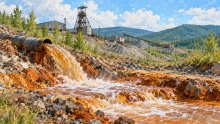
More than 500 houses in the Chistye Prudy district of the town of Kosshy have ended up next to the site of burial of animals that died of anthrax. Now the prosecutor's office of Akmola Region has asked for the legal status of this territory to be reviewed. It emerged that previous resolutions establishing sanitary protection zones had been revoked, and no new act by the authorised body had ever appeared.
WHAT WAS DISCOVERED IN THE CHISTYE PRUDY DISTRICT
According to the Kazinform news agency, the prosecutor's office of Akmola Region sent a letter to the regional akimat and the department of sanitary and epidemiological control asking them to consider the legal status of the territory.
According to information from the veterinary department, two sites linked to cases of animal anthrax have been registered in the area of the Chistye Prudy recreation zone in the town of Kosshy and the village of Taitobe.
The first is located in Taitobe and dates back to 1971. The presence of the pathogen was confirmed in the laboratory. The site is concreted, enclosed by a two-metre-high wall, equipped with a warning sign and is on the books of the veterinary station.
The second site is linked to an event in 1986. It is located directly in Kosshy, not far from the Sarkyrama river and the Chistye Prudy recreation zone.
WHY THE SANITARY PROTECTION ZONE WAS LEFT WITHOUT A NEW ACT
As it turned out, sanitary protection zones had indeed previously been established around anthrax livestock burial sites. The corresponding resolutions of the akimat of Tselinograd district were adopted on 30 November 2010 and 23 December 2014.
However, they were subsequently revoked following protests by the district prosecutor's office. The reason was that the local executive body lacked the authority to establish such zones. After the resolutions were revoked, no separate act by the authorised body on this matter was ever adopted.
At the same time, according to the sanitary rules previously cited by the veterinary department, livestock burial sites containing anthrax burials are classified as hazard class I, and the standard sanitary protection zone is 1000 metres.
Back in September, the FBRK reported that the 1986 burial site is located just 25 metres from the Sarkyrama river and 40–50 metres from residential buildings. Part of the new development falls within the standard sanitary protection zone.
WHAT SOIL TESTS SHOWED
There is also laboratory research data. Between 2021 and 2026, 28 soil samples were taken from the territory. According to the test results, no anthrax pathogen was found in them.
The department of sanitary and epidemiological control of Akmola Region said it is currently working on the prosecutor's office's request. At the same time, some of the issues raised fall within the department's own remit.
However, negative test results for individual samples and the legal status of the territory are different matters. The absence of the pathogen in 28 tested samples does not in itself replace a decision on the boundaries and legal formalisation of the sanitary protection zone.
WHY KAZAKHSTAN STILL HAS NO MAP OF BURIAL SITES
The story in Kosshy once again returns to a question the FBRK has raised repeatedly: why can citizens not check for themselves where dangerous burial sites are located?
The editorial team previously established that the ministry of agriculture (MoA) does not provide information on the location of such sites, citing the "For official use" (FOU) classification. At the same time, the agency promised a public map of livestock burial sites back in 2016.
The FBRK examined this story in detail in a special episode on YouTube, where it also reported on the situation in Balkhash and the absence of a publicly accessible map of dangerous sites.
Instead of a state map, the Pavlov Analytical Centre compiled its own map of anthrax outbreaks based on the National Atlas "Anthrax Outbreaks" for 1948–2004. It marked 625 locations with a positioning error of 2–4 kilometres.
The MoA later explained its refusal to publish the state map by the risk of unlawful use of the information. According to Vice-Minister Azat Sultanov, the necessary information is held by the relevant state bodies, and around 2,000 burial sites have been repaired. But there is still no open map.