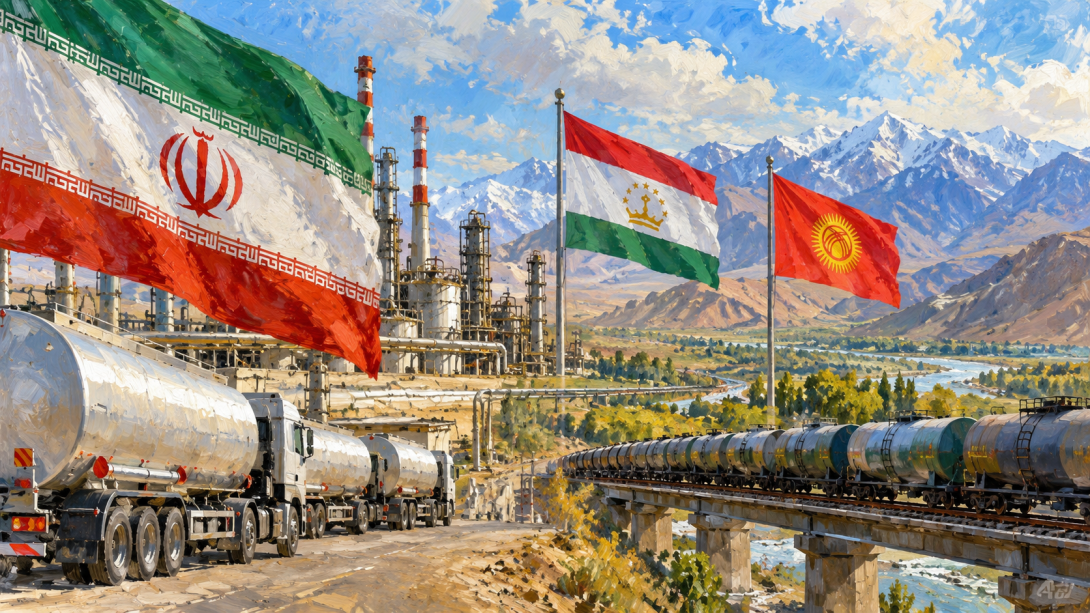
Tajikistan has begun receiving oil and petroleum products from Iran amid disruptions to Russian supplies, while Kyrgyzstan has agreed to a proposal to create a joint oil refinery. For Tehran, this opens up an additional sales market, but the volumes of Central Asia are not capable of replacing the main destinations of Iranian oil exports.
WHICH COUNTRIES FACED A SHORTAGE
According to Al Jazeera, Tajikistan announced in August supplies of oil and petroleum products from Iran. The country traditionally received up to 80% of its petroleum products from Russia, so disruptions to Russian fuel created a need to seek alternative sources.
Kyrgyzstan also depends on imports of petroleum products: the country receives more than 90% of its petrol from Russia. In August, Iranian President Masoud Pezeshkian supported the proposal to create a joint refinery in Kyrgyzstan and stated that Iran could supply the crude oil needed for the facility.
Kazakhstan has three large Soviet-era oil refineries, but fuel prices in the country have risen by 15.6% since the start of 2026. Uzbekistan depends to a lesser extent on Russian supplies and is simultaneously diversifying its imports.
WHY RUSSIAN SUPPLIES DECLINED
The fuel shortage in Russia is linked to Ukrainian drone strikes on oil refining infrastructure. According to an estimate cited by Al Jazeera, the attacks disabled between a quarter and half of Russia's total oil refining capacity.
Against this backdrop, Russia introduced restrictions on fuel sales, had previously banned the export of petrol and aviation kerosene, and is also considering restrictions on the export of diesel fuel. These circumstances affected the countries of Central Asia dependent on Russian supplies.
HOW IRAN SUPPLIES OIL TO THE REGION
Iran shares no border with either Tajikistan or Kyrgyzstan. According to Frederic Schneider, a senior research fellow at the Middle East Council on Global Affairs, Iranian oil and petroleum products destined for Tajikistan must transit through Turkmenistan and Uzbekistan by rail. A similar route will be required for supplies to Kyrgyzstan.
Tajikistan expects to receive 2.55 million tonnes of oil and petroleum products from Iran. At the same time, according to Asia-Plus, citing Tajikistan's Ministry of Energy and Water Resources, the supply route has not been officially disclosed.
CAN IRAN REPLACE RUSSIA
According to Schneider's assessment, supplies from Iran to Central Asia may prove to be a short-term opportunity, but not a full replacement for Russian fuel. Russia has established logistics infrastructure, rail links and existing contracts that ensure fuel supplies to the region.
Moreover, Central Asia's demand is significantly smaller than Iran's previous seaborne export volumes. In particular, Tajikistan's consumption is estimated at around 50,000 barrels per day, whereas a year earlier Iran exported about 1.7 million barrels per day by sea.
Sanctions risks may also affect the sustainability of trade. According to Schneider, US secondary sanctions extend to companies and banks that carry out significant transactions with Iranian oil. At the same time, he considers targeted restrictions against individual traders, logistics operators and small banks more likely than sanctions directly against the governments of Central Asian countries.
CONTEXT
In June 2026, it was reported that, amid a fuel shortage in Russia, the country could import about 50,000 tonnes of AI-92 petrol from Kazakhstan.
In July 2026, Kyrgyzstan asked Kazakhstan to consider supplies of fuels and lubricants (FSL). This occurred against the backdrop of the Kyrgyz market's dependence on external fuel supplies.
In August 2026, the Kondensat refinery in the West Kazakhstan Region agreed to refine Russian oil. At the same time, up to 30% of the petrol and diesel produced was to remain on Kazakhstan's domestic market.
In September 2026, supplies of Russian diesel fuel to Central Asia increased noticeably: in August they rose 2.5-fold compared with July. At that time, about 28,000 tonnes of diesel fuel arrived in Kazakhstan, whereas there were no supplies in July.