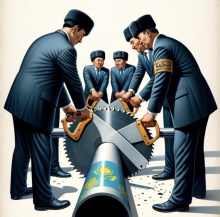
Information is circulating on social media that the restoration of order at JSC «Qarmet» has revealed the key players and beneficiaries of the long-term «plundering» of Kazakhstan's oldest enterprise.
It is reported that over a long period of time at JSC «Qarmet» (formerly «ArcelorMittal Temirtau»), interested parties, under the guise of companies involved in the collection and sale of ferrous scrap, were engaged in selling the plant's products abroad, particularly to China and Russia.
According to the information being spread, the price per tonne of scrap metal at collection points fluctuates around $25, while abroad the scrap is sold for $200-350 per tonne. Thus, the state is said to lose over $100 million annually on the export of hundreds of tonnes of scrap.
It turns out that Kazakhstan is hardly using its own raw materials. Instead, the products are exported to Russia, which is said to make hundreds of millions of dollars from just one shipment.
How accurate these figures are is still unknown. It is also noted that other countries, in order to prevent the plundering of their mineral resources, are instead introducing various restrictions on scrap exports and imposing high export duties on metal exports.
When corrupt and shadowy schemes at «Qarmet» began to be cut off, prominent names of relatives and former politicians interested in the resale of scrap abroad came to light. One of them turned out to be the Kazakh businessman and former head of the association of secondary metallurgy industrialists, Vladimir Dvoretsky.
It is reported that Dvoretsky directly benefits from the resale of scrap, and when Kazakhstan tried to impose a ban on exports, the businessman thought to complain not to just anyone, but to the Russian Prime Minister, Mikhail Mishustin. Apparently, the Kazakh side was hindering mutual trade. Dvoretsky is also linked to the head of the Russian «Ruslom», Viktor Kovshevny.
As anonymous sources note, instead of seeking a compromise, the «scrap king» preferred to use complaints to legitimise his «grey trade», hoping to pressure the Kazakh government through the Russian authorities and his long-term partner Kovshevny.
It is too early to talk about the reliability of the information being circulated, but one thing is clear – the upheaval beginning in the metallurgical industry will not pass without a trace. One can only hope that the changes will benefit domestic production.