Farmers in the Zhetisay and Maktaaral districts of the Turkestan region have reported significant losses to their melon harvest following prolonged May rainfall. Some farmers have linked the precipitation to a pilot project for artificial rainmaking, while specialists explain the weather conditions as being due to natural atmospheric processes.
WHAT HAPPENED
According to the TV channel KTK, farmers from the Zhetisay and Maktaaral districts are complaining about the spoiling of their melon crops.
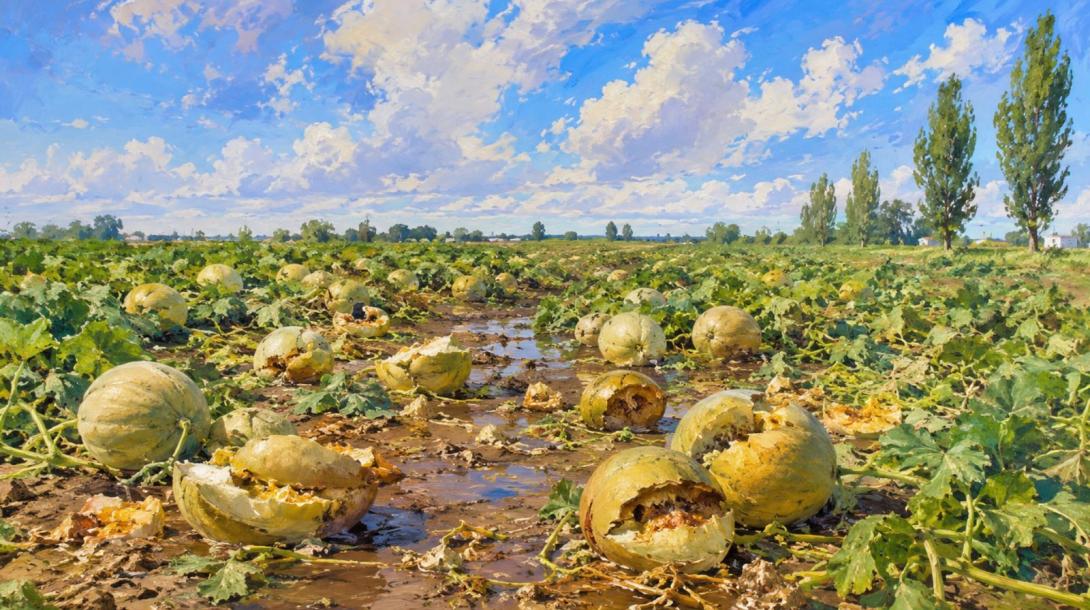
Farmers say that due to excess moisture, the melons have begun to rot and the root systems of the plants have been damaged. The farmers note that the disease has affected various varieties, and the use of fertilisers and treatments has not saved the harvest.
"Look, the roots are all rotten now, nothing will grow from this. We planted melons, took out loans, hoping our families would be fed. What do we do now? Who do we turn to for help?" said farmer Bakhtiyar Tolbasov.
Another farmer, Serik Tuyakbai, said many had been counting on a good harvest, but now hope only to recoup the costs of fertiliser and plastic sheeting.
WHY QUESTIONS AROSE ABOUT THE ORIGIN OF THE RAIN
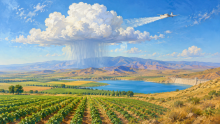
Some farmers speculated that the precipitation could be linked to a pilot project for artificial rainmaking launched in the Turkestan region last month.
HOW SPECIALISTS EXPLAIN THE SITUATION
According to the press service of the Turkestan region akimat, specialists from the RSE "Kazhydromet" reported that the weather conditions and precipitation in the region were caused by natural atmospheric processes and the passage of a cyclone.
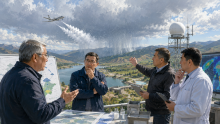
The director of the state-owned utility company on the right of economic management "Turan Su" of the Department of Agriculture of the Turkestan region, Kazybek Bedebaev, explained that the technology of artificial precipitation is used only in strictly defined areas. According to him, the radius of effect of the reagents on cloud masses does not exceed 5 km.
Since 17 May, specialists have carried out four flights. Reagents were sprayed at three points on the territory of Zhuantobe – Tasty Suzak district, as well as in the direction of the Kyzylkum desert. The materials emphasise that the precipitation that fell in the southern regions is not related to the implementation of the project.
HOW THE AUTHORITIES ASSESS THE SITUATION
Representatives of local authorities claim that the crop loss is not widespread and that issues must be resolved locally. In turn, farmers assert that representatives from the responsible bodies have not yet come to the fields to assess the situation or speak with agricultural producers.
CONTEXT
The pilot project is being implemented on the initiative of the Government of Kazakhstan in accordance with the instruction of President Kassym-Jomart Tokayev. The Turkestan region was chosen for the trials because the region faces drought, water scarcity, and the risk of desertification.
It was previously reported about the launch of the artificial precipitation project in the Turkestan region, aimed at replenishing reservoirs and providing water for the region's agricultural areas.
However, experts have questioned the technology's ability to significantly impact the moisture deficit in the region. An analysis by the founder of the FBRK, Kirill Pavlov, noted that the effectiveness of such solutions requires further assessment considering the climatic conditions, the state of the water infrastructure, and the specific characteristics of agriculture in southern Kazakhstan.
Furthermore, a number of experts and public figures from Kyrgyzstan have also expressed concern. They stated the need to study the project's potential impact on the region's water resources and climatic processes.