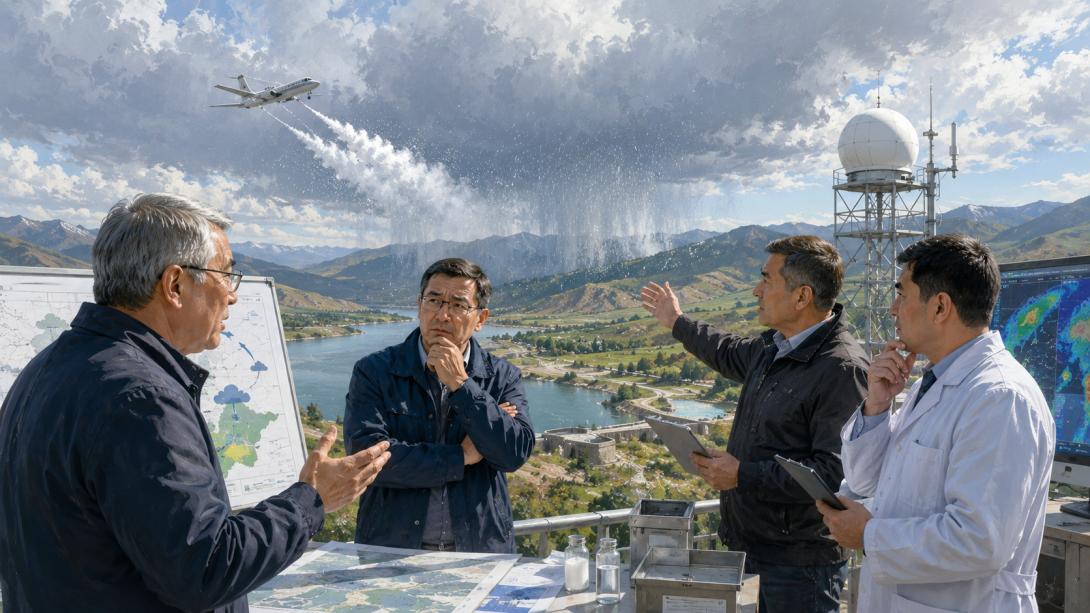
Following the launch of a project to artificially increase rainfall in the Turkestan Region, a number of experts and public figures from Kyrgyzstan have stated the need to study its possible impact on the region's water resources and climate processes.
WHAT QUESTIONS HAVE ARISEN FOR EXPERTS IN KYRGYZSTAN
The cause for discussion was a post by the former head of the Cabinet of Ministers of Kyrgyzstan, Akylbek Japarov, who expressed concern about the possible impact of large-scale intervention in atmospheric processes on the region's water balance. In his opinion, the atmosphere, glaciers, humidity, and precipitation form a single interconnected system, and the consequences of such projects may extend beyond the borders of one country.
Ecologist Gamal Soronkulov stated to Reporter.kg that, in his view, such initiatives should be discussed with neighbouring states at an interstate level.
Candidate of Geographical Sciences Kochkunbek Bakirov noted that the impact of such projects requires additional calculations and research. According to him, work on artificial precipitation enhancement has previously been carried out in Central Asian countries, including Kyrgyzstan.
WHAT IS SAID ABOUT INTERNATIONAL REGULATION
As reported by 24.kg, public figure Edil Marlis uulu reminded that there is currently no single international treaty that comprehensively regulates the civilian use of artificial precipitation enhancement technologies. However, the ENMOD Convention of 1976 is in force, which prohibits the use of environmental modification techniques for military purposes but permits their peaceful application provided international obligations are met.
According to him, the World Meteorological Organization (WMO) recommends notifying neighbouring states of major weather modification projects, as such initiatives can become the subject of transboundary discussions. The expert also noted that proving a direct causal link between changes in weather conditions in one country and such projects in another is extremely difficult.
WHAT POSITION HAVE STATE BODIES TAKEN
In Kyrgyzstan's Ministry of Natural Resources, the question was referred to Kyrgyzhydromet. The agency noted that artificial precipitation enhancement technologies are used in different countries and only affect existing cloud systems when suitable meteorological conditions are present.
Kyrgyzhydromet also emphasised that the effectiveness of such projects depends on many factors, including cloud characteristics, air humidity, and the synoptic situation. Specialised observations, scientific analysis, and long-term monitoring are required to assess the results.
CONTEXT
The topic of artificial precipitation enhancement has become one of the key points in the discussion on water security and climate adaptation in Central Asia. Kazakhstan became the first country in the region to move towards the practical application of such technologies.
It was previously announced that a project for artificial precipitation induction had been launched in the Turkestan Region, aimed at replenishing reservoirs and providing water for the region's agricultural areas.
However, experts have questioned the technology's ability to significantly impact the region's moisture deficit. An analysis by the founder of the FBRK, Kirill Pavlov, noted that the effectiveness of such solutions requires additional assessment, taking into account climatic conditions, the state of water infrastructure, and the characteristics of agriculture in southern Kazakhstan.