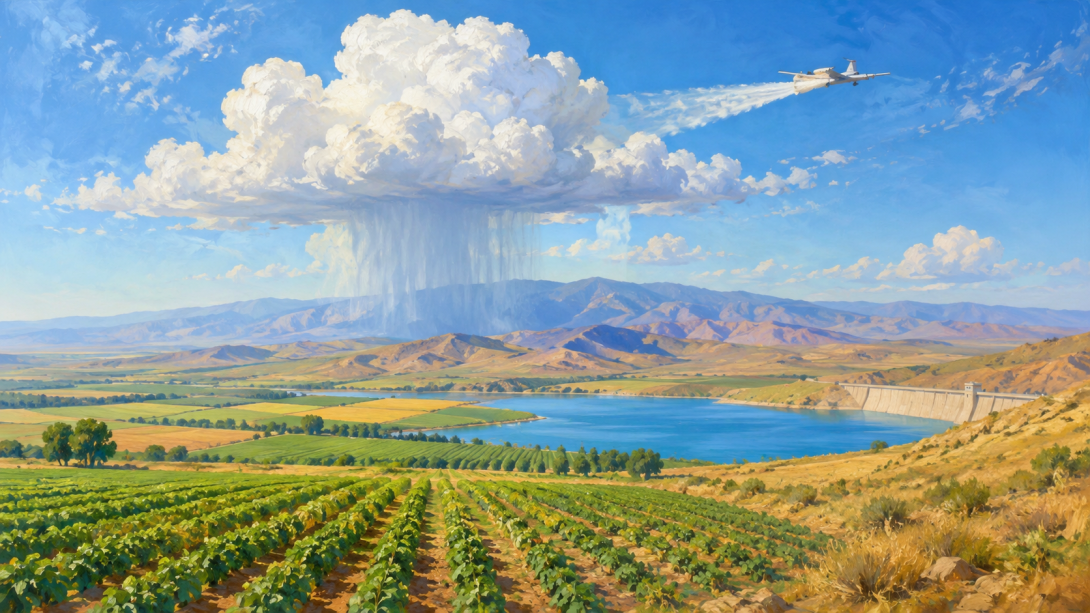
A project for artificial precipitation has launched in the Turkestan region, involving engineers from the United Arab Emirates (UAE). The initiative aims to increase rainwater volume and support the region's agricultural sector. However, experts who have analysed open data and climate indicators have reported a discrepancy between the project's stated goals and the region's actual natural conditions.
WHAT CONTRADICTIONS THE ANALYSIS REVEALED
FBRC founder Kirill Pavlov conducted an analysis of open data, satellite imagery, and climate statistics, in which he questioned the technology's ability to significantly impact the moisture deficit in southern Kazakhstan.
One cloud seeding zone covers an area with a radius of approximately five kilometres, whereas the project is promoted as a means of filling reservoirs and reducing the moisture deficit across the entire Turkestan region.
According to the calculations provided, even a 20% increase in precipitation would yield around 70 mm of additional moisture per year, against an annual evaporation rate on irrigated land of approximately 1,550 mm.
Such a volume of artificial precipitation cannot compensate for the existing moisture deficit.
WHY SOIL SALINITY IS IN THE SPOTLIGHT
In his analysis, Kirill Pavlov points out that soil salinisation remains one of the main problems for the agricultural sector in southern Kazakhstan.
The publication presents the following indicators:
- 42% of irrigated land in the Turkestan region is in an unsatisfactory reclamation state;
- 73.8% of arable land is characterised by a high groundwater level;
- the area of saline land has doubled compared to levels at the end of the last century.
The author refers to specialised reclamation studies, according to which, in the absence of effective drainage, additional moisture can accelerate soil salinisation.
It is noted that without restoring drainage infrastructure, increasing moisture volumes does not solve the systemic problems of the region's agriculture.
WHY THE TECHNOLOGY DEPENDS ON WEATHER CONDITIONS
The study also examines the seasonality of the project. The main phase of artificial precipitation is planned for the summer months, when natural cloud cover in the region is minimal.
As Kirill Pavlov notes, cloud seeding technology can only affect existing clouds and cannot form them in clear weather. During the hot season, the region may face a shortage of the atmospheric fronts themselves required to carry out such work.
WHAT RISKS THE PROJECT ENTAILS
The study also mentions potential transboundary consequences. The Turkestan region is located in a river basin where the distribution of water resources is regulated by international agreements. Interference in atmospheric processes could potentially lead to complaints from neighbouring states.
Furthermore, the publication considers climate forecasts from NASA NEX-GDDP CMIP6, according to which the increase in air temperature in the region may outpace the increase in precipitation volume. It is noted that this could intensify evaporation and maintain a high level of moisture deficit.
WHAT MEASURES THE AUTHOR CONSIDERS MORE EFFECTIVE
As an alternative, Kirill Pavlov proposes focusing on modernising the existing water infrastructure. Priority measures include repairing irrigation canals, restoring drainage wells, and switching to less water-intensive crops.
The effectiveness of such solutions is supported by years of hydrogeological research practice in arid regions.