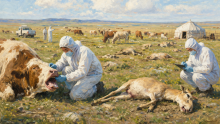
Since the start of the year, eight people have been hospitalised in the Turkestan region with a diagnosis of Crimean-Congo haemorrhagic fever. Among those who fell ill were citizens of Uzbekistan.
HOW THE INFECTION OCCURRED
According to the television channel "OTYRAR", the head of the sanitary and epidemiological control department of the Turkestan region, Nurbek Nyshanov, said at a briefing at the Regional Communications Service that eight people had been hospitalised in hospitals in the Turkestan region with a diagnosis of Crimean-Congo haemorrhagic fever.
According to him, in the majority of cases, the infection occurred through contact with farm animals.
Of the eight cases registered over six months, in six the infection occurred while tending livestock and coming into contact with animals. One further person was bitten by a tick while mowing grass in the courtyard of a house.
WHAT IS KNOWN ABOUT THE INFECTION
Crimean-Congo haemorrhagic fever is transmitted through tick bites and is classified as an acute infectious disease. It is accompanied by intoxication and haemorrhaging on the skin and internal organs.
In Kazakhstan, the southern regions, including the Turkestan region, are considered natural foci of the infection. Patients with this diagnosis are isolated in the infectious disease wards of hospitals.
HOW MANY CASES HAVE BEEN DETECTED IN THE REGION
According to official data, since 2002, 39 cases of Crimean-Congo haemorrhagic fever infection have been detected in the Turkestan region. Every year, particularly in spring and summer, residents seek medical help after tick bites.
Doctors recommend wearing clothing that fully covers the body when outdoors, and checking oneself for ticks after returning home.
CONTEXT
In 2024, it was reported that the Turkestan region had used the biological preparation "Baktitsid" to reduce the number of blood-sucking insects. This method was used instead of chemical treatment.
In 2025, the practice changed: the region already used the chemical insecticides "Enzhio" and "Karate". Their composition lists the active substances lambda-cyhalothrin and thiamethoxam.
In April 2026, it became known that the region had switched to chemical disinsection. Treatments of water bodies, green spaces and open areas were planned for April–May. Among the specifically named products was the insecticide "Taran", containing zeta-cypermethrin. The use of broad-spectrum pyrethroid preparations was also reported.
At the same time, in 2026, biological methods of insect control were not used in the region. The sanitary and epidemiological department did not disclose the full list of preparations used and their active substances.