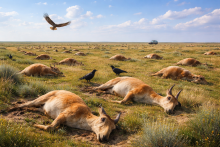
Deputy ministers of agriculture and ecology of Kazakhstan have commented on information about the possible spread of foot-and-mouth disease and the mass death of saiga antelopes in the country. According to them, no cases of foot-and-mouth disease have been registered in Kazakhstan, and the recorded death of saiga antelopes is within normal limits.
WHAT IS KNOWN ABOUT THE FOOT-AND-MOUTH DISEASE SITUATION
As reported by Deputy Minister of Agriculture Amangali Berdalin at a briefing following a Government meeting, no cases of foot-and-mouth disease have been detected in Kazakhstan among either agricultural or wild animals.
According to him, to prevent the spread of the infection, authorities have closed the border to the import of livestock products and also halted transit.
“Planned vaccination and relevant work are currently ongoing. We are vaccinating against 22 infections,” said Amangali Berdalin.
He clarified that over the past month, specialists took samples from 477 settlements. All results regarding foot-and-mouth disease were negative.
However, two samples tested positive for rhinotracheitis. According to the deputy minister, residents often confuse this infection with foot-and-mouth disease due to similar symptoms.
“We are also carrying out preventive measures against blackleg, rhinotracheitis, and even tuberculosis. Overall, 68 infectious diseases were previously registered in the country, now there are only 22 left,” noted the deputy minister.
WHAT IS KNOWN ABOUT THE SAIGA DEATHS
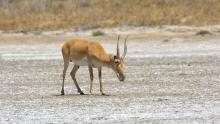
As reported by Deputy Minister of Ecology and Natural Resources Nurken Sharbiyev, the registered death of saiga antelopes corresponds to the natural mortality rate.
According to him, the average lifespan of saiga antelopes is less than five years, and population renewal occurs approximately every 3–4 years. Annual natural mortality can reach 15–20% of the total population. Currently, the death of about 26,000 saiga antelopes has been recorded nationwide. Of these, about 11,000 are in the West Kazakhstan Region (WKR), where the largest population of animals is concentrated.
Before the calving period, the number of saiga antelopes in Kazakhstan was about 4 million individuals. The population may preliminarily exceed 5 million, but the final results of the new census will be presented in June.
CAN THE SAIGA POPULATION BE REGULATED
Nurken Sharbiyev noted that, according to scientific data, the optimal number of saiga antelopes for Kazakhstan is estimated at no less than 900,000 individuals.
In this regard, the issue of population regulation may be considered in the future. However, according to the deputy minister, decisions will only be made based on biological justification and the conclusions of veterinary services.
IS THE LIVESTOCK DEATH LINKED TO SAIGA
Journalists also asked Amangali Berdalin whether saiga antelopes could be the cause of domestic livestock mortality.
The deputy minister stated that the cause of death of cattle could also be other factors, including inadequate animal care. According to him, it is not possible to link all cases of mortality exclusively to saiga antelopes.
CONTEXT
In the WKR, the death of saiga antelopes and cases of domestic livestock disease continue to be recorded. Previously, authorities reported a preliminary diagnosis of pasteurellosis, and a working group from the veterinary control committee travelled to the region to assess the epizootic situation.
Meanwhile, as reported earlier by farmers, during the winter in a number of the same settlements, animals were diagnosed with “infectious rhinotracheitis.” If the disease was initially incorrectly identified, this could have affected the treatment protocol and the absence of quarantine measures, which are usually applied for particularly dangerous infections.
Earlier, Deputy Minister of Agriculture Azat Sultanov commented on the situation with the death of saiga antelopes and domestic livestock in the WKR. At that time, he stated that specialists were conducting surveys and laboratory tests, and that there was no threat of mass livestock mortality.