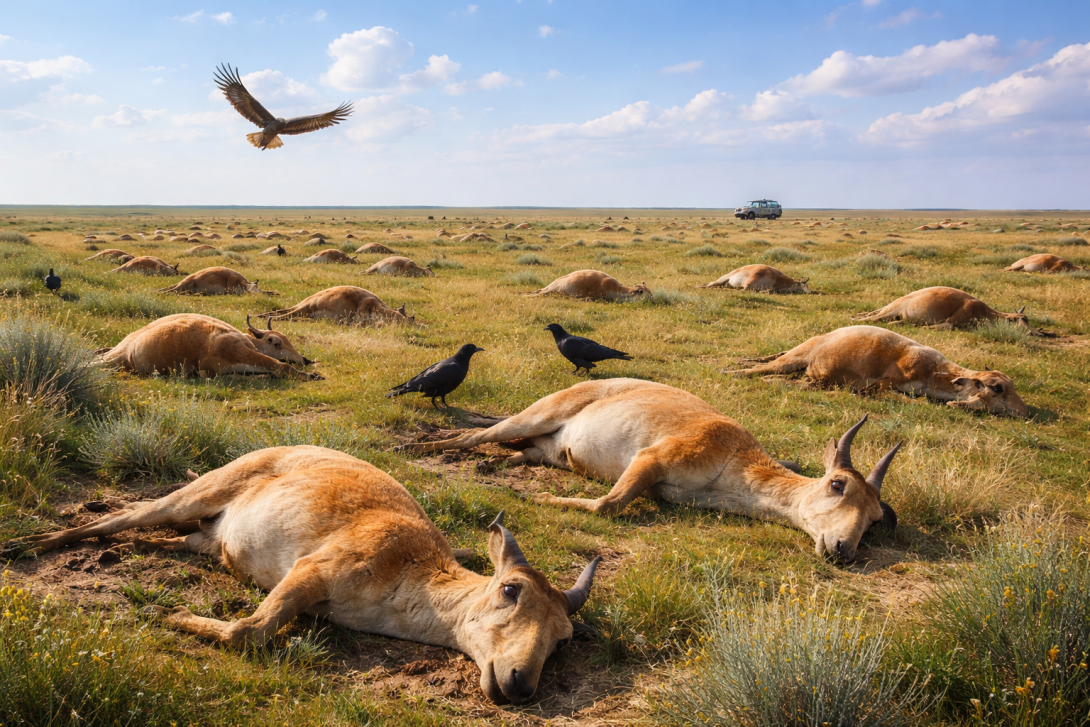
In the Kurmangazy district of the Atyrau region, more than 800 saiga carcasses have been collected following a mass die-off. The situation is causing concern among local farmers due to potential risks to livestock.
WHAT HAPPENED
According to the publication ‘Ak Zhayik’, over 800 carcasses have already been removed from the district. Specialists from ‘Okhotzooprom’, the Akzhayik Nature Reserve, the territorial inspection, and local executive bodies have been involved in the disposal. The carcasses are being burned and buried.
“It’s impossible to walk in the steppe — saiga carcasses are lying everywhere. If they are not burned and buried, it could cause disease. We are worried that this might harm our livestock,” local farmers stated.
WHAT THE AUTHORITIES SAY
The regional territorial inspection of forestry and wildlife has dismissed the theory that the animals died due to ticks.
Chief specialist Mereke Shalkharov described it as a natural process.
“The saigas are not dying from tick bites — this is a natural death. The animals may have been weakened after the winter. In general, the lifespan of saigas is 7–8 years,” said Mereke Shalkharov.
HOW MANY SAIGAS ARE IN THE DISTRICT
Earlier, around 800 saigas moved into the Kurmangazy district from the West Kazakhstan Region (WKR). Some of the animals later moved towards Russia. Currently, according to official data, there are approximately 15,000 individuals in the district.
CONTEXT
The editorial board of FBRK has previously drawn attention to the epizootic risks associated with the migration of saigas. In particular, in the WKR, video recordings were circulated on social media showing animals displaying signs of disorientation and lesions in the oral cavity.
Gaisa Absatirov, chairman of the ‘Veterinary Doctors of the WKR’ association, noted that such symptoms could correspond to the clinical picture of foot-and-mouth disease and are recorded in saiga migration zones.
He stressed that these animals are capable of moving quickly over long distances and crossing borders, which increases potential epizootic risks.
However, official comments on the current situation in the Kurmangazy district do not confirm a link between the saiga deaths and infectious diseases.