(25 February 2026 | Source: Informburo.kz)
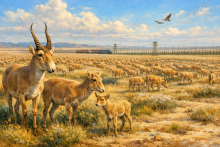
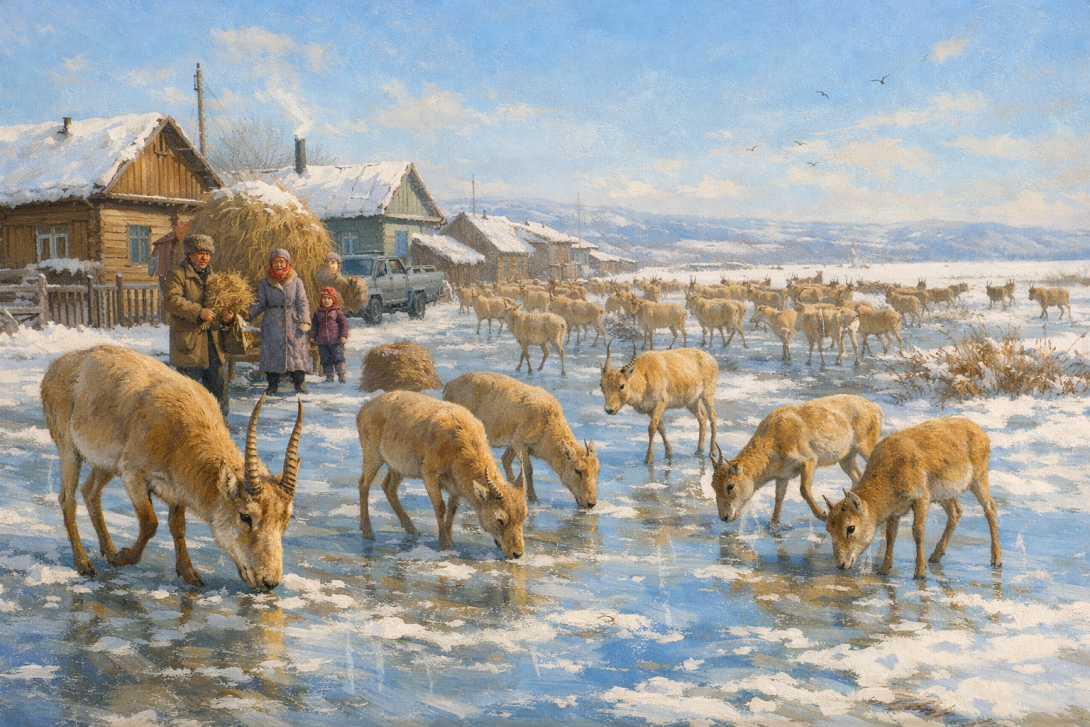
Kazakhstani scientists have explained the increasing cases of saiga entering populated areas. In winter, weakened saigas stray from their usual routes and appear near human dwellings — not due to a behavioural malfunction, but because the steppe is literally covered in ice.
This was reported by Informburo.kz, citing the Committee of Forestry and Wildlife of the Ministry of Ecology and Natural Resources.
WHY THE ANIMALS ARE COMING TO PEOPLE
Severe frosts and snowfall form a dense icy crust on the snow surface, blocking the animals' access to grass. Saigas are a migratory species, extremely sensitive to changes in weather. Weakened individuals leave their usual routes in search of food and softer conditions.
Specialists emphasise that this behaviour is not an anomaly at all, but a forced response to environmental conditions.
FEEDING WILL NOT HELP
Sergei Sklyarenko, Science Director of the Kazakhstan Association for the Conservation of Biodiversity, warned that attempts to help the animals artificially are almost futile. He recalled that back in Soviet times, saigas were fed from aircraft, but with their high numbers, the result was minimal, as the animals are constantly on the move.
According to the expert, natural mortality of males after the rut in harsh winters can reach 50–70%. With a total population of around 2 million individuals, the death of between 20 and 40 thousand males is a predictable indicator even in favourable years.
The dead animals become a food source for foxes, corsacs, and birds of prey, supporting the balance of the steppe ecosystem. It is noted that specialists are conducting daily monitoring. At present, the situation is assessed as stable.
WHY THIS MATTERS
It is worth noting that the current winter is unfolding against the backdrop of a story that has yet to receive a thorough explanation.
In 2022–2023, Kazakhstani authorities recorded a sharp increase in the saiga population, considering this a threat to the agricultural sector. The subsequent campaign to "regulate numbers" fairly quickly got out of official control. The media documented carcasses with organs removed in the steppe, illegal slaughter, and the black market trade of meat.
In 2025, after a brief suspension of culling, the shooting of the country's national asset continued, and no balanced scientific reasons were ever provided to the public, with authorities hiding behind questionable figures and concealing the biological justification.
Now, as scientists try to explain saiga behaviour in winter, questions arise that, in both 2023 and 2025, no one seems to have seriously asked.
The first, naturally, is about the numbers. The expert puts the population at around 2 million individuals. Yet the Ministry of Ecology has repeatedly used figures of 3.9–4.1 million, and some forecasts reached 5 million. That is quite a gap.
The second question is about alternatives. Sklyarenko points out that mass feeding with a multi-million population is largely ineffective. However, this argument alone does not exhaust the complexity of the problem nor close the door for further discussion.
Was an analysis of the causes of population growth carried out? Were methods for territorial redistribution of herds considered? Were targeted measures studied to help weakened animals that end up near housing? If answers to these questions are absent or limited to generalities, then talk of a comprehensive solution (if anyone is even looking for one) seems premature. Rejecting one measure is far from having a strategy.
Understanding saigas certainly requires time, data, and a willingness to study them. To what extent the Ministry of Ecology shares this approach is difficult to say.