The FBRK editorial team continues its series of articles on the methods used for disinsection in the regions of Kazakhstan. This article examines the Turkestan Region, where, despite previous statements about biological approaches, the use of chemical insecticides has been recorded.
WHAT IS KNOWN ABOUT THE PREPARATIONS USED
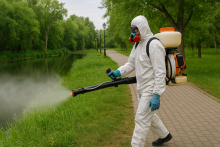
According to the Department of Sanitary and Epidemiological Control of the Turkestan Region, seasonal insect treatments are carried out annually in the region. In April–May 2026, disinsection of water bodies, green spaces, and open areas is planned.
However, a key detail — the list of preparations used and their active ingredients — is not disclosed by the department. The department directly states that this information is held by the structures of the akimat and the housing and communal services department.
In effect, this is a situation where the population does not receive complete information about the substances used in public spaces.
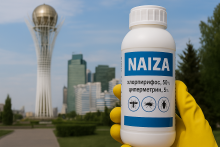
The only specifically named preparation is the insecticide "Taran", used as part of a state contract. The department also clarified that broad-spectrum pyrethroid preparations are used.
According to publicly available data, "Taran" contains zeta-cypermethrin — a highly active substance from the pyrethroid group, acting via contact and ingestion on insects and mites.
Zeta-cypermethrin is a more active form of cypermethrin, created to enhance the insecticide's effect.
Such substances are more effective at killing insects, including those resistant to conventional preparations. Simply put, treatments use not the basic, but a more "powerful" version of the chemical substance.
In terms of its mechanism of action, the substance remains a neurotoxic compound affecting the transmission of nerve impulses.
POTENTIAL RISKS
To understand the possible consequences, it is important to consider the properties of the pyrethroid group itself, to which the substance used belongs.
For example, cypermethrin, which is similar in chemical structure, affects the nervous system, can cause convulsions and impaired coordination, is particularly sensitive for children, and is extremely toxic to bees, fish, and aquatic organisms.
Given that zeta-cypermethrin is a more active form of this substance, the issue of dosages, control, and public information becomes critically important.
BIOLOGICAL METHODS EXCLUDED
Regional authorities directly stated that in 2026, biological methods of insect control are not being used. This means a complete transition to chemical disinsection in the segment of preventive treatments.
HOW THE PRACTICE HAS CHANGED
The situation is particularly illustrative when viewed over time.
In 2024, the Turkestan Region reported the use of the biological preparation "Bacticid", which allowed for a reduction in insect numbers without chemical impact.
In 2025, chemical insecticides "Engeo" and "Karate" were already used, with active ingredients lambda-cyhalothrin and thiamethoxam — substances belonging to neuroactive compounds toxic to insects.
In 2026, the region is definitively cementing this course, transitioning to the use of pyrethroids with enhanced efficacy.
WHO MAKES THE DECISIONS
The organisation of disinsection is entrusted to local executive bodies, and the selection of preparations to the structures of the akimat and relevant departments.
At the same time, the sanitary authorities do not compile the list of preparations, do not disclose the full list of substances used, and limit themselves to general recommendations.
Mechanisms for independent control of solution composition and actual concentrations are not disclosed in the provided data.
CONTEXT AND SIGNIFICANCE
The abandonment of previously used biological methods in favour of chemical insecticides, in the absence of complete information about the composition of the preparations, raises legitimate questions.
On what basis this choice was made in favour of more aggressive chemical schemes remains unclear.
The FBRK editorial team calls on local executive bodies to ensure transparency in such decisions, and on residents to remain vigilant during treatments and to observe precautionary measures.