The Bureau of National Statistics records that half of the family budget of Kazakh citizens is spent on food. Exactly 52.4% of household consumer expenditure in 2025 was spent on foodstuffs. And, as is well known, the poorer a country, the larger the share of income literally consumed by food. And if the average figures still look satisfactory, the breakdown by income level paints a radically different picture.
BREAD AS A MARKER OF LIMITED INCOME
The main indicator of wealth in a diet is not the presence of meat, but its quantity. According to data from the Bureau of National Statistics, the 10% least well-off Kazakh citizens consume 45.4 kg of meat per year, while the 10% most well-off consume 150 kg. A difference of 3.3 times.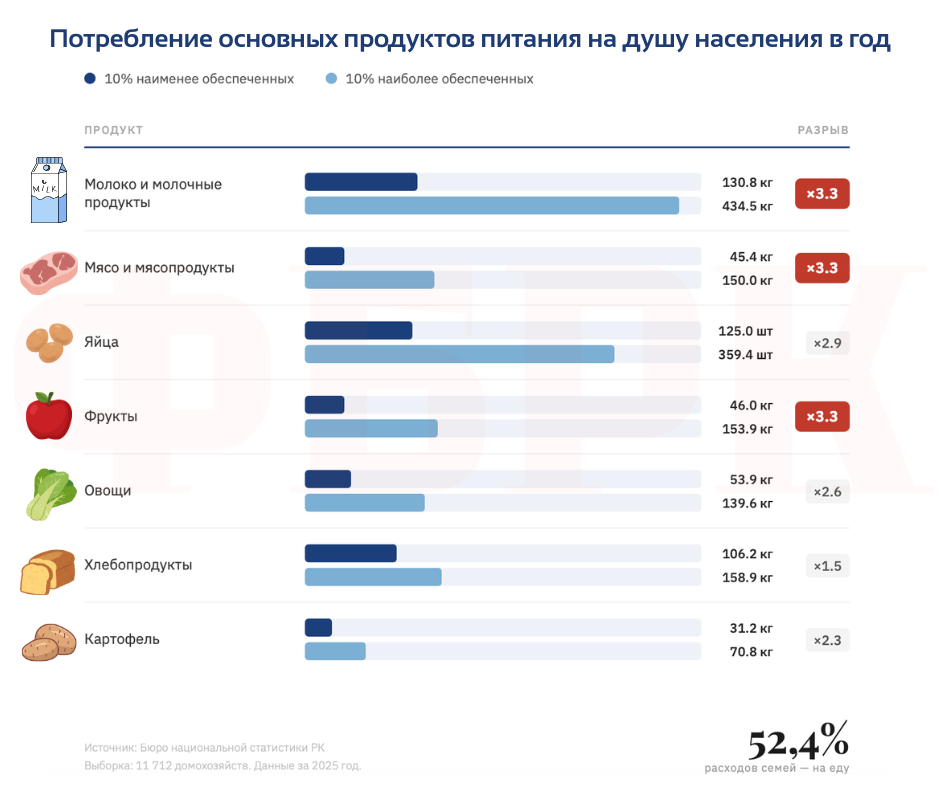
The opposite trend is seen with bread and flour products. The less well-off population consumes more of them: 106 kg compared to 159 kg for more well-off people. Bread products occupy a large share of the diet of the low-income group precisely because the rest is simply unaffordable. People with low incomes consume only 130.8 kg of milk per year, while the financially well-off population consumes 434.5 kg. For fruit: 46 kg compared to 154 kg. And for every category, a chasm-sized gap is recorded.
CITY DWELLERS EAT DIFFERENTLY FROM VILLAGERS
The gap between cities and rural areas is no less telling. Rural residents eat more bread — 140.3 kg per year compared to 117 kg for city dwellers, and less fruit (71.5 kg compared to 89.4 kg). However, the difference for meat is minimal: 78.7 kg in rural areas and 88 kg in cities — apparently thanks to private household farming.
The most striking contrast is seen in the consumption of water and beverages. City dwellers drink 7.5 times more bottled water than rural residents: 28.3 litres compared to 3.8 litres of drinking water per year. This doesn't mean villagers drink less. More likely, they simply get water from other sources.
REGIONAL DIETARY MAP
Kazakhstan is a country with huge regional differences, and dietary statistics confirm this. Turkestan Region leads in consumption of bread products — 168.9 kg per capita per year, which is almost twice the figure for Almaty (98 kg). Almaty residents, in turn, eat the most fruit (105.8 kg) and vegetables (104.3 kg).
For dairy products, Karaganda Region (315.8 kg per year) and Zhetysu (over 267 kg) are ahead. The lowest milk consumption is in Shymkent (163.5 kg) and Kyzylorda (172 kg). As for fish, it is most often eaten in the north: North Kazakhstan Region — 22.7 kg per year, while in Shymkent this figure is only 5.8 kg.
WHEN THE POVERTY LINE IS THE CEILING
A separate cross-section of statistics is the diet of Kazakh citizens with incomes below the poverty line. Their diet shrinks to basics: 97 kg of bread products per year, 41.7 kg of meat (2 times less than the national average), 5.5 kg of fish, 123.4 kg of dairy products and 42.2 kg of fruit, which is almost half of what well-off city residents consume.
At the same time, the share of expenditure on food in their budget is even higher. The statistics do not disclose data broken down by income group, but the overall picture is clear: the lower the income, the higher the share of food in expenditure, and the poorer the diet itself.
Dietary statistics are one of the most honest indicators of living standards. They cannot be adjusted by self-perception or credit. The fact that half of Kazakh family consumer spending goes on food, and the gap in meat consumption between rich and poor exceeds threefold, means that food still remains an item of primary necessity, rather than free choice.