Seizure of assets in a case of tax evasion is not an everyday event, even for Ukraine's shadow gambling market. The amount of claims here is measured in billions, and the scheme, according to the investigation, covered dozens of casinos and bookmakers. Significantly, among the clients of those involved were operators linked to the Pin-Up brand - a casino whose schemes have been widely discussed in Kazakhstan recently.
WHAT THE COURT SEIZED
According to the Telegram channel "Payment Shield in the CIS", Maksym Syhalov is suspected of tax evasion on an especially large scale (Part 3 of Article 212 of the Criminal Code of Ukraine), the illegal organisation of gambling (Part 2 of Article 203-2), the illegal use of trademarks (Part 2 of Article 229) and the legalisation of criminally obtained property (Part 1 of Article 209).
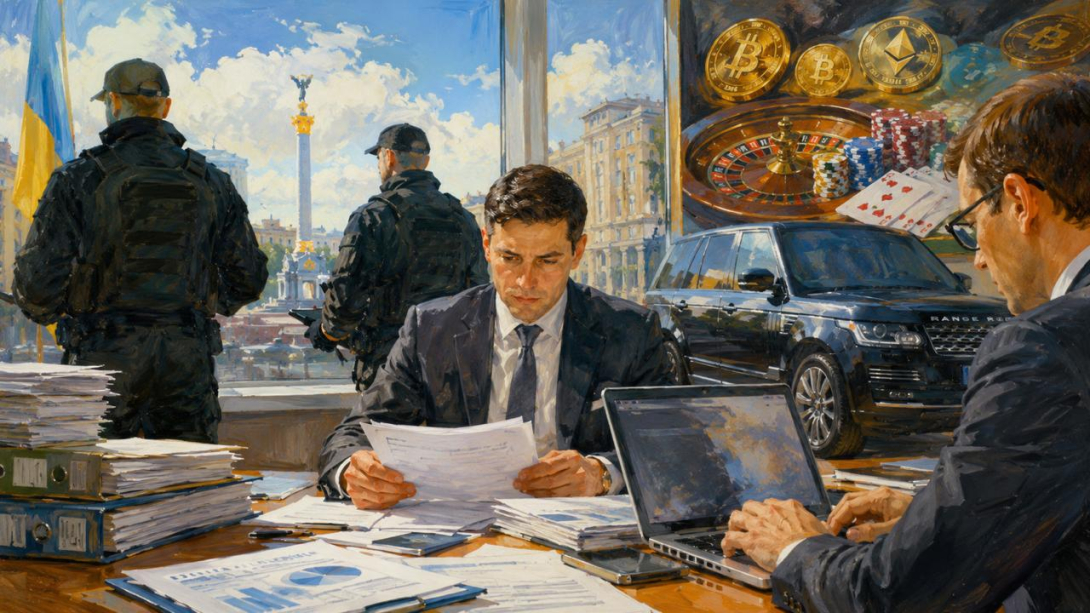
Seized as part of the criminal case were non-residential premises with an area of 104 m², a car - a 2023 Land Rover Range Rover - and funds in 42 bank accounts held in hryvnias, euros and dollars. The court considered the motion without notifying the owner. According to the prosecutor, otherwise the assets could have been withdrawn or hidden.
WHAT ROLE THE INVESTIGATION ASSIGNS TO SYHALOV
Maksym Syhalov is the actual owner of the non-bank financial institutions Diamond Pay LLC and E-Pay LLC, which provided internet acquiring services (a banking service that allows businesses to accept cashless payments from customers over the internet) and payouts for online casinos and bookmakers, including Ukr Game Technology (Pin-Up), Vbet and Casino UA. According to the investigation, these companies were used to circumvent payment blockages - after the National Bank of Ukraine (NBU) suspended the operations of VBet Ukraine and Ukr Game Technology in April 2024, funds were redirected to new merchant accounts.
HOW THE LEGALISATION SCHEME WORKED
It is reported that, according to the investigation's version, the legalisation of funds was carried out through the substitution of transaction codes, payouts to "drop" cards followed by cashing out or conversion into cryptocurrency. According to the Bureau of Economic Security (BES), E-Pay understated income for 2021-2022 by 21.8 billion hryvnias (approximately 228.3 billion tenge), resulting in the non-payment of corporate income tax in the amount of 3.9 billion hryvnias (around 40.8 billion tenge). In total, according to the investigation's estimates, more than 1 billion hryvnias (10.5 billion tenge) of funds that should have been blocked passed through Diamond Pay's schemes.
WHAT HAPPENED AFTER THE LICENCE WAS REVOKED
In July 2024, the NBU revoked the licence of Diamond Pay due to inaccurate information and links to Russia, after which the company's accounts were frozen. The investigation believes that the owners tried to withdraw funds through controlled court disputes - in particular, through a ruling by the Commercial Court of Dnipropetrovsk Oblast dated 19 December 2024 ordering the recovery of a fine of 364.8 million hryvnias (approximately 3.8 trillion tenge).
According to a source, Syhalov is currently in Spain, although Ukrainian registers list him as residing in Ukraine.
Earlier, FBRK has already written about the schemes surrounding Pin-Up. We reported on the search for Dmitry Druzhinsky and Marina Levkovich, as well as the detention of blogger Kaysar Kamza and the search for Makhmud Khikmatov.
According to the investigation's version, Dmitry Druzhinsky and Marina Levkovich coordinated the operation of online casinos under the Pin-Up and PINCO brands through a network of affiliated companies, including Bonami LLP, which obtained a bookmaking licence under the Pin-Up-KZ banner. Public figures promoted the casino to audiences - in particular, blogger Kaysar Kamza. And Makhmud Khikmatov acted as the link between the casino and the influencers.
Through the payment infrastructure that, according to some media reports, was built by Ilyas Karimov, more than 106.5 billion tenge flowed. It is claimed that these funds passed through fintech companies and acquiring channels, were then converted into cryptocurrency via the Intebix exchange, and were withdrawn outside Kazakhstan.