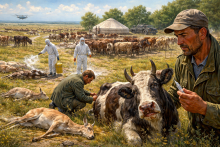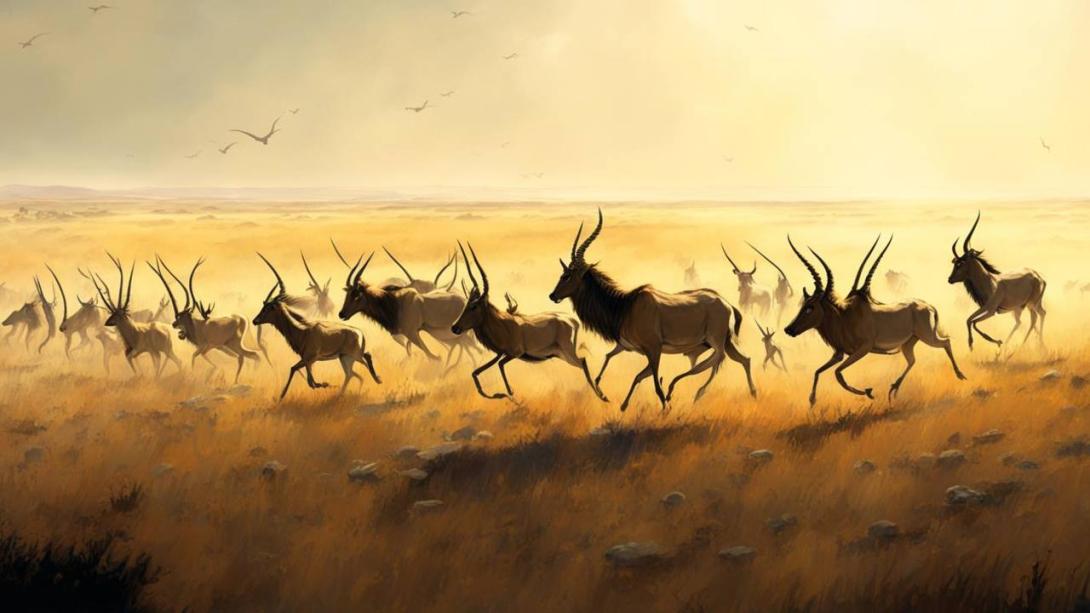
The FBRK editorial team regularly raises the issue of the unjustified culling of saiga, to which the Minister of Ecology and Natural Resources of the Republic of Kazakhstan, Yerlan Nysanbayev, is trying extremely clumsily to find some kind of justification.
Specifically, we conducted an analysis of the 'scientific' article 'Strategy for the Conservation of the Saiga in Kazakhstan', which to this day serves as the basis for the culling of these unique animals, despite the fundamental contradictions present in its writing.
In the article, co-authored by experts from the Kazakh National Agrarian Research University and the S. Seifullin Kazakh Agrotechnical University, the main reason given for the 'removal' of saiga is their negative impact on pastureland, and the significant growth in the animal population in 2021, the reliability of which is highly questionable, is said to only exacerbate the situation.
To complete the picture, the FBRK editorial team released a whole series of materials, in which we analysed the amount of free pastureland in the regions of Kazakhstan at the end of 2023, taking into account the area of plots seized under the 'Zher Amanaty' project.
We recently received an official response from the Department of Land Relations of the West Kazakhstan Region to our enquiry about the amount of free pastureland, where we were told that the total area of reserve land in the West Kazakhstan Region in 2023 amounted to over 2.6 million hectares, of which pastureland made up 1.4 million hectares.
Furthermore, we found open access to a scientific article written by experts from the Zhangir Khan West Kazakhstan Agrarian-Technical University on the current state of pastures in Western Kazakhstan depending on the method of their use.
The authors of the article concluded that "to preserve and increase pasture productivity, it is advisable to use seasonal pastures, including distant grazing plots in the pasture rotation". Simply put, to increase the productivity of pastureland, it must be used from season to season.
However, in early March, Mr Nysanbayev held a meeting in the West Kazakhstan Region with the teaching staff of that very Zhangir Khan Agrarian-Technical University. The meeting discussed new measures for regulating the saiga population. At that time, for some reason, no one remembered about preserving pastures through distant grazing.
In our case, haphazard livestock grazing leads to degradation and desertification, and, as always, the saiga turned out to be the culprits. We were probably simply forgotten to be informed that steppe antelopes are now responsible for the preservation of the country's natural resources.
Of course, by now it is no secret to anyone that the true goal of the extermination of saiga is in no way connected with the noble intentions of preserving them, as was claimed at the very beginning. Justifying the 'removal' by a shortage of pastureland also doesn't hold up, and admitting mistakes is not a common occurrence in our country.
Let us recall that recently the Border Service Department of the National Security Committee of the Zhetysu region detained three citizens of Kazakhstan in the border zone attempting to export 1,382 saiga horns. The damage to the state was estimated at over 3.5 billion tenge. Meanwhile, according to our data, one horn on the black market costs around $2,000.
Will Mr Nysanbayev have the courage to take responsibility when it turns out that his decisions have led to the destruction of a unique steppe antelope, which, incidentally, is also part of the country's national heritage?