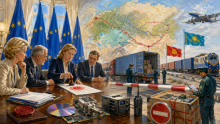
A business forum "EXPO-EURASIA KAZAKHSTAN 2024" was held in Almaty, with participation from companies in Russia, as well as guests from Uzbekistan and Tajikistan.
According to Ratel.kz, at the forum, Russian businessman and international logistics expert Nikolay Serebryakov spoke about how Russian businesses are circumventing sanctions.
"Before sanctions were imposed against Russia, goods from Europe went directly to the Russian market, and in some cases onwards to the Kazakh and Uzbek markets, via transport hubs in the Baltics. Now the chains are changing: goods go from Europe to Turkey, then transit documents are processed, and they go on to Russia, or to Kyrgyzstan and Uzbekistan, and from there back to Russia again. This naturally leads to increased costs: previously, delivery from Europe took around 14 days, now it takes a month", the businessman said.
It has become known that before the introduction of sanctions, international trade participants paid foreign suppliers directly for goods, and payment processing took one to three days.
Things are different now. For example, Chinese partners can still be paid directly, but not all Chinese banks accept payments from Russia. So-called payment agents are now used for this purpose.
"A tripartite agreement is concluded between the buyer company, the supplier, and the agent. Agents are entities from Kyrgyzstan, Uzbekistan, and China. The agents' commission ranges from 4% to 10%, depending on the payment amount. Under ideal conditions, payment processing takes 5-7 days, but this is not always the case: there are banks that refuse to accept payments in yuan, and we have to make the same transfers in dollars. Such payments are already relatively quick. The trend of recent days is that payment processing is speeding up. As for 'communication resources', we also bring in our partners from China, Uzbekistan, and Kyrgyzstan to communicate with those suppliers from the US or Europe who do not want to have direct contact with Russian companies. They correspond, receive an invoice for payment, and we begin its transfer… We have mail servers in these countries, and our logistics specialists themselves contact suppliers, creating a 'good story' for them", the Russian expert said.
He also spoke about an increase in the volume of transit cargo deliveries to Russia from China. According to the expert, many goods come from countries in Southeast Asia, Africa, the Middle East, and especially from the UAE. Furthermore, it became known that European and American air freight deliveries go to the UAE, then transit is arranged, and the cargo arrives in Russia.
"When the SMO began, a lot of cargo and payments went through Kazakhstan. But then goods started being held up or returned. We cannot clear a cargo through customs for a Russian legal entity in Kazakhstan; you need to have a company in Kazakhstan and clear it through customs on that entity", Nikolay Serebryakov said.
At the same time, according to Serebryakov, due to the situation on the currency market, exports from Russia are growing, most of which go through the Emirates. This mainly concerns fuels and lubricants, but an increase in sales of construction materials, cosmetics, and clothing is also expected, even to England.
In conclusion, the expert recommended that all international trade participants not skimp on drafting foreign trade contracts.
"You need to hire competent lawyers and use British law. It's not a cheap procedure, but it's better not to economise on this than to later wonder where the money has gone. And use one hundred percent prepayment", the report states.
It should be recalled that Kazakh officials have repeatedly stated that the Republic of Kazakhstan in no way facilitates the circumvention of international sanctions by other countries. At the same time, President Kassym-Jomart Tokayev, speaking at a meeting in the 'SCO Plus' format held during the recent summit in Astana, stated that sanctions conflicts cause significant damage to the global economy and also narrow the prospects for further development.