The Council of the European Union has approved another sanctions package against Russia, timed to coincide with the anniversary of the military actions in Ukraine. Despite the tightening of restrictive measures against Russia's military and defence sector, the flow of high-tech foreign goods into the country has not stopped.
Two Kazakh companies were included in the 13th EU sanctions package: Elem Group LLP and Da Group 22 LLP. However, the Ministry of Trade reported that the companies have not been carrying out import or export activities since last year, and Elem Group LLP is in the process of liquidation.
The ministry also notes that Kazakhstan is interested in continuing a "constructive dialogue" with Western partners.
Admittedly, dialogue is not always sufficient. Journalists repeatedly uncover new schemes for supplying goods to circumvent sanctions, in which Kazakh companies play a very active role.
A new investigation by Bureau Media (Belarus), Verstka (Russia), and the Organised Crime and Corruption Reporting Project (OCCRP) reveals details of another scheme, known as "false transit", involving companies from Kazakhstan and Belarus.
As is known, these countries are members of the Eurasian Economic Union (EAEU), which unites the economies of five independent states (Armenia, Belarus, Kazakhstan, Kyrgyzstan and Russia), allowing goods to move freely across national borders without customs control.
Journalists found that a Kazakh company ordered high-tech equipment for the production of semiconductors from European countries, which was delivered to a temporary Belarusian warehouse. From there, the ordered goods went on to Russian companies with extensive military contracts.
According to the OCCRP investigation, a huge number of private companies sponsor the Russian military. Among them is the conglomerate "Ostek", which supports high-tech industrial production.
The company does not manufacture weapons, but supplies equipment and creates facilities that enable their production to be set up.
"Ostek's" clients include several major Russian military contractors. For example, the company provided foreign technologies and technical services to the developer and manufacturer of the "Tochka-U" and "Iskander-M" missile systems.
Furthermore, the conglomerate is a supplier to the Ryazan Radio Plant, which is owned by the state corporation "Rostec", a major defence conglomerate and one of the largest suppliers of radiocommunication equipment for the Russian military-industrial complex.
After 24 February 2022, many international companies severed ties with Russia even before any sanctions were imposed. Similarly, within a few weeks, all of "Ostek's" European partners stopped supplying the company, except for one.
That supplier was "Inter-Trans" LLC.
Although the company was based in the Polish city of Siedlce and was controlled by the German logistics firm BMA Spedition GmbH, the controlling stake in "Inter-Trans" belonged to Belarusian businessman Yevgeny Kostyuk.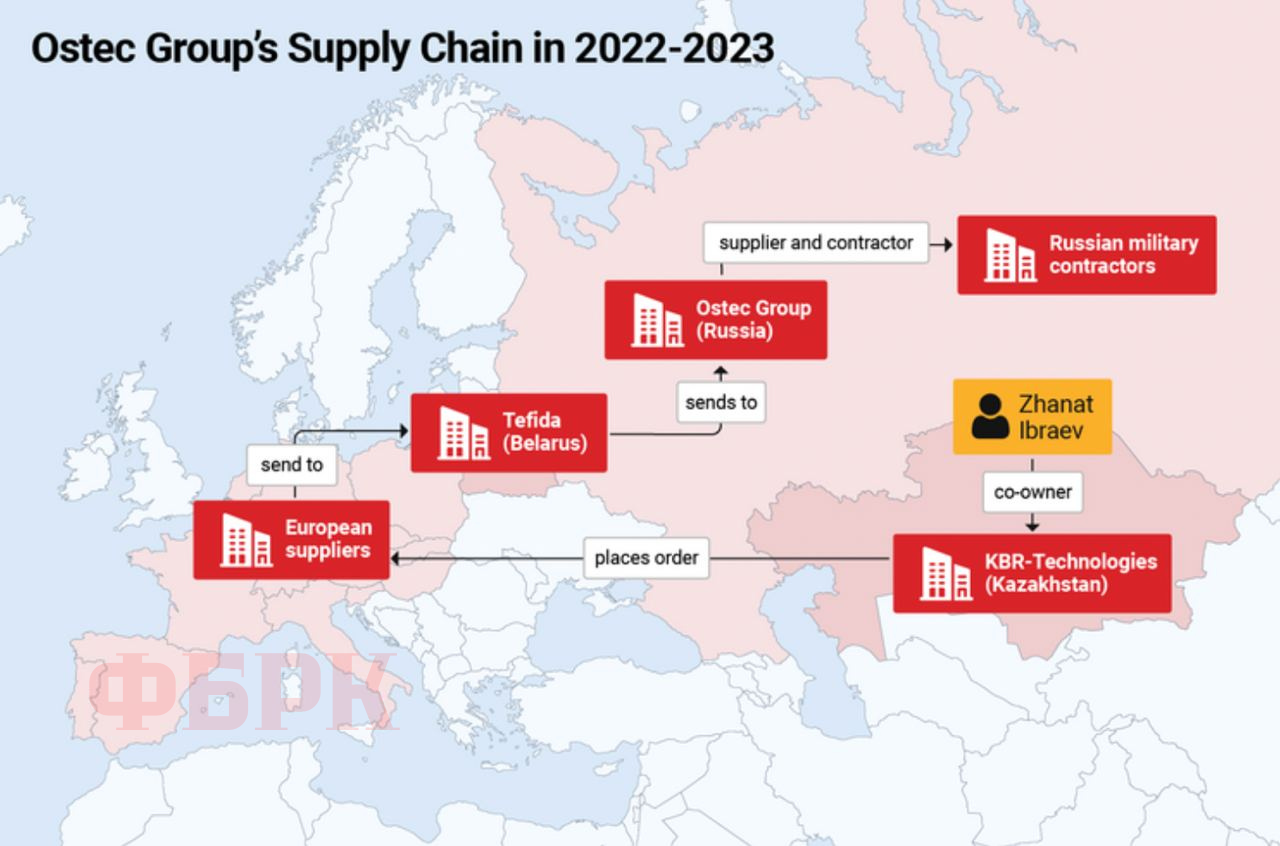
During 2022, "Inter-Trans" supplied goods to "Ostek" worth at least $24 million, the investigation states. Among the deliveries was equipment for the production of semiconductors and microchips worth over $4.7 million.
By the time European sanctions were introduced, an alternative route based in Kazakhstan had already been created for "Ostek".
In 2014, Mr Kostyuk's Russian firm "Mirtrans" established a subsidiary company in Kazakhstan, "KBR-Trans" LLP.
In May 2022, the director of "KBR-Trans", Zhanat Ibraev, became a co-founder of a new Kazakh firm, "KBR-Technologies" LLP, which soon began supplying "Ostek" with the same types of high-tech goods that "Inter-Trans" had previously supplied.
Journalists obtained a letter in which the director of "KBR-Technologies" informs a shipping company that, from July 2022, the new recipient of the goods would be the Belarusian company "Tefida".
The letter even explains the further plans: "KBR-Technologies LLP authorises the private enterprise "Tefida" to take ownership of the cargo on the territory of the Republic of Belarus, place it under customs warehouse procedure, and send it to Ostek-Integra LLC in the Russian Federation".
Among the goods supplied were six batches of equipment for manufacturing semiconductors, mainly produced in South Korea. And although their value did not exceed $716,000, the significance of the route itself in the current climate was enormous.
On 22 February 2023, three days before the EU announced a ban on sending any equipment for the production of semiconductors and microchips to Russia, "Tefida's" deliveries began to ramp up. In just three months, "Ostek" received goods worth around $8.6 million.
In May 2023, the US Department of the Treasury imposed sanctions against "Ostek".
However, between April and August, "Tefida" managed to supply equipment worth around $2.5 million to another Russian company — "FabCenter" LLC, which is linked to the "Ostek" group through shared — current and former — owners.
Journalists found no evidence that Mr Kostyuk and his companies still supply Russian military contractors. However, experts say that such schemes, which have not yet come to the attention of any supranational oversight bodies, are still operational.
The unending flow of sanctioned high-tech equipment into Russia could be bad news for Ukraine. However, this same fact indicates that Russia has problems with producing these very goods.
For their part, certain Kazakh companies serve merely as a tool for circumventing sanctions, thereby undermining relations with Western partners.
Recall that previously it became known about the supply of luxury cars from Canada to Russia. Officially, the cars were headed to Central Asian countries, but apparently "lingered" in Russia.
Some cars were put up for sale at a car showroom in Tomsk. The Canadian export company, for its part, denies selling cars to Russia.