
From 1 June 2026, a mandatory requirement for issuing goods waybills and travel logs in electronic format through the state platform - the Unified System for Managing Transport Documents (USMTD) - came into force in Kazakhstan. Administrative liability is stipulated for violations. The only problem is that, judging by complaints from dissatisfied users, by the time of the mandatory switchover, the system turned out to be unprepared both technically and organisationally.
WHAT HAPPENED
In May 2026, complaints began arriving at the FBRK anonymous bot from users of the Unified System for Managing Transport Documents (USMTD).
Registration on the portal is carried out via email address: after entering the data, a link for confirmation should arrive. According to users, initially emails did not arrive at all or ended up in spam. As a result, people were forced to contact the Telegram support chat, where they publicly send their IIN, BIN and email addresses. Access to the chat is open. The support service itself operated by default as a bot, manually activating accounts after requests.
The combination of an IIN and email address is classified as personal data under Kazakh law. Their public disclosure in an open chat appears to be a potential violation of the Law of the Republic of Kazakhstan "On Personal Data and Their Protection".
One user reported registering a company on the portal using the details of a person who died in 2018, and the registration was successful. Another user discovered that a registration already existed under their name, which they did not create. In other words, if user reports are to be believed, the system simply does not verify the authenticity of the persons being registered.
Among other things, people complain that the website has no instructions for users, no integration with accounting software, and the copyright holder and developer are not even listed on the portal. The process of linking a medical professional to approve travel logs turned out to be so opaque that users are forced to search for "remote medical workers" in the same Telegram chat, which could easily create a grey market for verification.
The editorial team of FBRK decided to investigate the platform's operation independently, and since there is almost no information about it in open sources, we contacted the Ministry of Transport.
WHAT IS THE SYSTEM AND WHERE DID IT COME FROM
USMTD is a digital platform designed for registering and exchanging primary transport documents between consignors, carriers, and consignees. Ideally, it should provide the state with data on cargo flows across the country, speed up transportation through the availability of documents in electronic format, and reduce the burden on road inspectors.
According to the Ministry of Transport's response, the system developer is Arta Software LLP, and the contract for its acquisition was concluded as early as 24 May 2021 with the Transport Committee of the Ministry of Industry and Infrastructure Development of the Republic of Kazakhstan. The contract value was 15 million tenge. According to the Ministry, no funding was allocated for subsequent maintenance of the system.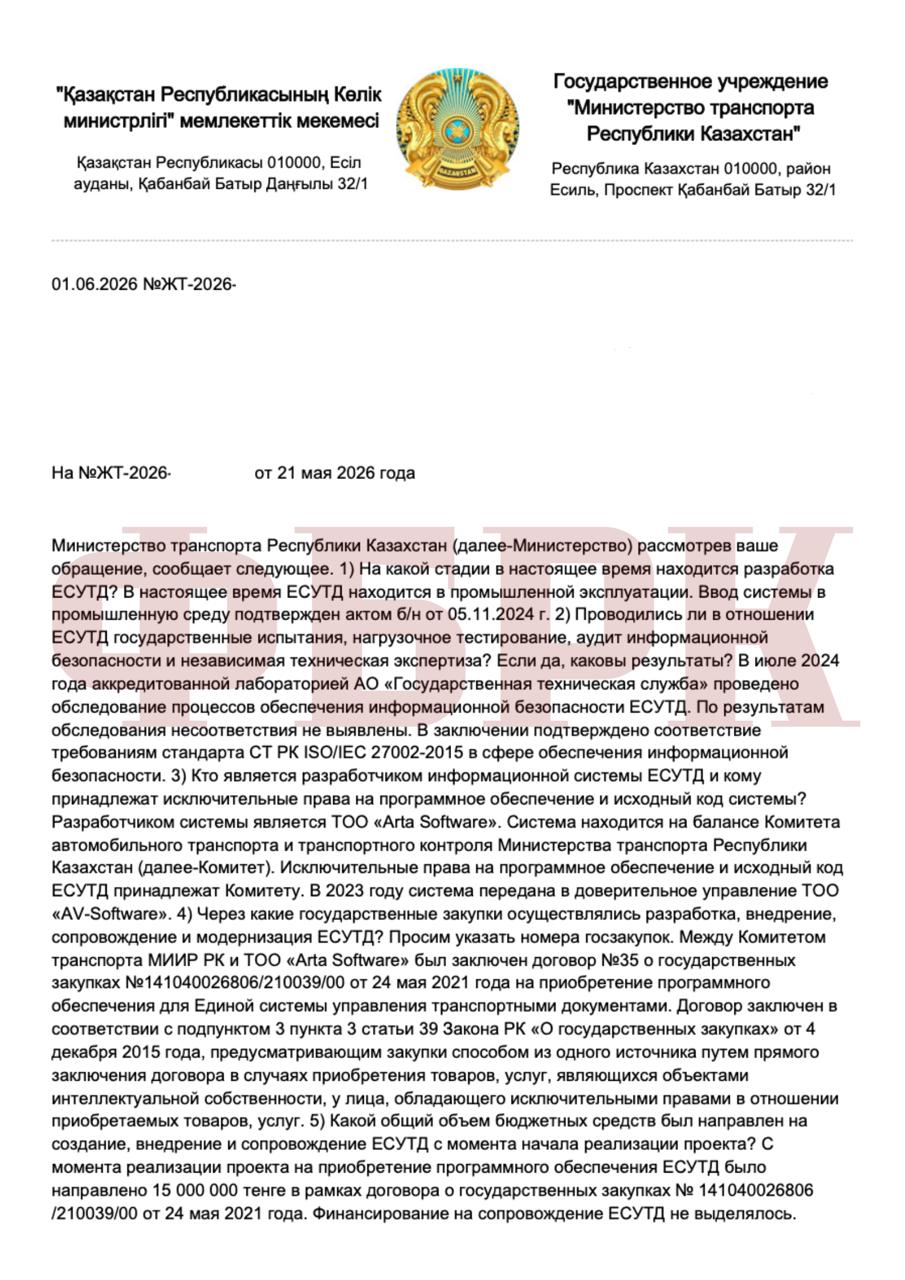
Notably, the contract was concluded from a single source. Exclusive rights to the USMTD software and source code, according to the Ministry's response, belong to the Transport Committee. However, in 2023, the system was transferred to the trust management of AV-Software LLP - without any explanation of the reasons.
According to data from the kompra.kz service, Arta Software LLP has been operating on the market for over 18 years, specialising in software code development and testing. The company director is Zhumagali Zhamanzhigitov, and the founder is Bolat Basheev. The company is affiliated with the Association "Electronic Trade in Railway Services" (AUL), ARTA Almaty LLP, and ARTA Astana LLP.
According to the Ministry, in November 2024 the system was put into commercial operation, and in July 2024, an accredited laboratory of JSC "State Technical Service" conducted an information security audit of USMTD: no discrepancies were found.
Incidentally, the technical specification for USMTD explicitly included a requirement for multi-factor authentication and a role-based model for differentiating access rights. Meanwhile, users note that requirements for password complexity and additional verification on the platform are absent. Fundamental problems with user authentication and verification, according to currently available information, have not been resolved.
WHY THIS MATTERS
One might think that technical shortcomings in a newly launched service are not uncommon. But the catch here is that the state has made using this platform mandatory under threat of administrative liability. Entrepreneurs and carriers are not given a choice; they are obliged to work with the system in its current form.
It is also strange that not a single tenge has been allocated for system maintenance since its creation - this is explicitly stated in the official response from the Ministry. Meanwhile, the technical specification of the contract with Arta Software LLP assumed an annual load of 500,000 travel logs, 1,500,000 goods waybills, and approximately 150,000,000 records with 15,000 users. How a system with a zero maintenance budget is supposed to handle such volumes is an open question.
Furthermore, the development contract was awarded from a single source in 2021, and by 2023, the system was transferred to the management of another company without public justification. The technical specification and copyright agreement, which are publicly available on the government procurement website, record the transfer of exclusive rights to the software from an individual, a certain Ayimgul Abileva, to Arta Software LLP free of charge and for the entire duration of the copyright. We believe the chain of ownership in this story deserves a separate analysis.
Undoubtedly, the state has the right to transition document flow to a digital format; it is a justified and forward-looking goal. However, introducing the mandatory use of a raw platform coupled with simultaneous administrative coercion creates a situation where the risks of systemic failures are shifted onto businesses, rather than those responsible for the system's quality. The lack of a maintenance budget given the stated load volumes, gaps in authentication, and exposure of personal data - these are all questions that, without any doubt, require public answers from the relevant government agencies.
We remind you that the FBRK editorial team year after year covers systemic problems in the transport industry. In May 2023, we reported on schemes using shell companies to obtain and resell foreign permit forms for $500-$1000. Despite the fact that in January 2024, the Road Transport Committee presented a draft reform of the permit distribution system, according to owners of transport companies, the situation has not improved.
In 2025, we covered the problems of the Information and Analytical System of the Transport Database and Transport Safety Monitoring (IAS TDB). Despite the system being designed to automate the processes of accounting for freight vehicles and buses at checkpoints, as well as exchanging data on the results of transport control, its functionality turned out to be severely limited. And, similarly to USMTD, the IAS TDB operated with serious violations of information security requirements, making it vulnerable to external interference.
It is worth noting that Kazakh information systems periodically come under a wave of criticism, and this applies not only to the transport sector. For instance, the Tasqyn system, developed by JSC "NC "Kazakhstan Garysh Sapary" for flood forecasting, did not impress Kazakhstanis with its effectiveness at all. And even the last flood season went unnoticed by the system, or at least that was the impression created against the backdrop of reports of flooding this year.
It seems that digitalisation in Kazakhstan, for now, works best on paper.